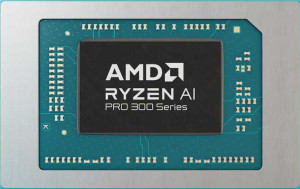
AMD Ryzen AI 5 Pro 340 specifications and in-depth review

AMD Ryzen AI 5 Pro 340

Manufacturer: AMD

The AMD Ryzen AI 5 Pro 340 is a mid-range processor designed for both laptop and desktop platforms, combining a compact 4nm semiconductor build with a respectable thermal envelope of 28W. It uses big.LITTLE technology to balance workload distribution across its six cores, and with 12 threads and a turbo frequency reaching 4.8GHz, it handles a variety of computing tasks without excessive power draw.

On the memory side, the Ryzen AI 5 Pro 340 supports DDR5 RAM at speeds up to 8000MHz, dual-channel configuration, up to 256GB of addressable memory, and ECC support — a notable inclusion for professional or reliability-sensitive workloads. The integrated Radeon 840M graphics runs at up to 2900MHz and supports up to four displays with DirectX 12 and OpenCL 2.1 compatibility. Cache consists of 6MB of L2 and 16MB of L3, and the chip supports a broad instruction set including AVX2, FMA3, and AES. PassMark results sit at 19,500 in multi-threaded workloads and 3,830 in single-threaded testing.

Pros
  • Supports DDR5 memory at speeds up to 8000MHz with dual-channel configuration, allowing for substantial memory bandwidth
  • ECC memory support adds a layer of data integrity that is useful in professional or reliability-sensitive workloads
  • Can address up to 256GB of RAM, accommodating memory-intensive workloads without hitting capacity limits early
  • The Radeon 840M integrated graphics supports up to four simultaneous displays, which is practical for multi-monitor setups without a discrete GPU
  • Broad instruction set coverage including AVX2, FMA3, and AES enables hardware-accelerated encryption and wide vectorized processing
  • Compatible with both laptop and desktop platforms, offering deployment flexibility across different form factors
Cons
  • The multiplier is locked, so there is no option to manually adjust clock speeds beyond the factory turbo ceiling of 4.8GHz
  • Base clock speeds of 2GHz across all cores are modest, which may limit sustained throughput in heavily threaded workloads that do not benefit from turbo frequencies
  • A TDP of 28W places constraints on sustained peak performance in thermally limited environments such as thin laptop chassis
Who is this for?

This processor is a solid fit for professionals who need a reliable, multi-display workstation setup without a discrete GPU, thanks to the Radeon 840M integrated graphics supporting up to four simultaneous outputs. Its ECC memory support and capacity ceiling of 256GB make it well-suited for data-sensitive or professional workloads such as virtualization, light server tasks, or engineering applications where memory integrity matters. The broad instruction set — including AES and AVX2 — also makes it a practical choice for developers or analysts running encryption-heavy or vectorized computing tasks within a power-efficient 28W envelope.

Who is this NOT for?

Users looking to push performance beyond factory limits will find this chip restrictive, as the locked multiplier prevents any overclocking. The base clock of 2GHz across all cores also makes it a poor fit for workloads that sustain heavy parallel loads without consistently hitting turbo frequencies, which can be a concern in thermally constrained thin-and-light laptop designs. Additionally, those requiring dedicated graphics performance for tasks like 3D rendering, high-frame-rate gaming, or GPU compute workloads will find the integrated Radeon 840M insufficient, as it is not designed to replace a discrete graphics card for demanding visual workloads.

General info:

Type Laptop, Desktop
Has integrated graphics
Thermal Design Power (TDP) 28W
semiconductor size 4 nm
CPU temperature 100 °C
PCI Express (PCIe) version 4
Supports 64-bit

The AMD Ryzen AI 5 Pro 340 is designed for both laptop and desktop platforms, built on a 4nm semiconductor process that helps keep power consumption in check at a TDP of 28W. It includes integrated graphics and fully supports 64-bit computing, while the maximum rated CPU temperature sits at 100°C. Connectivity is handled through PCIe 4.0, offering a solid interface for compatible expansion and storage devices.

Performance:

CPU speed 3 x 2 & 3 x 2 GHz
CPU threads 12 threads
turbo clock speed 4.8GHz
Has an unlocked multiplier
L2 cache 6 MB
L3 cache 16 MB
Uses big.LITTLE technology
clock multiplier 20

The processor operates across six cores using big.LITTLE technology, pairing two groups of cores running at base speeds of 2GHz each, with a turbo clock reaching up to 4.8GHz for demanding workloads. It offers 12 threads in total and carries a clock multiplier of 20, though the multiplier is locked, meaning manual overclocking is not supported. On the cache side, 6MB of L2 and 16MB of L3 cache are available to help reduce memory latency during sustained workloads.

Benchmarks:

PassMark result 19500
PassMark result (single) 3830

In PassMark testing, the processor achieves a multi-threaded score of 19,500, reflecting its capacity for parallel workloads across all available threads. The single-threaded result of 3,830 indicates how it performs when only one core is engaged, which is relevant for tasks that rely heavily on per-core throughput rather than parallelism.

Integrated graphics:

GPU name Radeon 840M
GPU turbo 2900 MHz
DirectX version DirectX 12
supported displays 4
OpenGL version 4.6
OpenCL version 2.1

The integrated graphics solution is the Radeon 840M, which reaches a turbo frequency of 2900MHz and can drive up to four displays simultaneously. It supports DirectX 12 for modern rendering workloads alongside OpenGL 4.6 and OpenCL 2.1, the latter being relevant for GPU-accelerated compute tasks.

Memory:

RAM speed (max) 8000 MHz
DDR memory version 5
memory channels 2
maximum memory amount 256GB
Supports ECC memory

The processor supports DDR5 memory running at speeds of up to 8000MHz across a dual-channel configuration, allowing for balanced bandwidth across both channels. It can address a maximum of 256GB of RAM, and notably includes support for ECC memory, which provides error-correcting capability useful in reliability-sensitive environments.

Features:

instruction sets MMX, F16C, FMA3, AES, AVX, AVX2, SSE 4.1, SSE 4.2
uses multithreading
Has NX bit

The processor supports multithreading and includes the NX bit for hardware-level memory protection against certain classes of malicious code execution. Its instruction set support spans MMX, SSE 4.1, SSE 4.2, AVX, AVX2, F16C, FMA3, and AES, covering a broad range of workloads from media processing and floating-point operations to hardware-accelerated encryption, with AVX2 in particular enabling wider vectorized data processing across compatible applications.
Final Verdict

The AMD Ryzen AI 5 Pro 340 is a well-rounded processor that carves out a clear niche for professional and productivity-oriented deployments across both laptop and desktop platforms. Its standout combination of DDR5 support with ECC capability and a 256GB memory ceiling makes it particularly compelling for workloads where data reliability and memory headroom matter, while the Radeon 840M integrated graphics adds genuine multi-display utility without requiring a discrete GPU. The locked multiplier and modest base clocks do set a ceiling on raw performance headroom, so it is best matched to users whose workloads align with its efficiency-first design rather than those chasing peak throughput. Overall, the Ryzen AI 5 Pro 340 presents a focused, capable option for professionals who prioritize platform flexibility, memory integrity, and broad instruction set coverage within a controlled power envelope.

Popular Comparisons

AMD Ryzen AI 5 Pro 340
VS
AMD Ryzen 5 Pro 215
AMD Ryzen 5 Pro 215
AMD Ryzen AI 5 Pro 340
VS
AMD Ryzen AI 7 Pro 350
AMD Ryzen AI 5 Pro 340
VS
Intel Core Ultra 7 265HX
AMD Ryzen AI 5 Pro 340
VS
Intel Core Ultra 7 255H
AMD Ryzen AI 5 Pro 340
VS
Intel Core Ultra 7 155U
AMD Ryzen AI 5 Pro 340
VS
Intel Core Ultra 7 265
AMD Ryzen AI 5 Pro 340
VS
Intel Core Ultra 7 268V
AMD Ryzen AI 5 Pro 340
VS
Apple M5
Apple M5