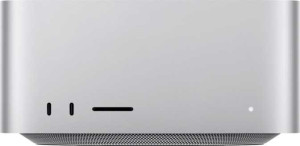
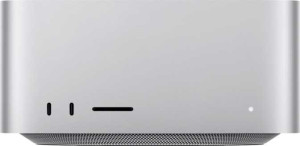
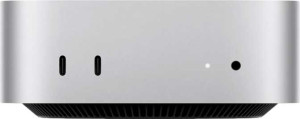
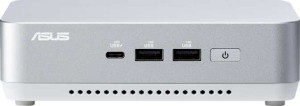
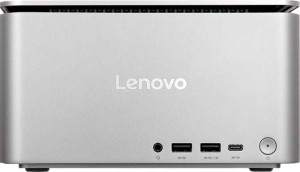
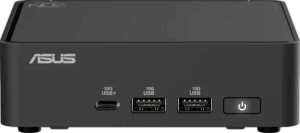
The Mac Studio 2025 M4 Max ships with 8TB of NVMe SSD storage, offering fast data access in a chassis that stays remarkably compact. Its footprint measures 196 mm wide and 196 mm deep, with a height of just 94 mm, giving it a total volume of 3,611.104 cm³. At 2,740 g, the unit has enough mass to sit firmly on a desk without feeling lightweight, while still remaining easy to reposition if needed.
The CPU operates across 16 threads using a split-frequency configuration — 12 cores run at 4.51 GHz for demanding tasks while 4 cores handle lighter workloads at 2.59 GHz. The processor supports 64-bit computing and includes integrated graphics, meaning a discrete GPU is not required for display output or general graphical workloads.
The integrated graphics solution is built on a 3nm semiconductor process and incorporates 28,000 million transistors, enabling a maximum memory bandwidth of 546 GB/s. It supports simultaneous output to up to three external displays, making it suitable for multi-monitor desktop configurations without requiring additional hardware.
The Mac Studio 2025 M4 Max is equipped with 128GB of DDR5 RAM, providing a substantial pool of memory for handling large datasets, complex workloads, and memory-intensive applications. DDR5 is the latest generation of double data rate memory, and at this capacity it represents the maximum supported memory amount for this configuration.
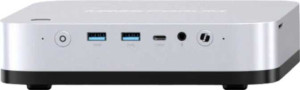
Wireless connectivity covers Wi-Fi 6E, Wi-Fi 6, Wi-Fi 5, and Wi-Fi 4, along with Bluetooth 5.3 for peripheral pairing. On the wired side, the machine provides two USB 3.2 Gen 2 Type-A ports and two USB 3.2 Gen 2 Type-C ports for high-speed data transfer, one HDMI output for display connectivity, and one RJ45 port for wired ethernet. A 3.5 mm audio jack is also present, while there are no VGA, S/PDIF, DisplayPort, Thunderbolt, or legacy USB outputs included.
The chip is classified for use in both laptop and desktop form factors and operates with four memory channels, supporting RAM speeds of up to 4,266 MHz and a maximum memory capacity of 128GB; ECC memory is not supported. It employs big.LITTLE technology alongside Heterogeneous Multi-Processing (HMP), allowing the scheduler to distribute threads dynamically across performance and efficiency cores. On the security side, the processor includes TrustZone and NX bit support, providing hardware-level isolation and protection against certain classes of code execution exploits.