ASRock B860M Steel Legend WiFi specifications and in-depth review

ASRock B860M Steel Legend WiFi

Manufacturer: ASRock

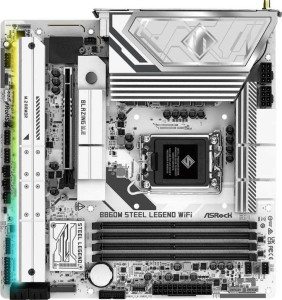
The ASRock B860M Steel Legend WiFi is a Micro-ATX motherboard built around the LGA 1851 socket and B860 chipset, designed for Intel's current-generation platform. It includes integrated Wi-Fi 6E connectivity alongside Bluetooth 5.3, making wired network adapters and separate wireless cards unnecessary for most builds. The board features RGB lighting and a dual BIOS configuration, and carries a three-year warranty.

On the memory side, the board accommodates up to 256GB of DDR5 across four slots in a dual-channel arrangement, with native support up to 5600 MHz and overclocked profiles reaching 8666 MHz. Expansion is anchored by a single PCIe 5.0 x16 slot, complemented by four M.2 sockets and four SATA 3 connectors supporting RAID 0, 1, 5, and 10. The rear I/O includes a USB 4 40Gbps port, a Thunderbolt 4 port, HDMI 2.1, DisplayPort, and RJ45, while the onboard audio delivers a 120 dB signal-to-noise ratio across a 7.1-channel configuration with S/PDIF output.

Pros
  • Four M.2 sockets provide substantial high-speed storage expansion for a Micro-ATX board
  • Includes both a USB 4 40Gbps port and a Thunderbolt 4 port on the rear I/O, covering demanding peripheral and display needs
  • Wi-Fi 6E and Bluetooth 5.3 are built in, removing the need for separate wireless expansion cards
  • DDR5 memory is supported with overclocked speeds up to 8666 MHz across four slots, allowing considerable headroom for memory tuning
  • Dual BIOS adds a layer of resilience against failed firmware updates
  • Seven fan headers offer broad cooling control flexibility within a compact form factor
Cons
  • No PCIe x1, x4, or secondary x16 slots are available, leaving no room for additional expansion cards beyond the primary GPU
  • CMOS reset requires standard BIOS procedures as there is no dedicated easy-reset button
  • ECC memory is not supported, limiting suitability for workstation or data-integrity-sensitive use cases
  • No USB-C ports at the USB 3.2 Gen 1 or Gen 2 level on the rear I/O, despite the board carrying a Type-C connector only at the USB 4 tier
  • RAID 0+1 is not supported, reducing flexibility for certain multi-drive redundancy configurations
Who is this for?

This board is well-suited to users building a capable desktop system around Intel's current LGA 1851 platform in a space-conscious Micro-ATX enclosure. Those who prioritize fast storage will benefit from the four M.2 sockets paired with a PCIe 5.0 x16 slot, making it a solid fit for content creators or power users who rely on rapid data throughput. The inclusion of Wi-Fi 6E, Thunderbolt 4, and USB 4 40Gbps also makes it a practical choice for users with modern peripherals, high-bandwidth external drives, or wireless setups that demand low latency and high throughput. DDR5 support with overclocked speeds up to 8666 MHz further suits builders who want meaningful memory performance tuning without moving to a full ATX platform.

Who is this NOT for?

Users who need multiple expansion cards — such as a dedicated GPU alongside capture cards, additional NIC, or sound cards — will find the single PCIe slot arrangement a limiting factor, making this board a poor fit for multi-card workstation or production setups. Similarly, professionals who require ECC memory support for error-correcting workloads in fields such as scientific computing or financial data processing will need to look elsewhere, as this capability is absent. The lack of legacy connectivity options like PS/2, eSATA, or DVI also means the board is not appropriate for environments that still depend on older hardware or display interfaces.

General info:

CPU socket LGA 1851
chipset B860
form factor Micro-ATX
supports Wi-Fi
Wi-Fi version Wi-Fi 4 (802.11n), Wi-Fi 5 (802.11ac), Wi-Fi 6 (802.11ax), Wi-Fi 6E (802.11ax)
Has Bluetooth
Bluetooth version 5.3
HDMI version HDMI 2.1
Easy to overclock
has RGB lighting
Easy to reset BIOS
Has dual BIOS
has aptX
CPU sockets 1
Has integrated graphics
warranty period 3 years
height 244 mm
width 244 mm
Has integrated CPU

The ASRock B860M Steel Legend WiFi uses the LGA 1851 socket paired with the B860 chipset and comes in a Micro-ATX form factor measuring 244 × 244 mm, making it a compact but capable platform for current-generation Intel builds. It includes built-in Wi-Fi spanning 802.11n through Wi-Fi 6E, along with Bluetooth 5.3, though aptX audio codec support is not present. Video output is handled via HDMI 2.1, and while the board does not carry integrated graphics or an embedded CPU, it does support easy overclocking and ships with a dual BIOS configuration for added reliability. RGB lighting is included, though the board lacks a one-press CMOS reset button. A single CPU socket is present, and the board is backed by a three-year warranty.

Memory:

maximum memory amount 256GB
RAM speed (max) 5600 MHz
overclocked RAM speed 8666 MHz
memory slots 4
DDR memory version 5
memory channels 2
Supports ECC memory

The board supports DDR5 memory across four slots in a dual-channel configuration, with a maximum capacity of 256GB. Native RAM speeds reach up to 5600 MHz, while overclocked profiles can push that figure to 8666 MHz. ECC memory is not supported.

Ports:

USB 3.2 Gen 2 ports (USB-A) 2
USB 3.2 Gen 1 ports (USB-A) 4
USB 3.2 Gen 2 ports (USB-C) 0
USB 3.2 Gen 1 ports (USB-C) 0
USB 2.0 ports 2
USB 3.2 Gen 2x2 ports 0
USB 4 40Gbps ports 1
USB 4 20Gbps ports 0
Thunderbolt 4 ports 1
Thunderbolt 3 ports 0
has an HDMI output
DisplayPort outputs 1
RJ45 ports 1
Has USB Type-C
eSATA ports 0
DVI outputs 0
has a VGA connector
PS/2 ports 0

The rear I/O offers a well-rounded USB lineup, including two USB 3.2 Gen 2 Type-A ports, four USB 3.2 Gen 1 Type-A ports, and two USB 2.0 ports, with no USB-C Gen 1 or Gen 2 ports present. At the higher end, there is one USB 4 40Gbps port and one Thunderbolt 4 port, both in Type-C form, while USB 4 20Gbps and Thunderbolt 3 are absent. Display outputs consist of one HDMI and one DisplayPort, with no DVI or VGA connectors included. Networking is handled by a single RJ45 port, and there are no eSATA or PS/2 ports on this board.

Connectors:

USB 3.2 Gen 1 ports (through expansion) 2
USB-C 3.2 Gen 2 ports (through expansion) 1
USB 2.0 ports (through expansion) 4
SATA 3 connectors 4
fan headers 7
USB 3.0 ports (through expansion) 2
M.2 sockets 4
Has TPM connector
U.2 sockets 0
Has mSATA connector
SATA 2 connectors 0

For internal expansion, the board provides two USB 3.2 Gen 1 headers, one USB-C 3.2 Gen 2 header, and four USB 2.0 ports through expansion, along with two additional USB 3.0 ports via headers. Storage connectivity is covered by four M.2 sockets and four SATA 3 connectors, with no SATA 2, U.2, or mSATA support present. Cooling is well catered for with seven fan headers onboard, and a TPM connector is included for security module installation.

Expansion slots:

PCIe 4.0 x16 slots 0
PCIe 5.0 x16 slots 1
PCIe 3.0 x16 slots 0
PCIe x1 slots 0
PCI slots 0
PCIe 2.0 x16 slots 0
PCIe x4 slots 0
PCIe x8 slots 0

The board offers a single PCIe 5.0 x16 slot as its sole expansion slot, with no PCIe 4.0, 3.0, 2.0, x8, x4, or x1 slots present, and no legacy PCI slots included.

Audio:

Signal-to-Noise ratio (DAC) 120 dB
audio channels 7.1
Has S/PDIF Out port
audio connectors 2

The onboard audio supports a 7.1-channel configuration and delivers a DAC signal-to-noise ratio of 120 dB, with two audio connectors available on the rear panel. An S/PDIF Out port is also included for digital audio output.

Storage:

Supports RAID 1
Supports RAID 10 (1+0)
Supports RAID 5
Supports RAID 0
Supports RAID 0+1

The board supports RAID 0, 1, 5, and 10 configurations, covering a range of performance and redundancy needs, while RAID 0+1 is not supported.
Final Verdict

The ASRock B860M Steel Legend WiFi carves out a focused position as a feature-dense Micro-ATX board for the LGA 1851 platform, bringing together a strong connectivity suite and a generous storage layout that belie its compact dimensions. Its four M.2 sockets combined with Thunderbolt 4 and USB 4 40Gbps rear I/O give it a meaningful edge for users who handle high-bandwidth workloads or rely on fast external devices, while integrated Wi-Fi 6E and DDR5 support with extensive overclocking headroom round out a well-considered feature set. The board's limitations — a single expansion slot and no ECC memory support — narrow its appeal for multi-card or professional workstation builds, but for a primary desktop system where storage speed, modern connectivity, and a compact footprint are the priorities, it represents a well-specified and practically configured choice.

Popular Comparisons

ASRock B860M Steel Legend WiFi
VS
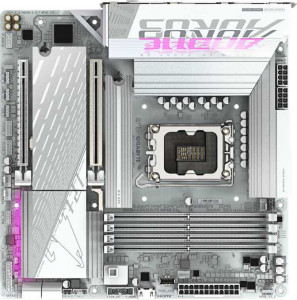
Gigabyte B860M Aorus Elite WiFi6E Ice
ASRock B860M Steel Legend WiFi
VS
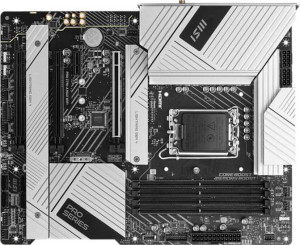
MSI Pro Z790-A Max WiFi