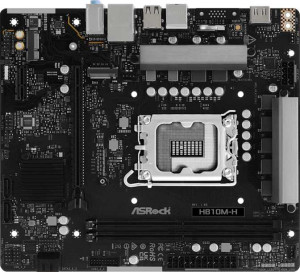
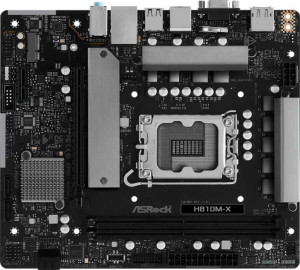
The ASRock H810M-H uses the LGA 1851 CPU socket and adopts a Micro-ATX form factor, with physical dimensions of 220 mm by 193 mm, making it a compact yet capable platform. It carries a single CPU socket and includes an HDMI 2.1 output, while RGB lighting adds a degree of visual customization. The board does not support Wi-Fi or Bluetooth, lacks integrated graphics, and does not feature an integrated CPU, so discrete components are required for those functions. Overclocking is not natively facilitated, and the board ships without a dual BIOS or a dedicated easy BIOS reset mechanism. A three-year warranty is included with the product.
The board supports DDR5 memory across two slots in a dual-channel configuration, with a maximum capacity of 128 GB and a peak RAM speed of 6400 MHz. ECC memory is not supported, so the platform is oriented toward standard consumer use rather than error-correcting workloads.
The rear I/O panel provides two USB 3.2 Gen 1 Type-A ports and four USB 2.0 ports for peripheral connectivity, while USB Type-C, USB 3.2 Gen 2, USB 4, Thunderbolt 3, and Thunderbolt 4 are all absent. Video output is handled by a single HDMI output, with no DisplayPort, DVI, or VGA connectors present. Networking is covered by one RJ45 Ethernet port, and a legacy PS/2 port is also included for compatible input devices. There are no eSATA ports on this board.
For storage, the board offers four SATA 3 connectors and one M.2 socket, while SATA 2 and U.2 sockets are not present, nor is an mSATA connector. Internal USB expansion is available through two USB 3.2 Gen 1 headers and two USB 2.0 headers, with an additional two USB 3.0 expansion ports also on board. Cooling is managed via two fan headers, and a TPM connector is included for security module support.
Expansion options are modest but focused, with one PCIe 4.0 x16 slot available for a discrete graphics card or other full-length expansion card, alongside one PCIe x1 slot for smaller add-in cards. There are no PCIe 5.0, PCIe 3.0, PCIe 2.0, PCIe x4, or PCIe x8 slots, and no legacy PCI slots are present.
The board delivers 7.1-channel audio output through three analog audio connectors on the rear panel. An S/PDIF Out port is not included, so digital optical or coaxial audio output is not available.
The board does not support RAID 0+1, so combined striping and mirroring configurations are not available on this platform.