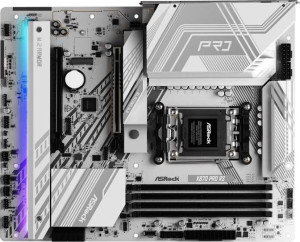
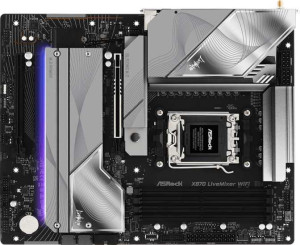
ASRock X870 LiveMixer Wi-Fi specifications and in-depth review

ASRock X870 LiveMixer Wi-Fi

Manufacturer: ASRock

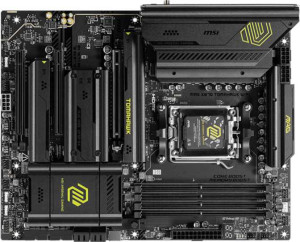
The ASRock X870 LiveMixer Wi-Fi is an ATX-form-factor motherboard built around the AM5 socket and X870 chipset. It ships with integrated Wi-Fi 7 (802.11be) alongside Bluetooth 5.4, making it a solid choice for builds where wireless connectivity is a priority. The board also includes RGB lighting, a dual BIOS setup for added reliability, and a three-year warranty.

On the connectivity side, the X870 LiveMixer Wi-Fi offers two Thunderbolt 4 ports paired with two USB 4 40Gbps ports, seven USB 3.2 Gen 1 Type-A ports, and six USB 2.0 ports on the rear panel. Expansion is handled by a single PCIe 5.0 x16 slot alongside two PCIe 3.0 x16 slots, while storage options include four M.2 sockets and two SATA 3 connectors with RAID 0, 1, and 10 support. The onboard audio section delivers a 130 dB signal-to-noise ratio through a 7.1-channel output, and memory support extends to four DDR5 slots capable of holding up to 256GB with overclocked speeds reaching 8000 MHz.

Pros
  • Supports Wi-Fi 7 along with four earlier Wi-Fi generations, providing broad wireless compatibility
  • Two Thunderbolt 4 ports and two USB 4 40Gbps ports offer high-bandwidth connectivity for demanding peripherals
  • Four M.2 sockets give substantial room for fast storage expansion
  • DDR5 memory support with overclocked speeds up to 8000 MHz across four slots and a 256GB maximum capacity
  • Dual BIOS adds a layer of protection against failed firmware updates
  • Onboard audio delivers a 130 dB signal-to-noise ratio with 7.1-channel output and S/PDIF Out
Cons
  • No PCIe 4.0 x16 slot; the secondary slots are limited to PCIe 3.0, which may restrict bandwidth for additional add-in cards
  • Only two SATA 3 connectors, which limits the number of traditional drives that can be connected directly
  • No USB 3.2 Gen 2 Type-A or Type-C ports on the rear panel, leaving a gap between Gen 1 and the USB 4 ports
  • ECC memory is not supported, ruling out use in error-sensitive workloads
  • No dedicated clear CMOS button, making BIOS recovery slightly less convenient
Who is this for?

This board is well-suited to enthusiast desktop builders who want a future-ready AM5 platform with broad connectivity. The combination of Wi-Fi 7, Thunderbolt 4, and USB 4 40Gbps ports makes it a strong fit for users who rely on high-speed peripherals, fast external storage, or wireless networking at the cutting edge. The four M.2 sockets, DDR5 support with speeds up to 8000 MHz, and a PCIe 5.0 x16 slot also cater well to performance-focused workstation builds where fast storage and GPU bandwidth are priorities. The dual BIOS and three-year warranty further appeal to users who value system stability and long-term reliability.

Who is this NOT for?

Users who need ECC memory support for error-sensitive or mission-critical workloads will find this board unsuitable, as that capability is absent. The limited two SATA 3 connectors make it a poor match for builds that depend on a large number of traditional hard drives or optical devices. Additionally, the lack of a clear CMOS button and the absence of PCIe 4.0 x16 slots may frustrate users who frequently test hardware configurations or need flexible high-bandwidth secondary expansion for multi-GPU or capture card setups.

General info:

CPU socket AM5
chipset X870
form factor ATX
supports Wi-Fi
Wi-Fi version Wi-Fi 4 (802.11n), Wi-Fi 5 (802.11ac), Wi-Fi 6 (802.11ax), Wi-Fi 6E (802.11ax), Wi-Fi 7 (802.11be)
Has Bluetooth
Bluetooth version 5.4
HDMI version HDMI 2.1
Easy to overclock
has RGB lighting
Easy to reset BIOS
Has dual BIOS
has aptX
CPU sockets 1
Has integrated graphics
warranty period 3 years
height 244 mm
width 305 mm
Has integrated CPU

The ASRock X870 LiveMixer Wi-Fi is built around the AM5 socket with X870 chipset compatibility, and follows the standard ATX form factor at 305 × 244 mm with a single CPU socket. It supports Wi-Fi 7 (802.11be) along with the four previous Wi-Fi generations, and includes Bluetooth 5.4, though aptX is not supported. The board features an HDMI 2.1 output, RGB lighting, and a dual BIOS for added resilience, while BIOS reset via a dedicated clear CMOS button is not available. Overclocking is noted as straightforward, and the board carries a three-year warranty. There is no integrated graphics or integrated CPU on this board.

Memory:

maximum memory amount 256GB
overclocked RAM speed 8000 MHz
memory slots 4
DDR memory version 5
memory channels 2
Supports ECC memory

The board uses DDR5 memory across four slots arranged in a dual-channel configuration, supporting a maximum total capacity of 256GB. Overclocked RAM speeds can reach up to 8000 MHz, giving enthusiasts meaningful headroom for memory tuning. ECC memory is not supported.

Ports:

USB 3.2 Gen 2 ports (USB-A) 0
USB 3.2 Gen 1 ports (USB-A) 7
USB 3.2 Gen 2 ports (USB-C) 0
USB 3.2 Gen 1 ports (USB-C) 1
USB 2.0 ports 6
USB 3.2 Gen 2x2 ports 0
USB 4 40Gbps ports 2
USB 4 20Gbps ports 0
Thunderbolt 4 ports 2
Thunderbolt 3 ports 0
has an HDMI output
DisplayPort outputs 0
RJ45 ports 1
Has USB Type-C
eSATA ports 0
DVI outputs 0
has a VGA connector
PS/2 ports 0

The rear I/O panel offers a well-rounded set of ports, anchored by two Thunderbolt 4 ports and two USB 4 40Gbps ports, all in USB-C form factor. USB-A connectivity is covered by seven USB 3.2 Gen 1 ports and six USB 2.0 ports, alongside a single USB 3.2 Gen 1 Type-C port. There are no USB 3.2 Gen 2, Gen 2x2, or USB 4 20Gbps ports present. Video output is limited to a single HDMI port, with no DisplayPort, DVI, or VGA connectors available. Networking is handled by one RJ45 port, and there are no eSATA or PS/2 ports on this board.

Connectors:

USB 3.2 Gen 1 ports (through expansion) 4
USB 3.2 Gen 2x2 ports (through expansion) 1
USB 2.0 ports (through expansion) 4
SATA 3 connectors 2
fan headers 6
USB 3.0 ports (through expansion) 4
M.2 sockets 4
Has TPM connector
U.2 sockets 0
Has mSATA connector
SATA 2 connectors 0

Internal connectivity is reasonably broad, with four M.2 sockets available for fast storage alongside two SATA 3 connectors; there are no SATA 2, U.2, or mSATA connectors. Front-panel USB expansion is supported through four USB 3.2 Gen 1 headers, four USB 3.0 headers, one USB 3.2 Gen 2x2 header, and four USB 2.0 headers. The board also includes six fan headers for cooling management and a TPM connector for hardware-level security.

Expansion slots:

PCIe 4.0 x16 slots 0
PCIe 5.0 x16 slots 1
PCIe 3.0 x16 slots 2
PCIe x1 slots 0
PCI slots 0
PCIe 2.0 x16 slots 0
PCIe x4 slots 0
PCIe x8 slots 0

The board provides three full-length expansion slots in total: one PCIe 5.0 x16 slot for the primary graphics card or high-speed add-in card, complemented by two PCIe 3.0 x16 slots for additional expansion needs. There are no PCIe 4.0, PCIe 2.0, PCIe x1, PCIe x4, PCIe x8, or legacy PCI slots present.

Audio:

Signal-to-Noise ratio (DAC) 130 dB
audio channels 7.1
Has S/PDIF Out port
audio connectors 2

The onboard audio supports a 7.1-channel configuration and delivers a DAC signal-to-noise ratio of 130 dB, indicating a clean output signal. Two analog audio connectors are available on the rear panel, and a S/PDIF Out port is included for digital audio output.

Storage:

Supports RAID 1
Supports RAID 10 (1+0)
Supports RAID 5
Supports RAID 0
Supports RAID 0+1

The board supports RAID 0, RAID 1, and RAID 10 configurations, covering the most common setups for performance, redundancy, and a combination of both. RAID 5 and RAID 0+1 are not supported.
Final Verdict

The ASRock X870 LiveMixer Wi-Fi is a well-specified ATX motherboard that targets enthusiast builders looking to get the most out of the AM5 platform. Its standout combination of Wi-Fi 7, Thunderbolt 4, and PCIe 5.0 positions it firmly in the upper tier of connectivity-focused builds, while four M.2 sockets and DDR5 support with overclocked speeds up to 8000 MHz ensure it holds its own for storage and memory performance. The dual BIOS and three-year warranty add a degree of long-term confidence that will appeal to users who prioritize system resilience. Some limitations — notably the absence of ECC support, a modest SATA connector count, and no clear CMOS button — mean it is not the right fit for every scenario, but for an enthusiast desktop or high-end workstation build centered on fast peripherals and wireless connectivity, it presents a coherent and capable package.

Popular Comparisons

ASRock X870 LiveMixer Wi-Fi
VS
MSI MAG X870 Tomahawk WiFi
ASRock X870 LiveMixer Wi-Fi
VS
ASRock X870 Pro RS
ASRock X870 Pro RS
ASRock X870 LiveMixer Wi-Fi
VS
ASRock X870 Steel Legend WiFi
ASRock X870 LiveMixer Wi-Fi
VS
ASRock X870E Nova WiFi
ASRock X870 LiveMixer Wi-Fi
VS
Asus ROG Crosshair X870E Extreme
ASRock X870 LiveMixer Wi-Fi
VS
Asus TUF Gaming X870-Plus WiFi
ASRock X870 LiveMixer Wi-Fi
VS
MSI MAG X870E Tomahawk WiFi
ASRock X870 LiveMixer Wi-Fi
VS
MSI MPG Z890 Edge Ti WiFi