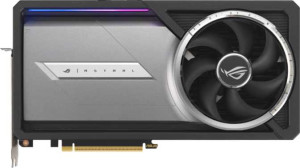
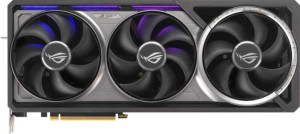
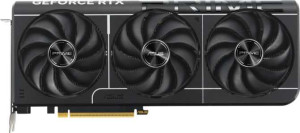
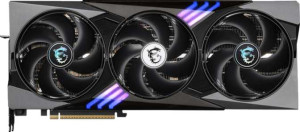
Asus ROG Astral LC GeForce RTX 5090 specifications and in-depth review

Asus ROG Astral LC GeForce RTX 5090

Manufacturer: Asus

The Asus ROG Astral LC GeForce RTX 5090 is a high-end graphics card from Asus's ROG lineup, designed around Nvidia's Blackwell architecture. It combines a liquid-assisted cooling solution with RGB lighting and supports up to four simultaneous displays, making it a technically dense offering within the current GeForce generation.

On the hardware side, the card ships with 32GB of GDDR7 memory across a 512-bit bus, reaching an effective memory speed of 28000 MHz and a peak bandwidth of 1790 GB/s. Its 21760 shading units operate at a base clock of 2017 MHz with a turbo ceiling of 2437 MHz, yielding a floating-point throughput of 106.1 TFLOPS. The card draws 575W under load, connects via PCIe 5.0, and is manufactured on a 5nm process housing approximately 92.2 billion transistors. Output options include two HDMI 2.1b ports and three DisplayPort connectors, with full support for DirectX 12 Ultimate, ray tracing, and DLSS.

Pros
  • The 512-bit memory bus paired with 32GB of GDDR7 VRAM delivers a peak bandwidth of 1790 GB/s, which is well-suited for memory-intensive workloads
  • Support for ray tracing and DLSS expands rendering capability options for compatible software
  • Five video outputs — two HDMI 2.1b and three DisplayPort — allow connection of up to four displays simultaneously
  • An air-water hybrid cooling solution is built in, addressing thermal management for a card with a 575W TDP
  • ECC memory support adds a layer of data reliability for compute-oriented tasks
  • Intel Resizable BAR support enables the CPU to access the full VRAM pool at once, which can improve data transfer efficiency
Cons
  • A 575W TDP places significant demand on system power supply capacity and overall system power budgeting
  • The physical dimensions of 288.5 mm wide and 153.7 mm tall may not fit in smaller or mid-tower cases without careful clearance checks
  • There are no USB-C or DVI outputs, limiting compatibility with older displays or devices that rely on those connection types
  • The absence of XeSS (XMX) support means this feature is unavailable for workflows or titles that rely on it
Who is this for?

This card is well-matched for users running compute-intensive or rendering workloads that can take advantage of 32GB of GDDR7 VRAM, 106.1 TFLOPS of floating-point throughput, and ECC memory support. It also suits those working with multi-display setups, as the five video outputs support up to four simultaneous screens across HDMI 2.1b and DisplayPort connections. Users with systems built around PCIe 5.0 and adequate power delivery will get the most from its full feature set, including ray tracing, DLSS, and Intel Resizable BAR.

Who is this NOT for?

The 575W TDP makes this card a poor fit for anyone working with a limited or standard power supply, as it demands substantial headroom that many existing builds cannot provide without upgrades. Its physical dimensions — 288.5 mm wide and 153.7 mm tall — mean it is not suited for compact or small-form-factor cases where clearance is restricted. Users who depend on USB-C display output or still rely on DVI-connected monitors will also find this card lacking, given the complete absence of those port types.

Performance:

GPU clock speed 2017 MHz
GPU turbo 2437 MHz
pixel rate 428.9 GPixel/s
floating-point performance 106.1 TFLOPS
texture rate 1657 GTexels/s
GPU memory speed 1750 MHz
shading units 21760
texture mapping units (TMUs) 680
render output units (ROPs) 176
Has Double Precision Floating Point (DPFP)

The Performance section of this card centers on a base GPU clock of 2017 MHz that boosts up to 2437 MHz under load, backed by a floating-point throughput of 106.1 TFLOPS. Its 21760 shading units work alongside 680 texture mapping units and 176 render output units, producing a texture rate of 1657 GTexels/s and a pixel rate of 428.9 GPixel/s. GPU memory operates at 1750 MHz, and the card includes support for Double Precision Floating Point (DPFP), adding utility for compute-oriented workloads alongside standard rendering tasks.

Memory:

effective memory speed 28000 MHz
maximum memory bandwidth 1790 GB/s
VRAM 32GB
GDDR version GDDR7
memory bus width 512-bit
Supports ECC memory

This card is equipped with 32GB of GDDR7 VRAM running across a 512-bit memory bus, reaching an effective memory speed of 28000 MHz and a peak bandwidth of 1790 GB/s. ECC memory support is also present, which helps maintain data integrity during memory-intensive operations.

Features:

DirectX version DirectX 12 Ultimate
OpenGL version 4.6
OpenCL version 3
Supports multi-display technology
supports ray tracing
Supports 3D
supports DLSS
has XeSS (XMX)
AMD SAM / Intel Resizable BAR Intel Resizable BAR
has LHR
has RGB lighting
supported displays 4

The card supports DirectX 12 Ultimate, OpenGL 4.6, and OpenCL 3, covering a broad range of graphics and compute APIs. Ray tracing and DLSS are both supported, as are stereoscopic 3D and multi-display technology with up to four displays simultaneously. Intel Resizable BAR is present, while XeSS (XMX) and LHR are not supported. RGB lighting is included on the card itself, rounding out the feature set.

Ports:

has an HDMI output
HDMI ports 2
HDMI version HDMI 2.1b
DisplayPort outputs 3
USB-C ports 0
DVI outputs 0
mini DisplayPort outputs 0

The card's output configuration consists of two HDMI 2.1b ports and three DisplayPort outputs, providing five video outputs in total. There are no USB-C, DVI, or mini DisplayPort connectors present on this card.

General info:

GPU architecture Blackwell
Thermal Design Power (TDP) 575W
PCI Express (PCIe) version 5
semiconductor size 5 nm
number of transistors 92200 million
Has air-water cooling
width 288.5 mm
height 153.7 mm

Built on the Blackwell architecture and manufactured using a 5nm process, this card integrates 92,200 million transistors and connects via PCIe 5.0. It carries a thermal design power of 575W and features an air-water cooling solution. The card measures 288.5 mm in width and 153.7 mm in height.

Final Verdict

The Asus ROG Astral LC GeForce RTX 5090 is a technically dense graphics card built around the Blackwell architecture, and its specification sheet reflects a clear focus on demanding workloads. With 32GB of GDDR7 VRAM across a 512-bit bus delivering 1790 GB/s of peak bandwidth, alongside ray tracing, DLSS, and ECC memory support, it covers a wide range of both rendering and compute use cases. The integrated air-water cooling solution is a sensible inclusion given the 575W TDP, though prospective users should carefully verify case clearance and power supply capacity before committing. For those whose systems meet its requirements, the RTX 5090 Astral LC represents a thoroughly specified option at the top of its product category.

Popular Comparisons

Asus ROG Astral LC GeForce RTX 5090
VS
Asus ROG Astral GeForce RTX 5090
Asus ROG Astral LC GeForce RTX 5090
VS
Asus ROG Astral GeForce RTX 5090 OC Edition
Asus ROG Astral LC GeForce RTX 5090
VS
AMD Radeon 890M
AMD Radeon 890M
Asus ROG Astral LC GeForce RTX 5090
VS
Asus Prime GeForce RTX 5080 OC Edition
Asus ROG Astral LC GeForce RTX 5090
VS
Inno3D GeForce RTX 5090 iChill Frostbite
Asus ROG Astral LC GeForce RTX 5090
VS
Galax GeForce RTX 5090 D General
Asus ROG Astral LC GeForce RTX 5090
VS
Zotac Gaming GeForce RTX 5090 Solid OC
Asus ROG Astral LC GeForce RTX 5090
VS
Gigabyte GeForce RTX 5090 WindForce
Asus ROG Astral LC GeForce RTX 5090
VS
Gigabyte Aorus GeForce RTX 5090 Master
Asus ROG Astral LC GeForce RTX 5090
VS
MSI GeForce RTX 5090 Suprim Liquid SOC
Asus ROG Astral LC GeForce RTX 5090
VS
Gigabyte Aorus GeForce RTX 5090 Xtreme WaterForce
Asus ROG Astral LC GeForce RTX 5090
VS
MSI GeForce RTX 5090 Vanguard SOC