Design:
| Type |
Gaming |
| weight |
1950 g |
| Uses a fanless design |
✕ |
| Has a backlit keyboard |
✓ |
| volume |
1219.176 cm³ |
| width |
354 mm |
| height |
246 mm |
| thickness |
14 mm |
| is weather-sealed (splashproof) |
✕ |
| has a rugged build |
✕ |
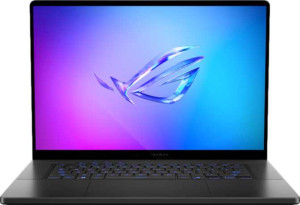
The Asus ROG Zephyrus G16 (2025) is a gaming laptop with a compact footprint measuring 354 mm wide, 246 mm deep, and just 14 mm thick, with an overall volume of 1,219.176 cm³. It weighs 1,950 g, keeping it reasonably manageable for a machine in its category. The chassis includes a backlit keyboard and relies on an active cooling system rather than a fanless design. It does not carry a weather-sealed or rugged build, so it is intended for standard indoor use.
Display:
| screen size |
16" |
| resolution |
2560 x 1600 px |
| pixel density |
188 ppi |
| Display type |
OLED/AMOLED |
| has a touch screen |
✕ |
| refresh rate |
240Hz |
| has anti-reflection coating |
✕ |
| supported displays |
4 |
The laptop features a 16″ OLED/AMOLED panel with a resolution of 2560 x 1600 px and a pixel density of 188 ppi, delivering a sharp and detailed image across the screen. It runs at a 240Hz refresh rate, which benefits fast-paced content and smooth motion rendering. The display does not include a touchscreen or an anti-reflection coating, and the system supports up to four simultaneous external displays in total.
Performance:
| RAM |
32GB |
| RAM speed |
7467 MHz |
| Uses flash storage |
✓ |
| internal storage |
2048GB |
| CPU speed |
6 x 2.9 & 8 x 2.7 GHz |
| CPU threads |
16 threads |
| VRAM |
8GB |
| floating-point performance |
9.684 TFLOPS |
| GDDR version |
GDDR7 |
| texture rate |
151.3 GTexels/s |
| pixel rate |
46.56 GPixel/s |
| Is an NVMe SSD |
✓ |
| DirectX version |
DirectX 12 Ultimate |
| GPU clock speed |
952 MHz |
| uses multithreading |
✓ |
| maximum memory amount |
32GB |
| DDR memory version |
5 |
| turbo clock speed |
5.4GHz |
| GPU turbo |
1455 MHz |
| memory slots |
0 |
| PCI Express (PCIe) version |
4 |
| semiconductor size |
5 nm |
| has XeSS (XMX) |
✕ |
| Supports 64-bit |
✓ |
The system is powered by a CPU with 16 threads, running at speeds of 6 x 2.9 GHz and 8 x 2.7 GHz with a turbo clock reaching 5.4GHz, built on a 5 nm semiconductor process and supporting multithreading and 64-bit operation. It is paired with 32GB of DDR5 RAM at 7,467 MHz, which is also the maximum supported memory amount, housed in a soldered configuration with no upgradeable slots. Storage is handled by a 2,048GB NVMe SSD using PCIe 4.0 flash storage. On the graphics side, the GPU runs at a base clock of 952 MHz with a turbo of 1,455 MHz, backed by 8GB of GDDR7 VRAM, delivering 9.684 TFLOPS of floating-point performance, a texture rate of 151.3 GTexels/s, and a pixel rate of 46.56 GPixel/s, with support for DirectX 12 Ultimate but no XeSS capability.
Benchmarks:
| Geekbench 6 result (multi) |
17173 |
| Geekbench 6 result (single) |
2897 |
| PassMark result |
33969 |
| PassMark result (single) |
4472 |
In benchmark testing, the CPU scores 17,173 in Geekbench 6 multi-core and 2,897 in the single-core test, reflecting its multi-threaded capability alongside its per-core output. The PassMark result stands at 33,969 overall, with a single-thread score of 4,472, providing a broader measure of general processing throughput across both parallel and sequential workloads.
Connectivity:
| USB 3.2 Gen 2 ports (USB-C) |
1 |
| USB 3.2 Gen 2 ports (USB-A) |
2 |
| USB 4 20Gbps ports |
0 |
| USB 4 40Gbps ports |
1 |
| Thunderbolt 4 ports |
1 |
| USB 3.2 Gen 1 ports (USB-C) |
0 |
| USB 3.2 Gen 1 ports (USB-A) |
0 |
| Thunderbolt 3 ports |
0 |
| has an HDMI output |
✓ |
| Has USB Type-C |
✓ |
| supports Wi-Fi |
✓ |
| Wi-Fi version |
Wi-Fi 7 (802.11be), Wi-Fi 6E (802.11ax), Wi-Fi 6 (802.11ax), Wi-Fi 5 (802.11ac), Wi-Fi 4 (802.11n) |
| has an external memory slot |
✓ |
| Bluetooth version |
5.4 |
| RJ45 ports |
0 |
| HDMI ports |
1 |
| HDMI version |
HDMI 2.1 |
| DisplayPort outputs |
0 |
| USB 2.0 ports |
0 |
| has AirPlay |
✓ |
| mini DisplayPort outputs |
0 |
| has a VGA connector |
✕ |
The laptop offers a well-rounded port selection, including one Thunderbolt 4 port, one USB 4 at 40Gbps, one USB 3.2 Gen 2 Type-C, and two USB 3.2 Gen 2 Type-A ports, while older standards such as USB 2.0, USB 3.2 Gen 1, and Thunderbolt 3 are absent. Video output is handled by a single HDMI 2.1 port, with no DisplayPort, mini DisplayPort, or VGA connector present. Wireless connectivity covers Wi-Fi 7 (802.11be) along with backward-compatible Wi-Fi 6E, 6, 5, and 4 standards, complemented by Bluetooth 5.4. There is no RJ45 ethernet port, but the machine does include an external memory slot and supports AirPlay.
Battery:
| battery size |
90 Wh |
| Has sleep-and-charge USB ports |
✓ |
| Has a MagSafe power adapter |
✕ |
The laptop houses a 90 Wh battery and includes sleep-and-charge USB ports, allowing connected devices to be charged even when the system is powered off or in sleep mode. It does not use a MagSafe power adapter for charging.
Features:
| has stereo speakers |
✓ |
| has a socket for a 3.5 mm audio jack |
✓ |
| supports ray tracing |
✓ |
| supports DLSS |
✓ |
| has Dolby Atmos |
✓ |
| Stylus included |
✕ |
| Has a fingerprint scanner |
✕ |
| number of microphones |
3 |
| Uses 3D facial recognition |
✓ |
| has voice commands |
✕ |
| has a front camera |
✓ |
| Has S/PDIF Out port |
✕ |
| has a gyroscope |
✕ |
| has GPS |
✕ |
| has an accelerometer |
✕ |
| has a compass |
✕ |
| Has an optical disc drive |
✕ |
Audio is handled by stereo speakers with Dolby Atmos support and a 3.5 mm headset jack, while three built-in microphones cover voice input needs, though voice commands as a feature are not supported. On the graphics side, the laptop supports both ray tracing and DLSS, enabling more advanced rendering capabilities in compatible applications. For user authentication, it uses 3D facial recognition via a front-facing camera, with no fingerprint scanner available. A stylus is not included, and the machine lacks an S/PDIF output, optical disc drive, and motion or location sensors such as a gyroscope, accelerometer, GPS, or compass.
Miscellaneous:
| clock multiplier |
29 |
| AMD SAM / Intel Resizable BAR |
Intel Resizable BAR |
| GPU architecture |
Blackwell |
| has LHR |
✕ |
| Thermal Design Power (TDP) |
45W |
| Supports 3D |
✓ |
| Supports multi-display technology |
✓ |
| OpenCL version |
3 |
| OpenGL version |
4.6 |
| Supports ECC memory |
✓ |
| memory bus width |
128-bit |
| effective memory speed |
28000 MHz |
| maximum memory bandwidth |
448 GB/s |
| render output units (ROPs) |
32 |
| texture mapping units (TMUs) |
104 |
| shading units |
3328 |
| Has Double Precision Floating Point (DPFP) |
✓ |
| GPU memory speed |
1750 MHz |
| number of transistors |
21900 million |
| PassMark result (overclocked) |
34411 |
| GPU execution units |
128 |
| GPU name |
Arc 140T |
| Type |
Laptop |
| CPU socket |
BGA 2049 |
| L3 cache |
24 MB |
| instruction sets |
MMX, F16C, FMA3, AES, AVX, AVX2, SSE 4.1, SSE 4.2 |
| Has an unlocked multiplier |
✕ |
| Has NX bit |
✓ |
| CPU temperature |
110 °C |
| Has integrated graphics |
✓ |
| memory channels |
2 |
| RAM speed (max) |
8400 MHz |
| Uses big.LITTLE technology |
✓ |
The CPU is a laptop-type processor mounted on a BGA 2049 socket, operating with a clock multiplier of 29, a TDP of 45W, and a maximum supported temperature of 110°C, with a 24 MB L3 cache and support for big.LITTLE technology, the NX bit, ECC memory, and instruction sets including MMX, F16C, FMA3, AES, AVX, AVX2, SSE 4.1, and SSE 4.2, though the multiplier is locked. It includes integrated graphics alongside the discrete GPU, and RAM speeds can reach up to 8,400 MHz across two memory channels. The discrete GPU is based on the Blackwell architecture and carries the Arc 140T name, featuring 3,328 shading units, 104 texture mapping units, 32 ROPs, and 128 execution units, built from 21,900 million transistors, with a 128-bit memory bus, a GPU memory speed of 1,750 MHz, an effective memory speed of 28,000 MHz, and a maximum memory bandwidth of 448 GB/s. It supports OpenCL 3, OpenGL 4.6, stereoscopic 3D, multi-display output, Double Precision Floating Point, and Intel Resizable BAR, and achieves a PassMark overclocked score of 34,411, while LHR is not present.