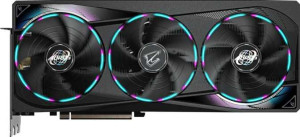
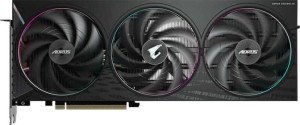
Gigabyte Aorus GeForce RTX 5070 Master specifications and in-depth review

Gigabyte Aorus GeForce RTX 5070 Master

Manufacturer: Gigabyte

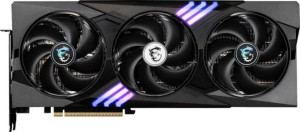
The Gigabyte Aorus GeForce RTX 5070 Master is a desktop graphics card from Gigabyte's Aorus line, built around Nvidia's Blackwell architecture on a 5 nm process node. It houses 6144 shading units alongside 192 texture mapping units and 80 render output units, with a base clock of 2325 MHz that boosts up to 2715 MHz under load. The card supports ray tracing, DLSS, and DirectX 12 Ultimate, and includes RGB lighting as part of its physical design. With support for up to four simultaneous displays, it connects via one HDMI 2.1b port and three DisplayPort outputs.

On the memory side, the RTX 5070 Master carries 12GB of GDDR7 VRAM across a 192-bit bus, reaching an effective memory speed of 28000 MHz and a maximum bandwidth of 672 GB/s. ECC memory support is included, and the card makes use of Intel Resizable BAR for improved CPU-to-GPU data transfers. It operates within a 250W TDP and connects to the system via a PCIe 5.0 interface. The card measures 317 mm in length and 136 mm in height, and relies entirely on air cooling rather than a hybrid liquid solution.

Pros
  • Supports up to four simultaneous displays, offering flexible multi-monitor setups
  • Includes ray tracing and DLSS support, enabling advanced rendering capabilities
  • GDDR7 memory with 672 GB/s bandwidth provides substantial data throughput for demanding workloads
  • ECC memory support adds data integrity assurance for error-sensitive tasks
  • Intel Resizable BAR is included, improving CPU-to-GPU data transfer efficiency
  • RGB lighting is built into the card for users who want a visually customizable build
Cons
  • The 192-bit memory bus is relatively narrow for a card with this level of performance, which may limit memory throughput in some scenarios
  • No USB-C display output is available, limiting compatibility with certain modern monitors
  • The 250W TDP places notable demands on the system power supply
  • No hybrid air-water cooling solution is included, leaving thermal management entirely dependent on the air cooler
  • XeSS (XMX) is not supported, restricting upscaling options to DLSS only
Who is this for?

This card is well-suited to users running demanding rendering and compute workloads that can take advantage of 33.36 TFLOPS of floating-point performance, GDDR7 memory with 672 GB/s bandwidth, and Double Precision Floating Point support. Content creators and professionals working with GPU-accelerated applications will also benefit from the ECC memory support and Intel Resizable BAR, which together improve data reliability and transfer efficiency. Additionally, users who want to drive up to four displays simultaneously — whether for multi-monitor productivity or immersive gaming environments — will find the output configuration practical and well-equipped with HDMI 2.1b and three DisplayPort connections.

Who is this NOT for?

Users working within tight system power budgets may find the 250W TDP a limiting factor, as it demands a capable power supply and adequate case airflow — particularly since the card relies entirely on air cooling with no hybrid liquid option. Those who rely on USB-C display connectivity or need DVI and mini DisplayPort outputs for legacy hardware will find the port selection restrictive. Similarly, users whose upscaling workflow depends on XeSS (XMX) will need to look elsewhere, as that technology is absent from this card's feature set.

Performance:

GPU clock speed 2325 MHz
GPU turbo 2715 MHz
pixel rate 217.2 GPixel/s
floating-point performance 33.36 TFLOPS
texture rate 521.3 GTexels/s
GPU memory speed 1750 MHz
shading units 6144
texture mapping units (TMUs) 192
render output units (ROPs) 80
Has Double Precision Floating Point (DPFP)

The Performance section of this card centers on a base GPU clock of 2325 MHz that scales up to a boost clock of 2715 MHz, underpinned by 6144 shading units, 192 texture mapping units, and 80 render output units. These figures translate into a texture rate of 521.3 GTexels/s and a pixel rate of 217.2 GPixel/s, with floating-point performance reaching 33.36 TFLOPS. The GPU memory runs at 1750 MHz, and the card includes support for Double Precision Floating Point (DPFP), which extends its usefulness beyond standard rendering workloads.

Memory:

effective memory speed 28000 MHz
maximum memory bandwidth 672 GB/s
VRAM 12GB
GDDR version GDDR7
memory bus width 192-bit
Supports ECC memory

This card is equipped with 12GB of GDDR7 VRAM running across a 192-bit memory bus, achieving an effective memory speed of 28000 MHz and a maximum memory bandwidth of 672 GB/s. ECC memory support is also included, adding a layer of data integrity that can be relevant in workloads sensitive to memory errors.

Features:

DirectX version DirectX 12 Ultimate
OpenGL version 4.6
OpenCL version 3
Supports multi-display technology
supports ray tracing
Supports 3D
supports DLSS
has XeSS (XMX)
AMD SAM / Intel Resizable BAR Intel Resizable BAR
has LHR
has RGB lighting
supported displays 4

The card supports DirectX 12 Ultimate, OpenGL 4.6, and OpenCL 3, covering a broad range of graphics and compute API requirements. Ray tracing and DLSS are both supported, as is stereoscopic 3D, while XeSS (XMX) is not present. Intel Resizable BAR is included to help improve data transfer efficiency between the CPU and GPU, and LHR is absent. Multi-display technology is supported with a maximum of four displays connected simultaneously, and RGB lighting is built into the card's physical design.

Ports:

has an HDMI output
HDMI ports 1
HDMI version HDMI 2.1b
DisplayPort outputs 3
USB-C ports 0
DVI outputs 0
mini DisplayPort outputs 0

The card's output configuration consists of one HDMI 2.1b port and three DisplayPort outputs, providing a total of four display connections. There are no USB-C, DVI, or mini DisplayPort outputs present on this card.

General info:

GPU architecture Blackwell
Thermal Design Power (TDP) 250W
PCI Express (PCIe) version 5
semiconductor size 5 nm
number of transistors 31100 million
Has air-water cooling
width 317 mm
height 136 mm

Built on the Blackwell architecture using a 5 nm process node, this card packs 31,100 million transistors and connects to the system via a PCIe 5.0 interface. It carries a Thermal Design Power of 250W and relies solely on air cooling, with no hybrid liquid cooling solution included. Physically, the card measures 317 mm in width and 136 mm in height.

Final Verdict

The Gigabyte Aorus GeForce RTX 5070 Master is a well-specified graphics card that brings together Blackwell architecture, GDDR7 memory, and a capable feature set including ray tracing, DLSS, and ECC memory support — making it a credible option for users with serious rendering or compute demands. Its 672 GB/s memory bandwidth and broad display output configuration give it practical versatility across both professional and enthusiast scenarios. That said, the 250W power requirement, air-only cooling, and absence of USB-C outputs mean it suits environments that are already equipped to handle its demands rather than being a universal fit. For users whose workflows align with its strengths, the RTX 5070 Master delivers a technically coherent and feature-complete package.

Popular Comparisons

Gigabyte Aorus GeForce RTX 5070 Master
VS
Gigabyte Aorus GeForce RTX 5060 Ti Elite 16GB
Gigabyte Aorus GeForce RTX 5070 Master
VS
Asus TUF Gaming GeForce RTX 5070 OC Edition
Gigabyte Aorus GeForce RTX 5070 Master
VS
Asus ROG Strix GeForce RTX 5070 Ti
Gigabyte Aorus GeForce RTX 5070 Master
VS
Asus ROG Strix GeForce RTX 5070
Gigabyte Aorus GeForce RTX 5070 Master
VS
Asus Prime GeForce RTX 5070 OC Edition
Gigabyte Aorus GeForce RTX 5070 Master
VS
Gigabyte GeForce RTX 5070 Ti Gaming OC
Gigabyte Aorus GeForce RTX 5070 Master
VS
Gigabyte GeForce RTX 5070 Ti WindForce OC SFF
Gigabyte Aorus GeForce RTX 5070 Master
VS
MSI GeForce RTX 5070 Gaming Trio OC
Gigabyte Aorus GeForce RTX 5070 Master
VS
Gigabyte GeForce RTX 5070 WindForce OC SFF