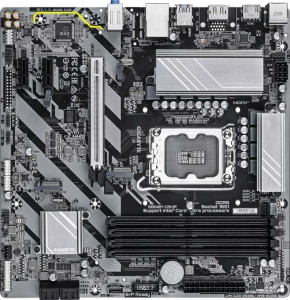
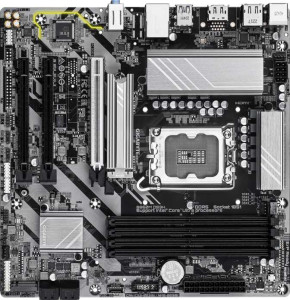
Gigabyte B860M D3HP specifications and in-depth review

Gigabyte B860M D3HP

Manufacturer: Gigabyte

The Gigabyte B860M D3HP is a Micro-ATX motherboard designed around Intel's LGA 1851 platform and the B860 chipset, offering a compact 244×244 mm footprint suited to space-conscious builds. It carries a three-year warranty and supports easy overclocking, making it a practical option for users who want some tuning headroom without committing to a higher-tier chipset. The board omits built-in Wi-Fi and Bluetooth, so connectivity relies entirely on its single RJ45 Ethernet port and any expansion cards added by the user.

Memory support reaches up to 256 GB of DDR5 across four slots in a dual-channel configuration, with a standard ceiling of 6400 MHz and an overclocked ceiling of 9066 MHz. The primary expansion slot runs at PCIe 5.0 x16, accompanied by two PCIe x1 slots for additional cards. Storage options include four SATA 3 connectors alongside two M.2 sockets, and the board supports RAID 0, 1, 5, and 10 configurations. On the rear panel, users will find three USB 3.2 Gen 1 Type-A ports, three USB 2.0 ports, HDMI 2.1 and DisplayPort outputs, a PS/2 port, and three audio connectors serving a 7.1-channel audio setup.

Pros
  • Dual BIOS provides a fallback option if a firmware update fails or the primary BIOS becomes corrupted
  • Supports overclocked DDR5 RAM speeds up to 9066 MHz, offering meaningful headroom for memory tuning
  • The single PCIe 5.0 x16 slot ensures full-bandwidth support for current-generation discrete graphics cards
  • Four RAID modes — 0, 1, 5, and 10 — give users flexibility in how they configure storage redundancy
  • A three-year warranty provides above-average coverage for a consumer motherboard
  • Seven USB ports on the rear panel, split between USB 3.2 Gen 1 and USB 2.0, covers a reasonable range of everyday peripherals
Cons
  • No Wi-Fi or Bluetooth means wireless connectivity requires a separate expansion card or adapter
  • No USB Type-C port on the rear panel limits compatibility with newer peripherals and devices
  • Lacks a clear CMOS button, making BIOS resets more cumbersome without this convenience feature
  • Only two M.2 sockets may feel restrictive for builds that rely heavily on NVMe storage
  • No S/PDIF Out port rules out digital audio passthrough to external receivers or DACs
  • Absence of USB 3.2 Gen 2 or faster ports on the rear I/O limits transfer speeds for high-bandwidth storage devices
Who is this for?

This board is a practical choice for users building a compact desktop system around Intel's LGA 1851 platform who want a straightforward, no-frills setup. The Micro-ATX form factor makes it well-suited for smaller cases where space is at a premium, while the dual BIOS and overclocking support appeal to enthusiasts who want some tuning flexibility without managing a full-sized board. Users who rely on wired Ethernet for networking and have no need for wireless connectivity will find the feature set aligned with their requirements, and the support for RAID 0, 1, 5, and 10 makes it a reasonable fit for home or small office setups where basic storage redundancy is a priority.

Who is this NOT for?

Users who need built-in Wi-Fi or Bluetooth will find this board lacking, as neither is included, requiring an additional expansion card to achieve wireless connectivity. The absence of USB Type-C and USB 3.2 Gen 2 ports on the rear panel makes it a poor match for workflows that depend on high-speed peripheral transfers or modern USB-C accessories. Similarly, content creators or professionals who rely on digital audio output via S/PDIF, or those who need Thunderbolt connectivity for specialized equipment, will find the board's I/O insufficient for those demands.

General info:

CPU socket LGA 1851
chipset B860
form factor Micro-ATX
supports Wi-Fi
Has Bluetooth
HDMI version HDMI 2.1
Easy to overclock
has RGB lighting
Easy to reset BIOS
Has dual BIOS
CPU sockets 1
Has integrated graphics
warranty period 3 years
height 244 mm
width 244 mm
Has integrated CPU

The Gigabyte B860M D3HP is built around the LGA 1851 socket and is compatible with the B860 chipset, housed in a Micro-ATX form factor measuring 244×244 mm. It features a single CPU socket and supports easy overclocking, while a dual BIOS setup adds a layer of resilience against failed firmware updates. The board outputs video through an HDMI 2.1 interface but does not include integrated graphics or an integrated CPU, so a discrete GPU or a processor with onboard graphics is required. Wi-Fi and Bluetooth are absent, and there is no RGB lighting or easy CMOS reset functionality. Gigabyte backs the board with a three-year warranty.

Memory:

maximum memory amount 256GB
RAM speed (max) 6400 MHz
overclocked RAM speed 9066 MHz
memory slots 4
DDR memory version 5
memory channels 2
Supports ECC memory

The board supports DDR5 memory across four slots in a dual-channel configuration, with a maximum capacity of 256 GB. Standard RAM speeds top out at 6400 MHz, while overclocking can push that figure up to 9066 MHz for users looking to extract additional memory performance. ECC memory is not supported, so the board is oriented toward consumer rather than workstation or server use cases.

Ports:

USB 3.2 Gen 2 ports (USB-A) 0
USB 3.2 Gen 1 ports (USB-A) 3
USB 3.2 Gen 2 ports (USB-C) 0
USB 3.2 Gen 1 ports (USB-C) 0
USB 2.0 ports 3
USB 3.2 Gen 2x2 ports 0
USB 4 40Gbps ports 0
USB 4 20Gbps ports 0
Thunderbolt 4 ports 0
Thunderbolt 3 ports 0
has an HDMI output
DisplayPort outputs 1
RJ45 ports 1
Has USB Type-C
eSATA ports 0
DVI outputs 0
has a VGA connector
PS/2 ports 1

The rear I/O panel provides three USB 3.2 Gen 1 Type-A ports and three USB 2.0 ports for peripheral connectivity, while USB Type-C, USB 3.2 Gen 2, USB 4, Thunderbolt 3, and Thunderbolt 4 are all absent. Display output is handled by an HDMI port and one DisplayPort output, with no DVI or VGA connectors present. Networking is covered by a single RJ45 port, and a PS/2 port is included for legacy input devices. There are no eSATA ports on the panel.

Connectors:

USB 3.2 Gen 1 ports (through expansion) 2
USB 2.0 ports (through expansion) 4
SATA 3 connectors 4
fan headers 4
USB 3.0 ports (through expansion) 2
M.2 sockets 2
Has TPM connector
U.2 sockets 0
Has mSATA connector
SATA 2 connectors 0

For internal storage, the board offers four SATA 3 connectors and two M.2 sockets, with no SATA 2, mSATA, or U.2 sockets available. USB expansion headers include two USB 3.2 Gen 1 connectors and two USB 3.0 connectors for front-panel or bracket use, along with four USB 2.0 expansion ports. Cooling is managed through four fan headers, and a TPM connector is present for hardware-based security module support.

Expansion slots:

PCIe 4.0 x16 slots 0
PCIe 5.0 x16 slots 1
PCIe 3.0 x16 slots 0
PCIe x1 slots 2
PCI slots 0
PCIe 2.0 x16 slots 0
PCIe x4 slots 0
PCIe x8 slots 0

The board's expansion layout centers on a single PCIe 5.0 x16 slot as the primary option for discrete graphics or other full-bandwidth cards, complemented by two PCIe x1 slots for smaller add-in cards. There are no PCIe 2.0, 3.0, or 4.0 x16 slots, and no PCIe x4, x8, or legacy PCI slots are present, keeping the layout straightforward given the Micro-ATX form factor.

Audio:

audio channels 7.1
Has S/PDIF Out port
audio connectors 3

The board provides 7.1-channel audio output through three analog audio connectors on the rear panel. There is no S/PDIF Out port, so digital optical or coaxial audio passthrough is not available.

Storage:

Supports RAID 1
Supports RAID 10 (1+0)
Supports RAID 5
Supports RAID 0
Supports RAID 0+1

The board supports a solid range of RAID configurations, including RAID 0, 1, 5, and 10, covering common setups for performance striping, mirroring, parity-based redundancy, and combined striping with mirroring. RAID 0+1 is not supported.

Final Verdict

The Gigabyte B860M D3HP is a focused, no-frills Micro-ATX motherboard that delivers a competent foundation for Intel LGA 1851 builds without overcomplicating the feature set. Its support for DDR5 memory with overclocked speeds up to 9066 MHz, combined with a PCIe 5.0 x16 slot and dual BIOS, gives it enough substance to satisfy builders who want modern platform capabilities in a compact form. The board's limitations — notably the absence of Wi-Fi, Bluetooth, USB Type-C, and higher-speed rear USB ports — make it a poor fit for users with demanding connectivity needs, but for wired, storage-focused desktop builds where reliability and straightforward functionality take precedence, it represents a sensible and well-rounded choice.

Popular Comparisons

Gigabyte B860M D3HP
Gigabyte B860M D3HP
VS
Gigabyte B860M DS3H
Gigabyte B860M DS3H