Gigabyte GeForce RTX 5060 OC Low Profile specifications and in-depth review

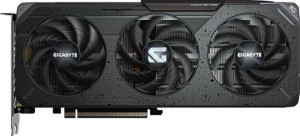
Gigabyte GeForce RTX 5060 OC Low Profile

Manufacturer: Gigabyte

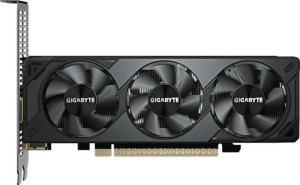
The Gigabyte GeForce RTX 5060 OC Low Profile is a low-profile graphics card designed around NVIDIA's Blackwell architecture, making it a compact option for systems with space constraints. With a base clock of 2280 MHz and a boost that reaches 2512 MHz, it delivers a floating-point throughput of 19.29 TFLOPS alongside support for ray tracing and DLSS technology.

On the memory side, the card is equipped with 8GB of GDDR7 VRAM running across a 128-bit bus at an effective speed of 28000 MHz, yielding a maximum bandwidth of 448 GB/s. The display output configuration includes one HDMI 2.1b port and three DisplayPort outputs, supporting up to four monitors simultaneously. Built on a 5 nm process with 21.9 billion transistors, it carries a TDP of 145W and connects via PCIe 5.0, with physical dimensions of 182 mm in width and 69 mm in height.

Pros
  • The low-profile form factor with dimensions of 182 mm x 69 mm makes it suitable for compact or small form factor PC builds where full-size cards cannot fit
  • GDDR7 memory running at an effective 28000 MHz across a 128-bit bus delivers up to 448 GB/s of bandwidth for a card in this size class
  • Support for ray tracing and DLSS expands rendering capabilities beyond standard rasterization
  • Four simultaneous display outputs via one HDMI 2.1b port and three DisplayPort connections offer flexible multi-monitor configurations
  • ECC memory support adds a layer of data integrity for error-sensitive workloads
  • PCIe 5.0 connectivity ensures compatibility with current-generation motherboard platforms
Cons
  • The 128-bit memory bus width is narrow, which limits memory bandwidth scaling compared to wider bus configurations
  • At 145W TDP, thermal management in compact cases without air-water cooling support may be a challenge, particularly since the card does not include air-water cooling
  • 8GB of VRAM may be restrictive for workloads or applications that require larger memory capacities
  • The absence of USB-C output limits compatibility with certain modern displays and adapters that rely on that connection type
Who is this for?

This card is well-matched for users building compact or small form factor systems where physical space is a primary constraint, given its low-profile dimensions of 182 mm x 69 mm. Its support for ray tracing, DLSS, and DirectX 12 Ultimate makes it a reasonable fit for those engaged in modern gaming or real-time rendering workloads that benefit from hardware-accelerated features. The inclusion of ECC memory support and Double Precision Floating Point also makes it relevant for users running compute or data-integrity-sensitive applications within a space-limited enclosure.

Who is this NOT for?

Users with demanding workloads that require large amounts of video memory will find the 8GB VRAM ceiling a limiting factor, particularly in scenarios involving high-resolution textures, large 3D scenes, or memory-intensive professional applications. The 128-bit memory bus, while paired with fast GDDR7 memory, may fall short for workloads that depend on sustained high memory bandwidth at scale. Additionally, the card's 145W TDP combined with the absence of air-water cooling support makes it a poor fit for thermally constrained builds that lack adequate airflow, where heat dissipation could become a persistent concern.

Performance:

GPU clock speed 2280 MHz
GPU turbo 2512 MHz
pixel rate 120.6 GPixel/s
floating-point performance 19.29 TFLOPS
texture rate 301.4 GTexels/s
GPU memory speed 1750 MHz
shading units 3840
texture mapping units (TMUs) 120
render output units (ROPs) 48
Has Double Precision Floating Point (DPFP)

The GPU operates at a base clock of 2280 MHz, with a boost that climbs to 2512 MHz, and delivers a floating-point throughput of 19.29 TFLOPS alongside a texture rate of 301.4 GTexels/s and a pixel rate of 120.6 GPixel/s. Underlying these figures are 3840 shading units, 120 texture mapping units, and 48 render output units, while the GPU memory runs at 1750 MHz. The card also supports Double Precision Floating Point (DPFP), broadening its suitability for compute-oriented workloads.

Memory:

effective memory speed 28000 MHz
maximum memory bandwidth 448 GB/s
VRAM 8GB
GDDR version GDDR7
memory bus width 128-bit
Supports ECC memory

The card is equipped with 8GB of GDDR7 VRAM running across a 128-bit memory bus at an effective speed of 28000 MHz, resulting in a maximum memory bandwidth of 448 GB/s. ECC memory support is also included, which helps maintain data integrity in error-sensitive workloads.

Features:

DirectX version DirectX 12 Ultimate
OpenGL version 4.6
OpenCL version 3
Supports multi-display technology
supports ray tracing
Supports 3D
supports DLSS
has XeSS (XMX)
AMD SAM / Intel Resizable BAR Intel Resizable BAR
has LHR
has RGB lighting
supported displays 4

The card supports DirectX 12 Ultimate, OpenGL 4.6, and OpenCL 3, covering a broad range of graphics and compute APIs. Ray tracing and DLSS are both supported, as are stereoscopic 3D and multi-display technology spanning up to four screens simultaneously. Intel Resizable BAR is included for optimized CPU-to-GPU data access, while XeSS (XMX) and LHR are not present on this model. The card does not feature RGB lighting.

Ports:

has an HDMI output
HDMI ports 1
HDMI version HDMI 2.1b
DisplayPort outputs 3
USB-C ports 0
DVI outputs 0
mini DisplayPort outputs 0

The card's output configuration consists of one HDMI 2.1b port and three DisplayPort outputs, totaling four display connections. There are no USB-C, DVI, or mini DisplayPort outputs on this model.

General info:

GPU architecture Blackwell
Thermal Design Power (TDP) 145W
PCI Express (PCIe) version 5
semiconductor size 5 nm
number of transistors 21900 million
Has air-water cooling
width 182 mm
height 69 mm

Built on the Blackwell architecture and fabricated using a 5 nm process, the GPU integrates 21,900 million transistors and connects to the system via PCIe 5.0. It carries a TDP of 145W and does not include air-water cooling. The card measures 182 mm in width and 69 mm in height, reflecting its low-profile physical footprint.

Final Verdict

The Gigabyte GeForce RTX 5060 OC Low Profile carves out a specific niche as a graphics card built around the demands of compact system builders who cannot accommodate full-size hardware. Its Blackwell architecture, GDDR7 memory, and support for ray tracing and DLSS give it a capable feature set within its physical constraints, while ECC memory support and PCIe 5.0 connectivity add relevance for users with reliability-focused or compute-oriented needs. That said, the low-profile form factor necessarily comes with trade-offs — the 128-bit bus width and 8GB VRAM ceiling mean it is best suited to moderate workloads rather than memory-intensive or bandwidth-demanding tasks. For users whose priority is fitting a modern, feature-rich GPU into a space-limited enclosure, this card represents a well-defined solution; those pushing heavier workloads would need to weigh its physical advantages against its inherent capacity limits.

Popular Comparisons

Gigabyte GeForce RTX 5060 OC Low Profile
VS
AMD Radeon RX 7400
AMD Radeon RX 7400
Gigabyte GeForce RTX 5060 OC Low Profile
VS
Gigabyte GeForce RTX 5050 OC Low Profile
Gigabyte GeForce RTX 5060 OC Low Profile
VS
Gigabyte GeForce RTX 5050 Gaming OC
Gigabyte GeForce RTX 5060 OC Low Profile
VS
Asus Prime GeForce RTX 5060 OC Edition
Gigabyte GeForce RTX 5060 OC Low Profile
VS
Asus Prime GeForce RTX 5060
Gigabyte GeForce RTX 5060 OC Low Profile
VS
Gigabyte Radeon RX 9060 XT Gaming 8GB
Gigabyte GeForce RTX 5060 OC Low Profile
VS
Nvidia GeForce RTX 5060
Gigabyte GeForce RTX 5060 OC Low Profile
VS
Inno3D GeForce RTX 4080 Super iChill Black