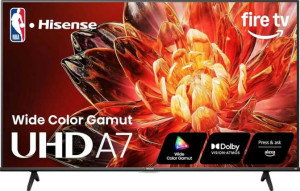
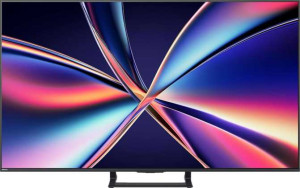
The Hisense 75A7NF features a 74.5-inch LED-backlit LCD panel with 4K UHD resolution at 3840 x 2160 pixels and a pixel density of 59 ppi. Its 10-bit panel supports up to 1.07 billion colors and a 60Hz refresh rate, while HDR compatibility spans HDR10, HDR10+, Dolby Vision, and HLG formats for broad content support. Viewing angles reach 178 degrees both horizontally and vertically, and the display also includes an anti-reflection coating and an ambient light sensor that can adjust brightness based on the surrounding environment.
The Hisense 75A7NF offers a solid range of wired and wireless connectivity options, including three HDMI 2.0 ports, two USB ports, and a single RJ45 Ethernet port for a wired network connection. Wireless networking is handled by Wi-Fi 4 (802.11n) and Wi-Fi 5 (802.11ac), while Bluetooth 5.0 allows for cable-free peripheral pairing. The TV also supports Miracast for screen mirroring and includes a 3.5mm headset jack for direct audio output. There is no external memory slot, VGA connector, or DVI connector on this model.
The Hisense 75A7NF uses a stereo speaker setup rated at 2 x 12W, with support for Dolby Atmos and Dolby Audio processing for enhanced sound reproduction. Digital Out is available for connecting external audio equipment, and the TV supports both HDMI ARC and HDMI eARC for passing audio to compatible soundbars or receivers. It does not include a subwoofer, SRS TheaterSound HD, or Dolby Virtual processing.
The Hisense 75A7NF measures 1676.4 mm wide, 960.1 mm tall, and 86.4 mm thick, with a total volume of approximately 139,061.8 cm³. It weighs 23,088 g and supports VESA mounting for wall installation flexibility.
The Hisense 75A7NF comes with a built-in smart TV platform that includes a web browser, AirPlay support, and Alexa compatibility for voice-based control, though it does not work with Google Assistant or Siri/Apple HomeKit. Voice commands are supported natively, and the TV can also be controlled via a smartphone used as a remote. Additional practical features include USB recording, a sleep timer, and a child lock. On the power side, operating consumption is rated at 230W with a low standby draw of 0.5W. The remote control is not rechargeable, and USB recording rounds out a feature set aimed at straightforward, everyday usability.