Nvidia RTX Pro 6000 Blackwell Max-Q Workstation Edition specifications and in-depth review

Nvidia RTX Pro 6000 Blackwell Max-Q Workstation Edition

Manufacturer: Nvidia

The Nvidia RTX Pro 6000 Blackwell Max-Q Workstation Edition is a workstation-class graphics card designed around Nvidia's Blackwell architecture, fabricated on a 5 nm process with 92,200 million transistors. It operates at a base clock of 1590 MHz with a turbo frequency reaching 2288 MHz, and its 96 GB of GDDR7 VRAM paired with a 512-bit memory bus delivers up to 1792 GB/s of memory bandwidth — a configuration oriented toward data-intensive professional workloads.

On the compute side, the card houses 24,064 shading units, 752 texture mapping units, and 192 render output units, yielding a texture rate of 1721 GTexels/s and a pixel rate of 439.3 GPixel/s. Floating-point performance is rated at 110 TFLOPS, and the GPU also supports Double Precision Floating Point for precision-critical tasks. The card has a 300 W TDP, connects via PCIe 5, supports DirectX 12, OpenGL 4.6, and OpenCL 3, and provides four DisplayPort outputs along with ray tracing and DLSS support. ECC memory and Intel Resizable BAR are also included, while HDMI, DVI, and USB-C outputs are absent from this configuration.

Pros
  • 96 GB of GDDR7 VRAM provides substantial memory capacity for large datasets, complex scenes, and memory-intensive professional workloads
  • A 512-bit memory bus paired with 1792 GB/s of bandwidth supports high-throughput data transfer across demanding tasks
  • ECC memory support adds data integrity protection, reducing the risk of silent errors in precision-critical workflows
  • Double Precision Floating Point (DPFP) support makes the card suitable for compute tasks requiring high numerical accuracy
  • Four DisplayPort outputs allow connection to multiple monitors simultaneously without additional adapters
  • Ray tracing and DLSS support are both present, extending the card's versatility across rendering and visualization applications
Cons
  • No HDMI, DVI, USB-C, or mini DisplayPort outputs limits display connectivity to DisplayPort-compatible hardware exclusively
  • Air-water cooling is not included, leaving thermal management entirely dependent on the system's own cooling solution
  • The 300 W TDP places significant power demands on the host workstation, requiring adequate power delivery infrastructure
  • Absence of RGB lighting may be a drawback for users who prefer visual customization in their build
  • XeSS (XMX) is not supported, restricting upscaling options to DLSS only
Who is this for?

This card is well-suited to professionals working with data-intensive visual and compute workloads, where the combination of 96 GB of GDDR7 VRAM and 1792 GB/s of memory bandwidth allows large assets, simulation datasets, or complex 3D scenes to reside fully in memory without bottlenecks. The inclusion of ECC memory and Double Precision Floating Point support makes it a reliable fit for scientific computing, engineering simulation, and precision-critical rendering tasks. Its four DisplayPort outputs also make it practical for multi-monitor workstation setups that demand high-resolution display connectivity across several screens simultaneously.

Who is this NOT for?

Users building compact or thermally constrained systems may find this card difficult to accommodate, given its 300 W TDP and the absence of integrated air-water cooling, which places the full burden of heat dissipation on the host system. It is also not well-suited to general consumer or gaming-oriented builds, as the lack of HDMI and USB-C display outputs limits compatibility with common consumer monitors and display peripherals that rely on those connections. Additionally, users seeking visual customization in their workstation will find no RGB lighting options available on this card.

Performance:

GPU clock speed 1590 MHz
GPU turbo 2288 MHz
pixel rate 439.3 GPixel/s
floating-point performance 110 TFLOPS
texture rate 1721 GTexels/s
GPU memory speed 1750 MHz
shading units 24064
texture mapping units (TMUs) 752
render output units (ROPs) 192
Has Double Precision Floating Point (DPFP)

The Performance section of this GPU centers on a base clock of 1590 MHz that boosts up to a turbo frequency of 2288 MHz, supported by a GPU memory speed of 1750 MHz. With 24,064 shading units alongside 752 texture mapping units and 192 render output units, the card achieves a texture rate of 1721 GTexels/s and a pixel rate of 439.3 GPixel/s. Floating-point performance is rated at 110 TFLOPS, and the inclusion of Double Precision Floating Point (DPFP) support extends its suitability to workloads that demand high numerical accuracy.

Memory:

effective memory speed 28000 MHz
maximum memory bandwidth 1792 GB/s
VRAM 96GB
GDDR version GDDR7
memory bus width 512-bit
Supports ECC memory

This GPU is equipped with 96 GB of GDDR7 VRAM running at an effective memory speed of 28,000 MHz, channeled through a wide 512-bit memory bus to deliver a maximum memory bandwidth of 1792 GB/s. ECC memory support is included, adding a layer of data integrity protection relevant to error-sensitive professional applications.

Features:

DirectX version DirectX 12
OpenGL version 4.6
OpenCL version 3
Supports multi-display technology
supports ray tracing
Supports 3D
supports DLSS
has XeSS (XMX)
AMD SAM / Intel Resizable BAR Intel Resizable BAR
has LHR
has RGB lighting

On the software and feature side, this GPU supports DirectX 12, OpenGL 4.6, and OpenCL 3, covering a broad range of graphics and compute workloads. Ray tracing and DLSS are both supported, as are multi-display configurations and stereoscopic 3D output. Intel Resizable BAR is available for improved CPU-to-GPU data access, while XeSS (XMX) and LHR are not present on this card. RGB lighting is also absent, reflecting its workstation-oriented focus.

Ports:

has an HDMI output
DisplayPort outputs 4
USB-C ports 0
DVI outputs 0
mini DisplayPort outputs 0

This GPU's display output configuration consists exclusively of four DisplayPort outputs, with no HDMI, DVI, mini DisplayPort, or USB-C ports included. This makes it a DisplayPort-only card, suited for workstation monitor setups that rely on that interface.

General info:

GPU architecture Blackwell
Thermal Design Power (TDP) 300W
PCI Express (PCIe) version 5
semiconductor size 5 nm
number of transistors 92200 million
Has air-water cooling
width 266.7 mm
height 111.8 mm

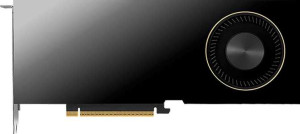
Built on the Blackwell architecture and manufactured using a 5 nm process, this GPU integrates 92,200 million transistors within physical dimensions of 266.7 mm wide and 111.8 mm tall. It carries a Thermal Design Power of 300 W and connects via PCIe 5, while air-water cooling is not included. The card uses a 5 nm semiconductor process, and its PCIe 5 interface reflects its positioning within current-generation workstation platforms.
Final Verdict

The Nvidia RTX Pro 6000 Blackwell Max-Q Workstation Edition is a purpose-built workstation GPU whose specifications reflect a clear focus on professional compute and visualization environments. Its 96 GB of GDDR7 VRAM backed by 1792 GB/s of memory bandwidth positions it for workloads where memory capacity and throughput are critical, while ECC support and Double Precision Floating Point capability reinforce its suitability for precision-sensitive tasks. The card's DisplayPort-only output configuration and high power draw mean it is best placed in a well-resourced workstation rather than a general-purpose or consumer build. For professionals requiring a high-capacity, compute-oriented GPU on the Blackwell architecture, this card represents a technically coherent and well-specified option for demanding workstation deployments.

Popular Comparisons

Nvidia RTX Pro 6000 Blackwell Max-Q Workstation Edition
VS
Nvidia RTX Pro 6000 Blackwell Server Edition