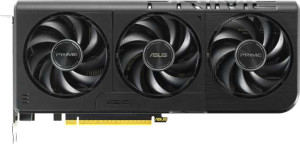
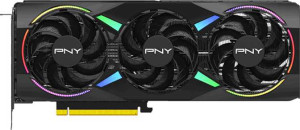
PNY GeForce RTX 5060 ARGB Epic-X OC Triple Fan specifications and in-depth review

PNY GeForce RTX 5060 ARGB Epic-X OC Triple Fan

Manufacturer: PNY

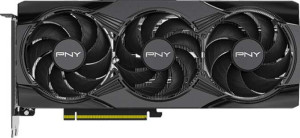
The PNY GeForce RTX 5060 ARGB Epic-X OC Triple Fan is a mid-range graphics card from PNY built around NVIDIA's Blackwell architecture. It ships with a triple-fan cooling solution and RGB lighting, running at a base clock of 2280 MHz with a boosted frequency that reaches 2580 MHz under load. The card carries a 145W TDP and measures 280 mm in length, fitting into a range of standard mid-tower enclosures.

On the memory side, the card equips 8GB of GDDR7 VRAM across a 128-bit bus, delivering an effective memory speed of 28000 MHz and a maximum bandwidth of 448 GB/s. Its 3840 shading units, 120 texture mapping units, and 48 render output units contribute to a floating-point throughput of 19.81 TFLOPS and a texture rate of 309.6 GTexels/s. The card supports DirectX 12 Ultimate, OpenGL 4.6, ray tracing, and DLSS, and connects to up to four displays via one HDMI 2.1b port and three DisplayPort outputs. It interfaces with the system through PCIe 5.0 and is backed by a three-year warranty.

Pros
  • Supports up to four simultaneous displays through one HDMI 2.1b port and three DisplayPort outputs
  • GDDR7 memory delivers a maximum bandwidth of 448 GB/s, enabling fast data throughput for demanding workloads
  • RGB lighting is built in, allowing for visual customization within a system build
  • Ray tracing and DLSS support are both included, expanding compatibility with modern rendering features
  • ECC memory support adds data integrity for workloads where accuracy matters
  • A three-year warranty provides extended coverage for long-term reliability
Cons
  • The 128-bit memory bus width is relatively narrow for a card at this tier, which can limit memory throughput scalability
  • With only 8GB of VRAM, memory capacity may become a constraint in scenarios that demand larger frame buffers
  • No USB-C output is available, limiting connectivity options for certain monitors or display adapters
  • Water cooling is not supported, so thermal management depends entirely on the triple air-cooling setup
  • XeSS (XMX) is not supported, reducing compatibility with that particular upscaling technology
Who is this for?

This card is well-suited to users who want to take advantage of ray tracing and DLSS in modern titles, as both features are fully supported alongside DirectX 12 Ultimate. The 448 GB/s memory bandwidth and GDDR7 memory make it a reasonable fit for 1080p and 1440p gaming workloads where fast data throughput matters. Its four-display output support also makes it a practical option for users who need a multi-monitor setup, whether for productivity or gaming across multiple screens. The inclusion of ECC memory support extends its appeal to light professional or creative workloads that require data integrity.

Who is this NOT for?

Users targeting high-resolution workloads at 4K may find the 8GB VRAM capacity and 128-bit memory bus limiting, as demanding textures and large frame buffers at that resolution can quickly exhaust available memory. The card is also not suited to users who need XeSS upscaling support, as that technology is absent. Those who require liquid cooling integration within a custom loop will need to look elsewhere, since water cooling is not supported and thermal management relies entirely on the triple-fan air cooler. Additionally, the 280 mm card length may present fitment challenges in compact or mini-ITX cases.

Performance:

GPU clock speed 2280 MHz
GPU turbo 2580 MHz
pixel rate 123.8 GPixel/s
floating-point performance 19.81 TFLOPS
texture rate 309.6 GTexels/s
GPU memory speed 1750 MHz
shading units 3840
texture mapping units (TMUs) 120
render output units (ROPs) 48
Has Double Precision Floating Point (DPFP)

The card operates at a base GPU clock of 2280 MHz, climbing to 2580 MHz in turbo mode, while the GPU memory runs at 1750 MHz. Its 3840 shading units work alongside 120 texture mapping units and 48 render output units to deliver a texture rate of 309.6 GTexels/s and a pixel rate of 123.8 GPixel/s. Overall floating-point throughput reaches 19.81 TFLOPS, and the card also supports double precision floating point (DPFP) operations.

Memory:

effective memory speed 28000 MHz
maximum memory bandwidth 448 GB/s
VRAM 8GB
GDDR version GDDR7
memory bus width 128-bit
Supports ECC memory

The card comes equipped with 8GB of GDDR7 VRAM running across a 128-bit memory bus, reaching an effective memory speed of 28000 MHz and delivering a maximum memory bandwidth of 448 GB/s. ECC memory support is also included, adding a layer of data integrity for workloads that require it.

Features:

DirectX version DirectX 12 Ultimate
OpenGL version 4.6
OpenCL version 3
Supports multi-display technology
supports ray tracing
Supports 3D
supports DLSS
has XeSS (XMX)
AMD SAM / Intel Resizable BAR Intel Resizable BAR
has LHR
has RGB lighting
supported displays 4

The card supports DirectX 12 Ultimate, OpenGL 4.6, and OpenCL 3, covering a broad range of graphics and compute workloads. Ray tracing and DLSS are both supported, while XeSS (XMX) is not. Multi-display technology is included, allowing connections to up to four displays simultaneously, and stereoscopic 3D is also supported. On the system side, Intel Resizable BAR is available, though LHR is not present. RGB lighting is built in, rounding out the feature set.

Ports:

has an HDMI output
HDMI ports 1
HDMI version HDMI 2.1b
DisplayPort outputs 3
USB-C ports 0
DVI outputs 0
mini DisplayPort outputs 0

The card's output configuration consists of one HDMI 2.1b port and three DisplayPort outputs, totaling four available display connections. There are no DVI, mini DisplayPort, or USB-C ports on this card.

General info:

GPU architecture Blackwell
Thermal Design Power (TDP) 145W
PCI Express (PCIe) version 5
semiconductor size 5 nm
number of transistors 21900 million
warranty period 3 years
Has air-water cooling
width 280 mm
height 120 mm

Built on the Blackwell architecture using a 5 nm manufacturing process, the GPU integrates 21,900 million transistors and connects to the system via PCIe 5.0. It carries a thermal design power of 145W and relies on air cooling, with no water-cooling option included. The card measures 280 mm in width and 120 mm in height, and does not include air-water cooling. A 3-year warranty is provided.
Final Verdict

The PNY GeForce RTX 5060 ARGB Epic-X OC Triple Fan is a well-specified card for users operating at 1080p or 1440p, combining Blackwell architecture with GDDR7 memory and full support for ray tracing and DLSS to cover the demands of modern rendering pipelines. Its four-display output capability and ECC memory support add a degree of versatility that extends slightly beyond pure gaming, while the triple-fan cooling and RGB lighting round out a feature set aimed at enthusiast system builders. That said, the 8GB VRAM ceiling and 128-bit bus width mean it has a defined upper boundary in terms of scalability, and users with ambitions beyond 1440p or high-VRAM workloads may find its headroom limited. Within its intended scope, however, it represents a focused and technically coherent option that delivers modern feature support in a practical, air-cooled package.

Popular Comparisons

PNY GeForce RTX 5060 ARGB Epic-X OC Triple Fan
VS
Gigabyte GeForce RTX 5060 Gaming OC
PNY GeForce RTX 5060 ARGB Epic-X OC Triple Fan
VS
Asus Prime GeForce RTX 5060 OC Edition
PNY GeForce RTX 5060 ARGB Epic-X OC Triple Fan
VS
PNY GeForce RTX 5070 ARGB Epic-X OC Triple Fan