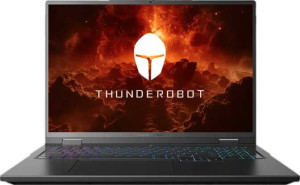
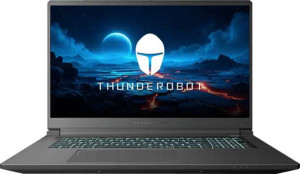
The Thunderobot Zero 16 Ultra 16″ is a gaming laptop with a chassis measuring 358 mm wide, 268 mm deep, and 26 mm thick, with a total volume of 2494.544 cm³. It weighs 2580 g and comes with a backlit keyboard as a standard inclusion. The laptop is not fanless, meaning it relies on active cooling to manage thermals. It does not carry a rugged build or weather-sealed construction, and it is not splash-resistant. A one-year warranty is included with the device.
The Thunderobot Zero 16 Ultra 16″ features a 16-inch IPS, LED-backlit LCD panel running at a 2560 x 1600 resolution with a pixel density of 188 ppi. Its 360Hz refresh rate makes it well-suited for fast-paced content, while a typical brightness of 600 nits and a contrast ratio of 1800:1 contribute to a clear and well-defined image. The display does not include a touch screen or an anti-reflection coating. The system supports up to four connected displays simultaneously.
The Thunderobot Zero 16 Ultra 16″ is equipped with a 20-thread CPU built on a 4 nm process, running at clock speeds of 8 x 2.4 GHz and 12 x 1.8 GHz with a turbo peak of 5.2 GHz, and it supports multithreading and 64-bit operation. System memory stands at 32GB DDR5, expandable up to 192GB, paired with a 1024GB NVMe SSD using flash storage over a PCIe 5 interface. On the graphics side, the laptop carries 16GB of GDDR7 VRAM with a base GPU clock of 975 MHz and a turbo of 1500 MHz, delivering 23.04 TFLOPS of floating-point performance, a texture rate of 384 GTexels/s, and a pixel rate of 144 GPixel/s. The GPU supports DirectX 12 Ultimate but does not include XeSS (XMX) support.
In benchmark testing, the Thunderobot Zero 16 Ultra 16″ achieves a PassMark score of 50,739 in the multi-core test, reflecting its overall CPU throughput capacity. The single-core PassMark result comes in at 4,645, indicating the processor's per-core execution performance.
The Thunderobot Zero 16 Ultra 16″ offers a varied port layout, including two USB 3.2 Gen 2 Type-A ports, two USB 3.2 Gen 1 Type-A ports, and one USB 4 40Gbps port for high-bandwidth connectivity. Video output is handled by a single HDMI 2.1 port, while DisplayPort, mini DisplayPort, and VGA outputs are absent. Wired networking is covered by one RJ45 port, and the laptop supports Wi-Fi 6 (802.11ax), Wi-Fi 5 (802.11ac), and Wi-Fi 4 (802.11n) for wireless connections, alongside Bluetooth 5.3. There is no external memory card slot, no Thunderbolt 3 or 4 ports, and no USB 2.0 or USB-C Gen 1/Gen 2 ports. AirPlay is supported, and USB Type-C connectivity is present via the USB 4 port.
The Thunderobot Zero 16 Ultra 16″ is fitted with an 80 Wh battery and includes sleep-and-charge USB ports, allowing connected devices to be charged even when the laptop is in sleep mode. It does not use a MagSafe power adapter.
The Thunderobot Zero 16 Ultra 16″ includes stereo speakers, a 3.5 mm headset jack, and a single microphone for audio input and output, though it lacks Dolby Atmos and an S/PDIF output port. A 1MP front camera is built in, but the laptop does not offer a fingerprint scanner, 3D facial recognition, or voice command support. On the graphics side, it supports both ray tracing and DLSS, adding hardware-accelerated rendering capabilities to its feature set. Sensors such as a gyroscope, accelerometer, compass, and GPS are not present, and there is no optical disc drive or stylus included.
The Thunderobot Zero 16 Ultra 16″ houses a laptop-class CPU using a BGA 2114 socket with a clock multiplier of 24, an unlocked multiplier, Turbo Boost version 2, and a maximum operating temperature of 105 °C. It employs big.LITTLE technology, features integrated graphics alongside the discrete GPU, and supports a broad instruction set including MMX, F16C, FMA3, AES, AVX, AVX2, SSE 4.1, and SSE 4.2. The CPU carries a 36 MB L2 cache, a TDP of 80W, and an NX bit for hardware-level execution protection. On the memory side, the system operates across a 256-bit bus with two memory channels, an effective speed of 25,400 MHz, a maximum RAM speed of 6,400 MHz, and a peak bandwidth of 811.5 GB/s, with ECC memory support also confirmed. The Blackwell-architecture GPU includes 7,680 shading units, 256 TMUs, 96 ROPs, Double Precision Floating Point support, a native memory speed of 2,000 MHz, and is not fitted with LHR. Additional GPU capabilities include multi-display support, stereoscopic 3D, Intel Resizable BAR, OpenCL 3, OpenGL 4.6, and an overclocked PassMark result of 53,565.