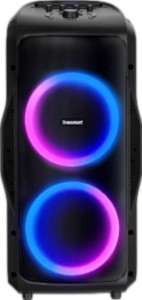
The Tronsmart Halo 300 is a sizeable unit, measuring 753 mm in height, 364 mm in width, and 406 mm in thickness, with a total volume of 111,281.352 cm³ and a weight of 14,000 g. It carries an IPX4 ingress protection rating, placing it in the sweat-resistant category while stopping short of full waterproofing. The speaker houses two drivers and includes a control panel mounted directly on the device, along with a detachable cable for added convenience. It does not feature a touch screen, RGB lighting, a remote control, a travel bag, or a neodymium magnet, and it is not a neckband-style speaker.
The Halo 300 delivers 2×120W of audio output power across two drivers, covering a frequency range from 40 Hz to 20,000 Hz, and reaches a sound pressure level of 111 dB/mW. It does not include a subwoofer, a noise-canceling microphone, or magnetic shielding.
The Halo 300 runs on a built-in rechargeable battery rated for up to 20 hours of playback, with a full charge taking approximately 4 hours. A battery level indicator is included so the remaining charge is always visible at a glance. The battery is not removable, and the speaker does not support wireless charging.
The Halo 300 connects wirelessly via Bluetooth 5.3 with a maximum range of 15 meters, and also accepts wired sources through an AUX input and a microphone input. It does not support NFC pairing, Wi-Fi, Ethernet, AirPlay, Chromecast, DLNA, or Auracast, and there is no external memory slot. On the codec side, the speaker lacks aptX, aptX HD, aptX Adaptive, aptX Lossless, aptX Low Latency, AAC, LDAC, and Bluetooth LE Audio. A 3.5 mm headset socket and a 3.5 mm male connector are also absent.
The Halo 300 can be used wirelessly and supports remote smartphone control, allowing playback management from a connected device. It includes voice prompts for audio feedback and a sleep timer for scheduled shutoff. Fast pairing, voice commands, a mute function, a built-in radio, and power bank functionality are not available on this speaker.
The Halo 300 supports stereo pairing, allowing two compatible units to be linked together for stereo sound playback.