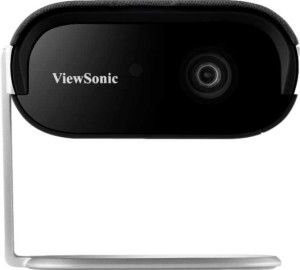
The ViewSonic M1 Max has a compact physical footprint, measuring 141 mm wide, 62 mm tall, and 182 mm deep, with a total volume of 1591.044 cm³ and a weight of 960 g, making it easy to carry between locations. It does not use a laser light source, and its audible noise levels sit at 26 dB under standard operation and 25 dB in eco mode, keeping fan noise relatively unobtrusive during use. A dedicated smartphone app is available for added control convenience, and the unit is backed by a one-year warranty.
The ViewSonic M1 Max outputs at 1080p resolution with a contrast ratio of 120000:1, and can project an image up to 100″ in size with a minimum throw distance of 0.8 m. Zoom adjustment is manual rather than motorized, as the unit does not include powered zoom. On the HDR side, the projector does not support HDR10, HDR10+, Dolby Vision, or HLG, and 3D content with glasses is not supported.
The ViewSonic M1 Max offers a broad set of wireless connectivity options, including Wi-Fi, Bluetooth, AirPlay, Chromecast built-in, and Miracast, covering most common streaming and casting scenarios without additional hardware. For wired connections, it provides one HDMI port and two USB ports, though there is no RJ45 Ethernet port, VGA connector, DVI connector, or S/PDIF audio output. DLNA certification is also absent, so network media sharing through that standard is not available.
The ViewSonic M1 Max includes built-in stereo speakers rated at 2 x 3W along with a 3.5 mm headset jack for wired audio output, though Dolby Atmos is not supported. A remote control is included, and the projector features built-in smart TV functionality, removing the need for a separate streaming device in many setups. Neither vertical nor horizontal lens shift is available, and there is no external memory slot or voice command support.