XFX Mercury Radeon RX 9070 XT OC Magnetic Air Edition specifications and in-depth review

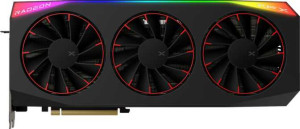
XFX Mercury Radeon RX 9070 XT OC Magnetic Air Edition

Manufacturer: XFX

The XFX Mercury Radeon RX 9070 XT OC Magnetic Air Edition is a graphics card occupying the upper tier of AMD's current consumer lineup, featuring the RDNA 4.0 architecture etched at 4 nm with 53.9 billion transistors. It carries 16GB of GDDR6 memory across a 256-bit bus and includes RGB lighting alongside support for up to four simultaneous displays. The card connects via PCIe 5.0 and ships with a three-year warranty.

On the performance side, the XFX Mercury RX 9070 XT OC reaches a turbo clock of 3100 MHz and delivers 50.79 TFLOPS of floating-point throughput, backed by a pixel rate of 396.8 GPixel/s and a texture rate of 793.6 GTexels/s. Memory bandwidth reaches 640 GB/s at an effective speed of 20000 MHz, while the 4096 shading units are complemented by 256 TMUs and 128 ROPs. The card supports DirectX 12 Ultimate, OpenGL 4.6, ray tracing, AMD FSR4, and AMD SAM, and its display outputs consist of three DisplayPort 2.1 connectors and one HDMI 2.1b port. At a TDP of 304W, the card measures 360 mm in length and 155 mm in height.

Pros
  • The 16GB GDDR6 frame buffer with 640 GB/s of memory bandwidth gives the card substantial headroom for memory-intensive workloads and high-resolution rendering
  • Support for up to four simultaneous displays makes it well-suited for multi-monitor setups
  • Ray tracing support is included alongside AMD FSR4, enabling hardware-accelerated rendering and upscaling within compatible titles
  • ECC memory support adds a layer of data integrity protection that can be valuable in compute-oriented tasks
  • The three-year warranty period provides meaningful long-term coverage for the buyer
  • RGB lighting is present on the board, offering visual customization options
Cons
  • At 304W TDP, the card has a notably high power draw that demands a well-specced power supply and adequate case airflow
  • Its 360 mm length may cause fitment issues in smaller or mid-tower cases
  • Liquid cooling is not supported, so thermal management depends entirely on the air cooler
  • DLSS and XeSS upscaling are not supported, leaving FSR4 as the only upscaling option available
  • There is only one HDMI port, which limits direct connection options for users relying on multiple HDMI displays
Who is this for?

This card is well-matched to users running high-resolution or multi-display gaming and rendering workloads, where the 16GB GDDR6 frame buffer and 640 GB/s of memory bandwidth can be fully utilized. The inclusion of ray tracing, AMD FSR4, and DirectX 12 Ultimate support makes it a capable choice for those working within AMD-compatible gaming ecosystems that leverage these technologies. Its ECC memory support and Double Precision Floating Point capability also make it a reasonable fit for users who occasionally handle compute or precision-sensitive workloads, and the four-display output support suits professionals or enthusiasts who rely on expansive multi-monitor configurations.

Who is this NOT for?

Users building compact or small-form-factor systems may find this card impractical, as its 360 mm length and reliance on air cooling require a spacious case with good airflow and leave no option for liquid cooling integration. Those with high-efficiency builds or modest power supplies will also face challenges, given the 304W TDP demands a robust power delivery setup. Additionally, users invested in DLSS-based upscaling workflows or XeSS-dependent applications will find this card unsuitable, as neither technology is supported — FSR4 is the only upscaling path available.

Performance:

GPU clock speed 1870 MHz
GPU turbo 3100 MHz
pixel rate 396.8 GPixel/s
floating-point performance 50.79 TFLOPS
texture rate 793.6 GTexels/s
GPU memory speed 2518 MHz
shading units 4096
texture mapping units (TMUs) 256
render output units (ROPs) 128
Has Double Precision Floating Point (DPFP)

The Performance section of this card centers on a base GPU clock of 1870 MHz that scales up to a turbo frequency of 3100 MHz, paired with a GPU memory speed of 2518 MHz. Its 4096 shading units work alongside 256 texture mapping units and 128 render output units to deliver a texture rate of 793.6 GTexels/s and a pixel rate of 396.8 GPixel/s. Overall compute throughput reaches 50.79 TFLOPS of floating-point performance, and the card additionally supports Double Precision Floating Point (DPFP), broadening its suitability for workloads that require higher numerical precision.

Memory:

effective memory speed 20000 MHz
maximum memory bandwidth 640 GB/s
VRAM 16GB
GDDR version GDDR6
memory bus width 256-bit
Supports ECC memory

This card is equipped with 16GB of GDDR6 VRAM running across a 256-bit memory bus, reaching an effective memory speed of 20000 MHz and delivering a maximum memory bandwidth of 640 GB/s. ECC memory support is also included, which helps detect and correct memory errors — a useful capability for workloads where data integrity is a priority.

Features:

DirectX version DirectX 12 Ultimate
OpenGL version 4.6
OpenCL version 2.2
Supports multi-display technology
supports ray tracing
Supports 3D
supports DLSS
has FSR4
has XeSS (XMX)
AMD SAM / Intel Resizable BAR AMD SAM
has LHR
has RGB lighting
supported displays 4

On the features side, this card supports DirectX 12 Ultimate, OpenGL 4.6, and OpenCL 2.2, covering a broad range of graphics and compute workloads. Ray tracing, stereoscopic 3D, and multi-display technology are all supported, with up to four displays connectable simultaneously. AMD SAM (Smart Access Memory) is available for compatible platform configurations, and AMD FSR4 is included as the card's upscaling solution — DLSS and XeSS are not supported. The card does not carry LHR restrictions, and RGB lighting is present on the board. It does not support DLSS or XeSS (XMX).

Ports:

has an HDMI output
HDMI ports 1
HDMI version HDMI 2.1b
DisplayPort outputs 3
USB-C ports 0
DVI outputs 0
mini DisplayPort outputs 0

The card's output configuration consists of three DisplayPort outputs and one HDMI 2.1b port, giving a total of four video outputs. There are no USB-C, DVI, or mini DisplayPort connectors on this card.

General info:

GPU architecture RDNA 4.0
Thermal Design Power (TDP) 304W
PCI Express (PCIe) version 5
semiconductor size 4 nm
number of transistors 53900 million
warranty period 3 years
Has air-water cooling
width 360 mm
height 155 mm

This card is built on the RDNA 4.0 architecture, with the GPU manufactured at a 4 nm process node and housing 53,900 million transistors. It connects via PCIe 5.0 and carries a Thermal Design Power of 304W, relying solely on air cooling — liquid cooling is not supported. The card measures 360 mm in width and 155 mm in height, and it comes backed by a three-year warranty.
Final Verdict

The XFX Mercury Radeon RX 9070 XT OC Magnetic Air Edition is a capable graphics card that brings together AMD's RDNA 4.0 architecture, a generous 16GB GDDR6 frame buffer, and a broad feature set including ray tracing, AMD FSR4, and DirectX 12 Ultimate support within a single board. Its 50.79 TFLOPS of floating-point throughput and 640 GB/s of memory bandwidth position it well for demanding rendering and multi-display workloads, while ECC memory support adds practical value for compute-adjacent tasks. That said, its 304W power draw and 360 mm length mean it is best suited to spacious, well-equipped builds, and users dependent on DLSS or XeSS upscaling will need to look elsewhere. For those within an AMD-compatible ecosystem who can accommodate its physical and power requirements, this card represents a technically well-rounded option with solid long-term coverage through its three-year warranty.

Popular Comparisons

XFX Mercury Radeon RX 9070 XT OC Magnetic Air Edition
VS
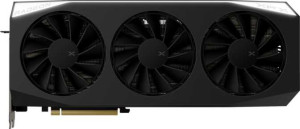
XFX Mercury Radeon RX 9070 XT Gaming Edition