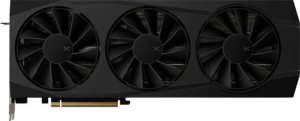
XFX Quicksilver Radeon RX 9070 OC Gaming Edition specifications and in-depth review

XFX Quicksilver Radeon RX 9070 OC Gaming Edition

Manufacturer: XFX

The XFX Quicksilver Radeon RX 9070 OC Gaming Edition is a graphics card designed around AMD's RDNA 4.0 architecture, manufactured on a 5 nm process node and housing 53,900 million transistors. It carries a base GPU clock of 1440 MHz with a turbo frequency reaching up to 2700 MHz, and the card is rated at a TDP of 220W, making thermal management a relevant consideration for system builders.

On the memory side, the card is equipped with 16GB of GDDR6 running across a 256-bit bus at an effective speed of 20,000 MHz, delivering up to 640 GB/s of bandwidth. It supports DirectX 12 Ultimate and OpenGL 4.6, and includes hardware ray tracing alongside AMD FSR4 upscaling. The card offers 3,584 shading units, 224 TMUs, and 128 ROPs, yielding a pixel rate of 345.6 GPixel/s and a texture rate of 604.8 GTexels/s. Display output consists of one HDMI 2.1b port and three DisplayPort outputs, supporting up to four displays simultaneously, and the card connects via PCIe 5.0 and comes with a three-year warranty.

Pros
  • 16GB of GDDR6 VRAM across a 256-bit bus provides a substantial memory pool for demanding workloads
  • Hardware ray tracing support is included out of the box
  • AMD FSR4 upscaling is available, offering an in-house alternative to other upscaling solutions
  • ECC memory support adds a layer of data integrity useful for compute tasks
  • Four simultaneous display outputs are supported through a combination of one HDMI 2.1b and three DisplayPort connections
  • RGB lighting is built in for users who value visual customization of their build
Cons
  • A 220W TDP places a notable power draw demand on the system and PSU
  • No water-cooling or hybrid air-water cooling option is included
  • DLSS and XeSS upscaling are not supported, limiting upscaling choices to AMD FSR4 only
  • The card's length of 355 mm may present fitment challenges in smaller or mid-tower cases
  • No USB-C or DVI outputs are available, which may limit compatibility with certain older or specialized displays
Who is this for?

This card is well-suited to users who work with high-resolution, multi-display setups, given its support for up to four simultaneous outputs and generous 16GB of GDDR6 VRAM. Those running compute-intensive tasks alongside graphics work will appreciate the inclusion of ECC memory support and Double Precision Floating Point capability. Builders who want a feature-complete AMD-based system will also find value in native AMD SAM support, hardware ray tracing, and FSR4 upscaling, all of which integrate well within an AMD-centric platform.

Who is this NOT for?

Users working within compact or small-form-factor cases may find the card's 355 mm length a limiting factor, as fitment in tighter enclosures can be problematic at that size. Those who rely on DLSS or XeSS upscaling — common in NVIDIA or Intel-oriented workflows — will not find support for either technology here. Additionally, systems with a limited power supply headroom may struggle to accommodate the 220W TDP without upgrades, making this card a poor fit for low-wattage or energy-constrained builds.

Performance:

GPU clock speed 1440 MHz
GPU turbo 2700 MHz
pixel rate 345.6 GPixel/s
floating-point performance 38.71 TFLOPS
texture rate 604.8 GTexels/s
GPU memory speed 2518 MHz
shading units 3584
texture mapping units (TMUs) 224
render output units (ROPs) 128
Has Double Precision Floating Point (DPFP)

The XFX Quicksilver Radeon RX 9070 OC Gaming Edition operates at a base GPU clock of 1440 MHz, boosting up to a turbo frequency of 2700 MHz. It is backed by 3,584 shading units, 224 texture mapping units, and 128 render output units, translating into a texture rate of 604.8 GTexels/s and a pixel rate of 345.6 GPixel/s. Overall floating-point performance reaches 38.71 TFLOPS, while the GPU memory runs at 2518 MHz. The card also supports Double Precision Floating Point (DPFP), broadening its suitability for compute-oriented workloads alongside standard graphics tasks.

Memory:

effective memory speed 20000 MHz
maximum memory bandwidth 640 GB/s
VRAM 16GB
GDDR version GDDR6
memory bus width 256-bit
Supports ECC memory

The card comes equipped with 16GB of GDDR6 VRAM running across a 256-bit memory bus, reaching an effective memory speed of 20,000 MHz and delivering a maximum memory bandwidth of 640 GB/s. ECC memory support is also included, which helps detect and correct memory errors — a useful capability for workloads where data integrity is a priority.

Features:

DirectX version DirectX 12 Ultimate
OpenGL version 4.6
OpenCL version 2.2
Supports multi-display technology
supports ray tracing
Supports 3D
supports DLSS
has FSR4
has XeSS (XMX)
AMD SAM / Intel Resizable BAR AMD SAM
has LHR
has RGB lighting
supported displays 4

This card supports DirectX 12 Ultimate, OpenGL 4.6, and OpenCL 2.2, covering a broad range of graphics and compute workloads. Hardware ray tracing is included, as is AMD FSR4 for upscaling, though DLSS and XeSS (XMX) are not supported. Multi-display technology is present with support for up to four simultaneous displays, and stereoscopic 3D is also available. AMD SAM (Smart Access Memory) is supported, while LHR (Lite Hash Rate) is not present on this model. The card additionally features RGB lighting and does not carry any hash rate limitation.

Ports:

has an HDMI output
HDMI ports 1
HDMI version HDMI 2.1b
DisplayPort outputs 3
USB-C ports 0
DVI outputs 0
mini DisplayPort outputs 0

The card's output configuration consists of one HDMI 2.1b port and three DisplayPort outputs, offering a total of four display connections. There are no USB-C, DVI, or mini DisplayPort outputs present on this model.

General info:

GPU architecture RDNA 4.0
Thermal Design Power (TDP) 220W
PCI Express (PCIe) version 5
semiconductor size 5 nm
number of transistors 53900 million
warranty period 3 years
Has air-water cooling
width 355 mm
height 140 mm

Built on the RDNA 4.0 architecture and fabricated using a 5 nm process, this card integrates 53,900 million transistors and connects to the system via PCIe 5.0. It carries a Thermal Design Power of 220W and relies on air cooling, with no water-cooling option included. The card measures 355 mm in width and 140 mm in height, and it does not feature an air-water hybrid cooling solution. A 3-year warranty is provided with the product.

Final Verdict

The XFX Quicksilver Radeon RX 9070 OC Gaming Edition presents a well-rounded specification set built around AMD's RDNA 4.0 architecture, combining a strong compute throughput of 38.71 TFLOPS with a 16GB GDDR6 memory configuration that should serve demanding workloads comfortably across both graphics and compute scenarios. Features like hardware ray tracing, FSR4 upscaling, ECC memory support, and four-display output capability give the card a broad functional scope within an AMD-native environment. Its 220W TDP and 355 mm length do place real demands on system compatibility, so careful consideration of case dimensions and power delivery remains important before committing. Overall, this card is a capable option for users building or expanding an AMD-based workstation or gaming system who prioritize memory capacity, multi-display flexibility, and compute versatility.

Popular Comparisons

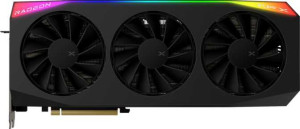
XFX Quicksilver Radeon RX 9070 OC Gaming Edition
VS
XFX Mercury Radeon RX 9070 XT OC Gaming Edition