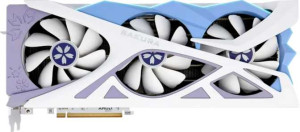
Yeston Sakura Radeon RX 9070 XT specifications and in-depth review

Yeston Sakura Radeon RX 9070 XT

Manufacturer: Yeston

The Yeston Sakura Radeon RX 9070 XT is a graphics card from Yeston based on AMD's RDNA 4.0 architecture, fabricated on a 4 nm process with 53,900 million transistors. It operates with a base GPU clock of 1660 MHz and reaches a turbo frequency of 3060 MHz, delivering 50.14 TFLOPS of floating-point performance alongside a pixel rate of 391.7 GPixel/s and a texture rate of 783.4 GTexels/s.

The card is equipped with 16GB of GDDR6 memory across a 256-bit bus, offering an effective memory speed of 20,000 MHz and a maximum bandwidth of 644.6 GB/s, with ECC support included. It carries 4096 shading units, 256 TMUs, and 128 ROPs, and supports DirectX 12, OpenGL 4.6, OpenCL 2.2, ray tracing, FSR4, and AMD SAM. Connectivity includes one HDMI 2.1b port and three DisplayPort outputs for up to four simultaneous displays, while the card has a rated TDP of 304W and measures 330 mm in length by 136 mm in height.

Pros
  • The 16GB GDDR6 frame buffer running across a 256-bit bus with 644.6 GB/s of bandwidth provides substantial headroom for memory-intensive workloads
  • Hardware ray tracing support adds real-time lighting and shadow accuracy to compatible titles and applications
  • FSR4 upscaling support allows the card to render at lower resolutions and reconstruct higher-resolution output, helping maintain smoother frame delivery
  • Support for up to four simultaneous displays makes it well-suited for multi-monitor setups
  • ECC memory support adds a layer of data integrity protection useful in compute or professional tasks
  • The 4 nm fabrication process with 53,900 million transistors reflects a modern, dense silicon design that fits substantial compute capability into the chip
Cons
  • A 304W TDP places meaningful demands on system power delivery and case airflow, requiring a suitably rated PSU and chassis
  • The card does not support DLSS or XeSS, limiting AI-based upscaling to FSR4 only
  • No USB-C output is available, which may be a limitation for users with USB-C monitors or VR headsets
  • Air cooling is the only thermal solution — there is no water-cooling option for users seeking quieter or more aggressive thermal management
  • At 330 mm in length, physical fitment may be a concern in smaller or mid-tower cases
Who is this for?

This card is well-suited for users running demanding rendering and compute workloads that benefit from 16GB of GDDR6 memory with 644.6 GB/s of bandwidth and ECC support, such as 3D content creation or GPU-accelerated processing. The combination of hardware ray tracing, FSR4 upscaling, and a high boost clock also makes it a strong fit for users engaged in high-resolution gaming at 1440p or 4K where visual fidelity and frame reconstruction are priorities. Additionally, those building multi-display workstations will appreciate native support for up to four simultaneous outputs via three DisplayPort and one HDMI 2.1b connector.

Who is this NOT for?

Users with compact or small-form-factor builds may find the 330 mm card length difficult to accommodate, and the 304W TDP demands a well-ventilated case with a capable power supply, making it a poor fit for constrained or low-power system configurations. Those who rely on DLSS or XeSS upscaling — common in certain game engines and productivity tools — will find neither supported here, as only FSR4 is available. The absence of a USB-C video output also makes this card less suitable for users with USB-C or Thunderbolt-based display setups or compatible VR hardware that depends on that connection type.

Performance:

GPU clock speed 1660 MHz
GPU turbo 3060 MHz
pixel rate 391.7 GPixel/s
floating-point performance 50.14 TFLOPS
texture rate 783.4 GTexels/s
GPU memory speed 2518 MHz
shading units 4096
texture mapping units (TMUs) 256
render output units (ROPs) 128
Has Double Precision Floating Point (DPFP)

The Performance section of the Yeston Sakura Radeon RX 9070 XT centers on a base GPU clock of 1660 MHz that boosts up to 3060 MHz under load, supported by 4096 shading units, 256 texture mapping units, and 128 render output units. These figures translate into a texture rate of 783.4 GTexels/s and a pixel rate of 391.7 GPixel/s, while overall compute throughput reaches 50.14 TFLOPS of floating-point performance. The GPU memory runs at 2518 MHz, and the card also supports Double Precision Floating Point (DPFP), extending its utility to workloads that depend on higher numerical precision.

Memory:

effective memory speed 20000 MHz
maximum memory bandwidth 644.6 GB/s
VRAM 16GB
GDDR version GDDR6
memory bus width 256-bit
Supports ECC memory

The Yeston Sakura Radeon RX 9070 XT is equipped with 16GB of GDDR6 VRAM running across a 256-bit memory bus, reaching an effective memory speed of 20,000 MHz and delivering a maximum memory bandwidth of 644.6 GB/s. The card also supports ECC memory, which helps detect and correct data errors during operation, making it suitable for tasks where memory accuracy is a consideration.

Features:

DirectX version DirectX 12
OpenGL version 4.6
OpenCL version 2.2
Supports multi-display technology
supports ray tracing
Supports 3D
supports DLSS
has FSR4
has XeSS (XMX)
AMD SAM / Intel Resizable BAR AMD SAM
has LHR
has RGB lighting
supported displays 4

The Yeston Sakura Radeon RX 9070 XT supports DirectX 12, OpenGL 4.6, and OpenCL 2.2, covering a broad range of rendering and compute workloads. It includes hardware ray tracing, stereoscopic 3D, and AMD FSR4 for upscaling, while DLSS and XeSS (XMX) are not supported. The card supports up to four simultaneous displays through its multi-display technology and uses AMD SAM (Smart Access Memory) for CPU-to-GPU memory access optimization. LHR restrictions are absent, and the card does not feature RGB lighting.

Ports:

has an HDMI output
HDMI ports 1
HDMI version HDMI 2.1b
DisplayPort outputs 3
USB-C ports 0
DVI outputs 0
mini DisplayPort outputs 0

The Yeston Sakura Radeon RX 9070 XT offers a total of four video outputs, consisting of three DisplayPort connectors and one HDMI 2.1b port. There are no USB-C, DVI, or mini DisplayPort outputs on this card.

General info:

GPU architecture RDNA 4.0
Thermal Design Power (TDP) 304W
PCI Express (PCIe) version 5
semiconductor size 4 nm
number of transistors 53900 million
Has air-water cooling
width 330 mm
height 136 mm

The Yeston Sakura Radeon RX 9070 XT is built on the RDNA 4.0 architecture, using a 4 nm manufacturing process that integrates 53,900 million transistors. It connects via PCIe 5 and carries a rated TDP of 304W, relying solely on air cooling without a water-cooling option. The card measures 330 mm in width and 136 mm in height, giving a clear picture of the physical space it requires in a system.

Final Verdict

The Yeston Sakura Radeon RX 9070 XT is a capable graphics card built around AMD's RDNA 4.0 architecture, bringing together a strong set of specifications that point clearly toward high-resolution gaming and GPU-accelerated work. Its 16GB GDDR6 memory with 644.6 GB/s of bandwidth, combined with hardware ray tracing, FSR4 upscaling, and ECC support, gives it a well-rounded technical foundation for users who push their systems hard. That said, its 304W power draw, 330 mm length, and absence of DLSS or XeSS mean it asks something of the system it goes into and the software ecosystem around it. For builders who can meet those requirements, it delivers a focused, modern feature set that holds up well for demanding display and compute scenarios.

Popular Comparisons

Yeston Sakura Radeon RX 9070 XT
VS
ASRock Radeon RX 7700 XT Steel Legend OC
Yeston Sakura Radeon RX 9070 XT
VS
Nvidia GeForce RTX 5090 Laptop