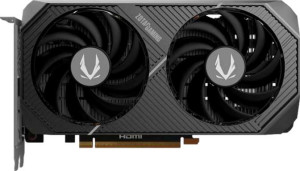
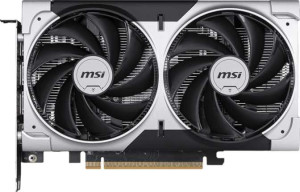
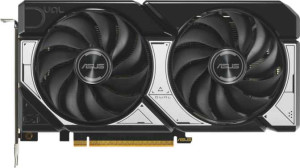
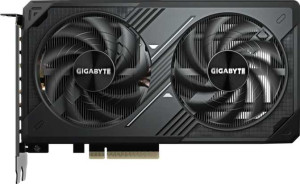
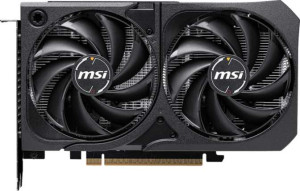
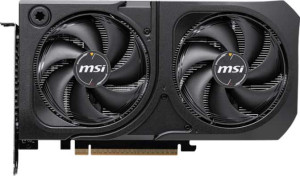
The RTX 5060 Twin Edge OC runs at a base clock of 2,280 MHz, with a boost clock reaching 2,527 MHz under load. Its 3,840 shading units are supported by 120 texture mapping units and 48 render output units, producing a texture rate of 303.2 GTexels/s and a pixel rate of 121.3 GPixel/s. Floating-point performance sits at 19.41 TFLOPS, while GPU memory operates at 1,750 MHz. The card also supports Double Precision Floating Point (DPFP), adding versatility for workloads that benefit from higher numerical precision.
The card is equipped with 8GB of GDDR7 VRAM running at an effective speed of 28,000 MHz across a 128-bit memory bus, yielding a maximum memory bandwidth of 448 GB/s. ECC memory support is also included, which helps maintain data integrity in workloads where memory error correction is relevant.
The RTX 5060 Twin Edge OC supports DirectX 12 Ultimate, OpenGL 4.6, and OpenCL 3, covering a broad range of graphics and compute workloads. Ray tracing and DLSS are both supported, along with stereoscopic 3D and multi-display technology spanning up to four screens simultaneously. Intel Resizable BAR is included, while XeSS (XMX) and LHR are not present on this card. There is no RGB lighting, and Lite Hash Rate limiting is absent.
The card's output configuration consists of one HDMI 2.1b port and three DisplayPort outputs, providing a total of four display connections. There are no USB-C, DVI, or mini DisplayPort outputs on this model.
Built on the Blackwell architecture, this card is manufactured using a 5 nm process and integrates 21,900 million transistors. It connects via PCIe 5 and carries a Thermal Design Power of 145W. The card measures 220.5 mm in width and 120.25 mm in height, and relies solely on air cooling, as water cooling is not supported.