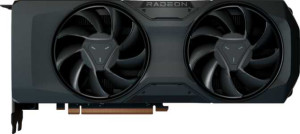
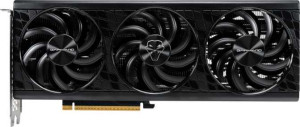
The AMD Radeon AI Pro R9700 operates at a base GPU clock of 1660 MHz, boosting up to 2920 MHz in turbo mode, while the GPU memory runs at 2518 MHz. Its shader configuration consists of 4096 shading units paired with 256 texture mapping units and 128 render output units, producing a texture rate of 747.5 GTexels/s and a pixel rate of 373.76 GPixels/s. At the top level, the card delivers 47.8 TFLOPS of floating-point performance and includes support for Double Precision Floating Point (DPFP), making it capable of handling workloads that demand high numerical precision.
The AMD Radeon AI Pro R9700 features 32GB of GDDR6 VRAM running across a 256-bit memory bus, with an effective memory speed of 20,100 MHz and a maximum memory bandwidth of 640 GB/s. ECC memory support is included, adding a layer of data integrity suited to workloads where memory error correction is a requirement.
The AMD Radeon AI Pro R9700 supports DirectX 12 Ultimate, OpenGL 4.6, and OpenCL 2.2, covering a broad range of graphics and compute API requirements. Ray tracing, stereoscopic 3D, and multi-display output across up to four screens are all supported, and AMD FSR4 is available for upscaling. The card uses AMD SAM for CPU-GPU memory access and does not include LHR, XeSS (XMX), or RGB lighting.
The AMD Radeon AI Pro R9700 provides four full-size DisplayPort outputs as its sole display connectivity option, with no HDMI, DVI, mini DisplayPort, or USB-C ports present on the card.
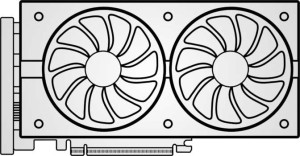
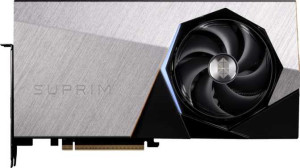
The AMD Radeon AI Pro R9700 is built on the RDNA 4.0 architecture, fabbed at 4nm with 53,900 million transistors, and connects via PCIe 5. It carries a TDP of 300W and does not include air-water cooling. The card measures 267mm in width and 111mm in height, and its physical dimensions reflect a dual-slot, standard-length design profile.