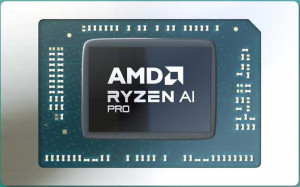
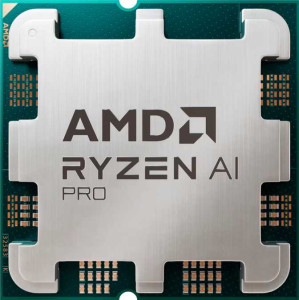
AMD Ryzen AI 5 340 specifications and in-depth review

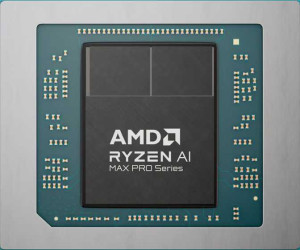
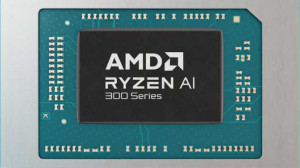
AMD Ryzen AI 5 340

Manufacturer: AMD

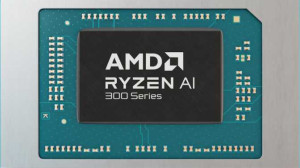
The AMD Ryzen AI 5 340 is a mid-range processor designed for both laptop and desktop platforms, built on a compact 4 nm semiconductor process. It employs big.LITTLE technology to balance workload distribution across its six cores, and its 12-thread configuration allows it to handle moderately demanding multitasking scenarios with reasonable efficiency. The chip operates within a 28W thermal design power envelope, making it a practical fit for thin-and-light portable systems as well as compact desktop builds.

On the performance side, the Ryzen AI 5 340 reaches a turbo clock speed of 4.8 GHz, supported by 6 MB of L2 cache and 16 MB of L3 cache. It recorded a PassMark score of 20,210 and a Geekbench 6 multi-core result of 8,951. The integrated Radeon 840M graphics support up to four displays simultaneously, reach a GPU turbo of 2,900 MHz, and are compatible with DirectX 12 Ultimate. Memory support extends to DDR5 at up to 8,000 MHz across two channels, with a maximum addressable capacity of 256 GB. The processor also includes a broad set of instruction sets such as AVX2, AES, FMA3, and SSE 4.2, and connects via PCIe 4.0.

Pros
  • Supports both laptop and desktop platforms, offering flexibility across different form factors
  • DDR5 memory support with speeds up to 8,000 MHz and a maximum capacity of 256 GB provides substantial memory bandwidth and headroom
  • The integrated Radeon 840M GPU can drive up to four displays simultaneously without requiring a discrete graphics card
  • big.LITTLE core architecture allows the processor to distribute workloads across cores with different roles, aiding efficiency
  • A broad set of instruction sets including AVX2, AES, and FMA3 enables compatibility with a wide range of software workloads
  • The 28W TDP makes it suitable for thermally constrained systems such as thin-and-light laptops
Cons
  • The multiplier is locked, removing any possibility of manual clock speed adjustments beyond factory settings
  • ECC memory is not supported, limiting its suitability for error-sensitive or mission-critical computing environments
  • Base clock speeds of 2 GHz across all six cores are relatively low, with performance depending heavily on sustained turbo behavior
  • Single-core Geekbench 6 score of 2,280 reflects modest per-core throughput for single-threaded workloads
Who is this for?

This processor is a solid fit for users building or buying thin-and-light laptops or compact desktop systems where thermal constraints are a real consideration, given its 28W TDP. The integrated Radeon 840M with support for up to four simultaneous displays makes it well-suited for multi-monitor productivity setups that do not require discrete graphics. Additionally, its DDR5 memory support at up to 8,000 MHz and a 256 GB capacity ceiling appeals to users running memory-intensive productivity or creative workloads who still want a power-efficient platform.

Who is this NOT for?

Users who rely on heavily single-threaded applications may find the processor's single-core throughput limiting, as reflected in its modest single-core benchmark scores. The locked multiplier makes it a poor fit for enthusiast or overclocking builds where fine-grained clock speed control is expected. Similarly, those working in environments that demand ECC memory for data integrity — such as certain server, scientific computing, or financial workloads — will need to look elsewhere, as ECC support is absent.

General info:

Type Laptop, Desktop
Has integrated graphics
Thermal Design Power (TDP) 28W
semiconductor size 4 nm
CPU temperature 100 °C
PCI Express (PCIe) version 4
Supports 64-bit

The AMD Ryzen AI 5 340 is designed for both laptop and desktop use, built on a 4 nm semiconductor process that contributes to its relatively modest 28W thermal design power. It includes integrated graphics and fully supports 64-bit computing. The processor connects via PCIe 4.0 and is rated to handle a maximum operating temperature of 100 °C, reflecting its thermal headroom under sustained workloads.

Performance:

CPU speed 3 x 2 & 3 x 2 GHz
CPU threads 12 threads
turbo clock speed 4.8GHz
Has an unlocked multiplier
L2 cache 6 MB
L3 cache 16 MB
Uses big.LITTLE technology
clock multiplier 20

The Ryzen AI 5 340 features a six-core configuration using big.LITTLE technology, pairing two groups of three cores each running at 2 GHz base, with a turbo clock speed reaching up to 4.8 GHz and a clock multiplier of 20. Across its 12 threads, the chip is equipped to manage moderately parallel workloads, backed by 6 MB of L2 cache and 16 MB of L3 cache for responsive data access. The processor does not include an unlocked multiplier, meaning clock speeds cannot be manually adjusted beyond factory-defined limits.

Benchmarks:

PassMark result 20210
PassMark result (single) 3882
Geekbench 6 result (multi) 8951
Geekbench 6 result (single) 2280
PassMark result (overclocked) 22769

In benchmark testing, the Ryzen AI 5 340 achieved a PassMark multi-core score of 20,210, with a single-core result of 3,882. Under overclocked conditions, the PassMark score rises to 22,769, reflecting additional headroom in sustained performance. On Geekbench 6, the processor recorded a multi-core score of 8,951 and a single-core score of 2,280, rounding out a consistent picture of its measured performance across multiple testing platforms.

Integrated graphics:

GPU name Radeon 840M
GPU turbo 2900 MHz
DirectX version DirectX 12 Ultimate
supported displays 4

The Ryzen AI 5 340 includes an integrated Radeon 840M GPU, capable of reaching a turbo frequency of 2,900 MHz. It supports up to four simultaneous displays, making it a practical option for multi-monitor setups without a discrete graphics card. The GPU is compatible with DirectX 12 Ultimate, enabling access to modern graphics features within that API standard.

Memory:

RAM speed (max) 8000 MHz
DDR memory version 5
memory channels 2
maximum memory amount 256GB
Supports ECC memory

The Ryzen AI 5 340 supports DDR5 memory across two channels, with a maximum RAM speed of 8,000 MHz. It can address up to 256 GB of system memory, providing substantial headroom for memory-intensive workloads. ECC memory is not supported, which is a consideration for applications that require error-correcting capabilities.

Features:

instruction sets MMX, F16C, FMA3, AES, AVX, AVX2, SSE 4.1, SSE 4.2
uses multithreading
Has NX bit

The Ryzen AI 5 340 supports multithreading and includes the NX bit for hardware-level memory protection. It is compatible with a broad range of instruction sets, including MMX, F16C, FMA3, AES, AVX, AVX2, SSE 4.1, and SSE 4.2, covering everything from legacy multimedia extensions to AVX2-accelerated floating-point and cryptographic operations.
Final Verdict

The AMD Ryzen AI 5 340 presents a well-rounded specification set for users seeking an efficient, versatile processor across laptop and desktop form factors. Its DDR5 memory support paired with the integrated Radeon 840M GPU makes it a practical choice for productivity-focused builds that demand multi-display capability without the addition of discrete graphics. While its locked multiplier and modest single-core output place clear boundaries on its appeal to performance enthusiasts, the chip's thermal efficiency, broad instruction set compatibility, and generous memory ceiling give it a coherent and credible position in the mainstream computing segment. For users prioritizing platform flexibility and power efficiency over raw peak performance, the Ryzen AI 5 340 delivers a balanced and purposeful package.

Popular Comparisons

AMD Ryzen AI 5 340
AMD Ryzen AI 5 340
VS
AMD Ryzen 5 Pro 230
AMD Ryzen 5 Pro 230
AMD Ryzen AI 5 340
AMD Ryzen AI 5 340
VS
AMD Ryzen 5 220
AMD Ryzen 5 220
AMD Ryzen AI 5 340
AMD Ryzen AI 5 340
VS
AMD Ryzen 5 230
AMD Ryzen 5 230
AMD Ryzen AI 5 340
AMD Ryzen AI 5 340
VS
AMD Ryzen 5 240
AMD Ryzen 5 240
AMD Ryzen AI 5 340
AMD Ryzen AI 5 340
VS
AMD Ryzen 5 Pro 8540U
AMD Ryzen AI 5 340
AMD Ryzen AI 5 340
VS
AMD Ryzen 7 Pro 8840U
AMD Ryzen AI 5 340
AMD Ryzen AI 5 340
VS
AMD Ryzen 5 8640U
AMD Ryzen 5 8640U
AMD Ryzen AI 5 340
AMD Ryzen AI 5 340
VS
AMD Ryzen 5 8640HS
AMD Ryzen 5 8640HS
AMD Ryzen AI 5 340
AMD Ryzen AI 5 340
VS
AMD Ryzen 5 Pro 8600G
AMD Ryzen AI 5 340
AMD Ryzen AI 5 340
VS
AMD Ryzen AI 5 330
AMD Ryzen AI 5 330
AMD Ryzen AI 5 340
AMD Ryzen AI 5 340
VS
AMD Ryzen 7 7435H
AMD Ryzen 7 7435H
AMD Ryzen AI 5 340
AMD Ryzen AI 5 340
VS
AMD Ryzen AI 7 350
AMD Ryzen AI 7 350
AMD Ryzen AI 5 340
AMD Ryzen AI 5 340
VS
Intel Core Ultra 5 226V
AMD Ryzen AI 5 340
AMD Ryzen AI 5 340
VS
Intel Core Ultra 5 225H
AMD Ryzen AI 5 340
AMD Ryzen AI 5 340
VS
Intel Core Ultra 5 125H
AMD Ryzen AI 5 340
AMD Ryzen AI 5 340
VS
Intel Core 5 120U
Intel Core 5 120U
AMD Ryzen AI 5 340
AMD Ryzen AI 5 340
VS
Intel Core Ultra 7 155H
AMD Ryzen AI 5 340
AMD Ryzen AI 5 340
VS
AMD Ryzen AI Max Plus Pro 395
AMD Ryzen AI 5 340
AMD Ryzen AI 5 340
VS
Intel Core Ultra 7 256V
AMD Ryzen AI 5 340
AMD Ryzen AI 5 340
VS
Intel Core Ultra 7 266V
AMD Ryzen AI 5 340
AMD Ryzen AI 5 340
VS
Intel Core Ultra 7 165UL
AMD Ryzen AI 5 340
AMD Ryzen AI 5 340
VS
Intel Core Ultra 5 225U
AMD Ryzen AI 5 340
AMD Ryzen AI 5 340
VS
Intel Core Ultra 5 235U
AMD Ryzen AI 5 340
AMD Ryzen AI 5 340
VS
Intel Core Ultra 5 236V
AMD Ryzen AI 5 340
AMD Ryzen AI 5 340
VS
Intel Core Ultra 5 238V
AMD Ryzen AI 5 340
AMD Ryzen AI 5 340
VS
Intel Core Ultra 5 125HL