Asus Dual GeForce RTX 5050 specifications and in-depth review

Asus Dual GeForce RTX 5050

Manufacturer: Asus

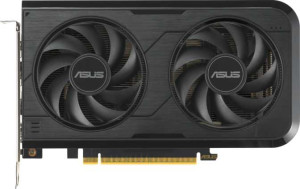
The Asus Dual GeForce RTX 5050 is a mid-range graphics card from Asus based on NVIDIA's Blackwell architecture, fabricated on a 5nm process with 16,900 million transistors. It carries a thermal design power of 130W and connects via PCIe 5.0, making it suited for compact and standard desktop builds alike. The card measures 203mm in length and 120.2mm in height, fitting a dual-slot form factor without RGB lighting.

On the memory side, the RTX 5050 is equipped with 8GB of GDDR6 VRAM across a 128-bit bus, delivering an effective memory speed of 20,000 MHz and a maximum bandwidth of 320 GB/s. The GPU runs at a base clock of 2,317 MHz with a boost up to 2,602 MHz, producing 13.32 TFLOPS of floating-point throughput, a pixel rate of 83.26 GPixel/s, and a texture rate of 208.2 GTexels/s across 2,560 shading units and 80 TMUs. Feature support includes ray tracing, DLSS, and DirectX 12 Ultimate, along with OpenGL 4.6 and OpenCL 3. For display output, the card provides one HDMI 2.1b port and three DisplayPort outputs, supporting up to four displays simultaneously.

Pros
  • Supports ray tracing and DLSS, enabling hardware-accelerated visual effects and AI-driven upscaling in compatible applications
  • Can drive up to four displays simultaneously through a combination of one HDMI 2.1b and three DisplayPort outputs
  • ECC memory support adds a layer of data integrity for workloads where memory accuracy is important
  • Intel Resizable BAR is supported, allowing the CPU to access the full GPU frame buffer for potentially smoother data throughput
  • Built on a 5nm process with 16,900 million transistors, reflecting a dense and modern silicon design
  • Compact dimensions of 203mm by 120.2mm make it compatible with smaller desktop chassis
Cons
  • The 128-bit memory bus width is narrow for a card with 8GB of VRAM, which can limit memory throughput in bandwidth-intensive scenarios
  • No USB-C display output is available, limiting compatibility with newer monitors and displays that rely on that connection
  • Does not support water cooling, restricting thermal management options to air cooling only
  • Floating-point performance of 13.32 TFLOPS and 32 ROPs may become a bottleneck in demanding or high-resolution rendering workloads
  • No RGB lighting, which may be a drawback for users building systems with coordinated aesthetic setups
Who is this for?

This card is well-suited for users who want to run ray tracing and DLSS-enabled titles at moderate resolutions without requiring a high-end power setup, given its 130W TDP and compact 203mm form factor. It also fits well in systems where multi-display productivity is a priority, with support for up to four simultaneous outputs via HDMI 2.1b and DisplayPort. Additionally, users engaged in compute or data-sensitive workloads will benefit from the ECC memory support and Double Precision Floating Point capability, making it a reasonable fit for light professional and mixed-use desktop builds.

Who is this NOT for?

Users targeting high-resolution or graphically demanding workloads — such as 4K gaming or complex 3D rendering — may find the 128-bit memory bus and 32 ROPs limiting, as these constrain the card's ability to sustain high throughput under heavy loads. The absence of USB-C display output makes it a poor match for users relying on modern monitors or laptops that depend on that connection. Those looking to build a thermally optimized or custom-cooled system will also find this card restrictive, as it supports air cooling only with no provision for water-cooling solutions.

Performance:

GPU clock speed 2317 MHz
GPU turbo 2602 MHz
pixel rate 83.26 GPixel/s
floating-point performance 13.32 TFLOPS
texture rate 208.2 GTexels/s
GPU memory speed 1750 MHz
shading units 2560
texture mapping units (TMUs) 80
render output units (ROPs) 32
Has Double Precision Floating Point (DPFP)

The Asus Dual GeForce RTX 5050 runs at a base GPU clock of 2,317 MHz, boosting up to 2,602 MHz under load, while delivering 13.32 TFLOPS of floating-point performance alongside a texture rate of 208.2 GTexels/s and a pixel rate of 83.26 GPixel/s. Its shader configuration comprises 2,560 shading units, 80 texture mapping units, and 32 render output units, with GPU memory operating at 1,750 MHz. The card also supports Double Precision Floating Point (DPFP), broadening its suitability for compute workloads alongside standard graphics tasks.

Memory:

effective memory speed 20000 MHz
maximum memory bandwidth 320 GB/s
VRAM 8GB
GDDR version GDDR6
memory bus width 128-bit
Supports ECC memory

The Asus Dual GeForce RTX 5050 is equipped with 8GB of GDDR6 VRAM running across a 128-bit memory bus, reaching an effective memory speed of 20,000 MHz and a maximum memory bandwidth of 320 GB/s. The card also supports ECC memory, which helps detect and correct data errors during operation — a useful trait for workloads where memory reliability matters.

Features:

DirectX version DirectX 12 Ultimate
OpenGL version 4.6
OpenCL version 3
Supports multi-display technology
supports ray tracing
Supports 3D
supports DLSS
has XeSS (XMX)
AMD SAM / Intel Resizable BAR Intel Resizable BAR
has LHR
has RGB lighting
supported displays 4

The Asus Dual GeForce RTX 5050 supports DirectX 12 Ultimate, OpenGL 4.6, and OpenCL 3, covering a broad range of graphics and compute workloads. It includes ray tracing and DLSS, along with stereoscopic 3D and multi-display technology for up to four simultaneous outputs. Intel Resizable BAR is supported to allow the CPU broader access to GPU memory, though the card does not include XeSS (XMX), LHR, or RGB lighting.

Ports:

has an HDMI output
HDMI ports 1
HDMI version HDMI 2.1b
DisplayPort outputs 3
USB-C ports 0
DVI outputs 0
mini DisplayPort outputs 0

The Asus Dual GeForce RTX 5050 offers a total of four display outputs, consisting of one HDMI 2.1b port and three DisplayPort outputs. There are no USB-C, DVI, or mini DisplayPort connections on this card, keeping the output configuration straightforward and focused on the two most widely used modern display interfaces.

General info:

GPU architecture Blackwell
Thermal Design Power (TDP) 130W
PCI Express (PCIe) version 5
semiconductor size 5 nm
number of transistors 16900 million
Has air-water cooling
width 203 mm
height 120.2 mm

The Asus Dual GeForce RTX 5050 is built on the Blackwell architecture, manufactured using a 5nm process with 16,900 million transistors, and connects to the motherboard via PCIe 5.0. It carries a thermal design power of 130W and relies on air cooling, with no water-cooling support. The card measures 203mm in width and 120.2mm in height, placing it in a compact form factor suitable for a range of desktop system builds.
Final Verdict

The Asus Dual GeForce RTX 5050 is a compact, energy-efficient graphics card built on NVIDIA's Blackwell architecture that covers the essentials for moderate gaming and light professional use. Its support for ray tracing, DLSS, and DirectX 12 Ultimate, combined with a sensible 130W power envelope and a four-display output configuration, makes it a practical choice for users who need a capable, space-conscious card without the demands of a high-end system. Where it falls short — particularly around memory bus width and rendering throughput — it signals a card designed for measured workloads rather than pushing resolution or graphical complexity to its limits. For users whose needs align with that scope, the RTX 5050 Dual delivers a well-rounded and feature-complete package.

Popular Comparisons

Asus Dual GeForce RTX 5050
VS
MSI GeForce RTX 5050 Gaming OC
Asus Dual GeForce RTX 5050
VS
Nvidia GeForce RTX 4060
Asus Dual GeForce RTX 5050
VS
MSI GeForce RTX 5060 Ventus 2X
Asus Dual GeForce RTX 5050
VS
XFX Speedster SWFT 210 Radeon RX 7600 XT
Asus Dual GeForce RTX 5050
VS
AX Gaming GeForce RTX 5060 X2W OC