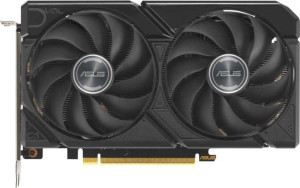
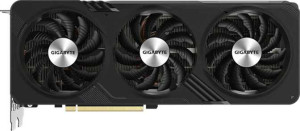
Asus GeForce RTX 5060 LP BRK OC Edition specifications and in-depth review

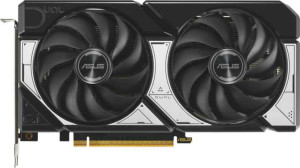
Asus GeForce RTX 5060 LP BRK OC Edition

Manufacturer: Asus

The Asus GeForce RTX 5060 LP BRK OC Edition is a compact graphics card designed around Nvidia's Blackwell architecture, manufactured on a 5 nm process with 21,900 million transistors. Its low-profile form factor — measuring just 175.8 mm wide and 69 mm tall — makes it well suited for small form factor builds where physical space is a constraint. The card ships with a factory overclock, pushing the GPU boost clock to 2550 MHz from a base of 2280 MHz, while maintaining a 145W TDP.

On the memory side, the card carries 8GB of GDDR7 VRAM across a 128-bit bus, reaching an effective speed of 28,000 MHz and a peak bandwidth of 448 GB/s. Its 3,840 shading units, 120 texture mapping units, and 48 ROPs contribute to a texture rate of 306 GTexels/s and floating-point performance of 19.58 TFLOPS. Feature support includes DirectX 12 Ultimate, OpenGL 4.6, ray tracing, DLSS, and Intel Resizable BAR, alongside connectivity through two HDMI 2.1 ports and one DisplayPort output, with support for up to four simultaneous displays.

Pros
  • The low-profile dimensions of 175.8 mm x 69 mm make it compatible with compact and small form factor cases where full-size cards cannot fit
  • GDDR7 memory with an effective speed of 28,000 MHz and 448 GB/s bandwidth offers strong throughput for the 128-bit bus width
  • Support for ray tracing and DLSS broadens its capability for modern rendering workloads
  • ECC memory support adds a layer of data integrity useful for workloads sensitive to memory errors
  • Up to four simultaneous displays can be driven, with two HDMI 2.1 ports and one DisplayPort output available
  • Intel Resizable BAR support allows the CPU to access the full GPU memory pool, which can improve frame delivery in compatible systems
Cons
  • The 128-bit memory bus width limits memory bandwidth scaling compared to wider bus configurations
  • Only 8GB of VRAM may prove restrictive for memory-intensive workloads at higher resolutions
  • No USB-C output is available, limiting connectivity options for certain modern monitors and displays
  • Air-water cooling is not supported, restricting thermal management to whatever air cooling solution ships with the card
  • The single DisplayPort output offers limited flexibility for users who prefer or require multiple DisplayPort connections
Who is this for?

This card is a practical fit for users building or upgrading small form factor or compact desktop systems, where its low-profile dimensions make it one of the few viable discrete GPU options. Its support for ray tracing, DLSS, and DirectX 12 Ultimate makes it a reasonable choice for light to moderate gaming workloads at 1080p or entry-level 1440p. The inclusion of ECC memory and Double Precision Floating Point support also makes it relevant for users running compute or data-integrity-sensitive tasks within a constrained chassis.

Who is this NOT for?

Users targeting demanding workloads at high resolutions — such as 4K gaming or heavy creative rendering — are likely to find the 8GB VRAM ceiling and 128-bit memory bus insufficient for sustained performance at those settings. The card is also a poor match for those requiring extensive multi-monitor DisplayPort setups, given that only a single DisplayPort output is available. Additionally, users who need robust thermal headroom for sustained loads may find the card limiting, as it does not support air-water or liquid cooling configurations, leaving thermal management entirely dependent on the included air cooler.

Performance:

GPU clock speed 2280 MHz
GPU turbo 2550 MHz
pixel rate 122.4 GPixel/s
floating-point performance 19.58 TFLOPS
texture rate 306 GTexels/s
GPU memory speed 1750 MHz
shading units 3840
texture mapping units (TMUs) 120
render output units (ROPs) 48
Has Double Precision Floating Point (DPFP)

The card operates at a base GPU clock of 2280 MHz, rising to 2550 MHz in boost mode, while the GPU memory runs at 1750 MHz. With 3,840 shading units, 120 texture mapping units, and 48 render output units, it delivers a texture rate of 306 GTexels/s and a pixel rate of 122.4 GPixel/s. Floating-point performance reaches 19.58 TFLOPS, and the card includes support for Double Precision Floating Point (DPFP), adding utility for workloads that require higher numerical precision.

Memory:

effective memory speed 28000 MHz
maximum memory bandwidth 448 GB/s
VRAM 8GB
GDDR version GDDR7
memory bus width 128-bit
Supports ECC memory

This card is equipped with 8GB of GDDR7 VRAM running across a 128-bit memory bus, reaching an effective memory speed of 28,000 MHz and a maximum memory bandwidth of 448 GB/s. ECC memory support is also included, which helps detect and correct memory errors — a useful capability for tasks where data integrity is a concern.

Features:

DirectX version DirectX 12 Ultimate
OpenGL version 4.6
OpenCL version 3
Supports multi-display technology
supports ray tracing
Supports 3D
supports DLSS
has XeSS (XMX)
AMD SAM / Intel Resizable BAR Intel Resizable BAR
has LHR
has RGB lighting
supported displays 4

The card supports DirectX 12 Ultimate, OpenGL 4.6, and OpenCL 3, covering a broad range of graphics and compute workloads. Ray tracing and DLSS are both supported, alongside stereoscopic 3D and multi-display technology spanning up to four screens. Intel Resizable BAR is included to allow the CPU broader access to GPU memory, while XeSS (XMX), LHR, and RGB lighting are not present on this model.

Ports:

has an HDMI output
HDMI ports 2
HDMI version HDMI 2.1
DisplayPort outputs 1
USB-C ports 0
DVI outputs 0
mini DisplayPort outputs 0

The card's output configuration consists of two HDMI 2.1 ports and one DisplayPort output, totaling three physical display connectors. There are no USB-C, DVI, or mini DisplayPort outputs on this model.

General info:

GPU architecture Blackwell
Thermal Design Power (TDP) 145W
PCI Express (PCIe) version 5
semiconductor size 5 nm
number of transistors 21900 million
Has air-water cooling
width 175.8 mm
height 69 mm

Built on the Blackwell architecture and fabricated using a 5 nm process, the GPU integrates 21,900 million transistors and connects via a PCIe 5 interface. It carries a Thermal Design Power of 145W and does not include air-water cooling. The card measures 175.8 mm in width and 69 mm in height, reflecting its low-profile physical footprint.
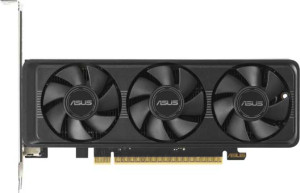
Final Verdict

The Asus GeForce RTX 5060 LP BRK OC Edition occupies a well-defined niche as a discrete graphics card built specifically around spatial constraints. Its low-profile form factor paired with Blackwell architecture gives compact system builders access to modern features — including ray tracing, DLSS, and GDDR7 memory — that are rarely available in this physical footprint. The 8GB VRAM and 128-bit bus do place a ceiling on what the card can handle at higher resolutions or in more demanding workloads, so it is best understood as a capable solution within its intended scope rather than a broadly universal one. For users whose primary need is a modern, feature-complete GPU that fits where full-size cards cannot, this card delivers a coherent and well-specified option.

Popular Comparisons

Asus GeForce RTX 5060 LP BRK OC Edition
VS
Asus Dual GeForce RTX 5060
Asus GeForce RTX 5060 LP BRK OC Edition
VS
Asus Dual Radeon RX 9060 XT 16GB
Asus GeForce RTX 5060 LP BRK OC Edition
VS
AMD Radeon RX 9060
AMD Radeon RX 9060
Asus GeForce RTX 5060 LP BRK OC Edition
VS
Gigabyte Radeon RX 7600 XT Gaming OC
Asus GeForce RTX 5060 LP BRK OC Edition
VS
Nvidia GeForce RTX 4060