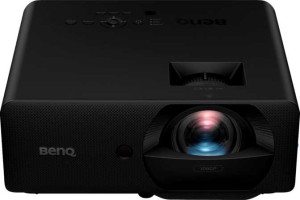
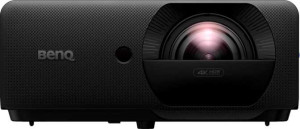
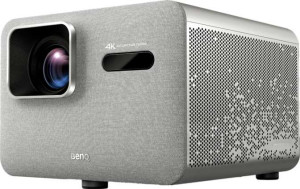
The BenQ LH830ST uses a laser light source with a rated lamp life of 200 hours, dropping to just 0.5 hours in eco mode. Operating power consumption sits at 320 W, while standby draw is a minimal 0.5 W. In terms of acoustics, the unit produces 33 dB of audible noise under standard operation and 29 dB in eco mode. Physically, it measures 279.2 mm wide, 120.5 mm tall, and 229.3 mm deep, with a total weight of 3,400 g and a volume of approximately 7,714.48 cm³.
The BenQ LH830ST delivers 4,000 ANSI lumens of brightness at a native 1080p output resolution, with a maximum projection size of 180″ and a minimum throw distance of 0.5 m. Focus is handled manually, as neither motorized focus nor motorized zoom are available. The refresh rate runs at 60 Hz with a response time of 16.7 ms, and 10-bit color depth is supported alongside HDR10 and HLG for broader tonal compatibility. Dolby Vision and HDR10+ are not supported.
The BenQ LH830ST offers a mix of wired and wireless connectivity options. On the wired side, it includes one HDMI port and two USB ports, along with an S/PDIF output for digital audio; there is no VGA connector, DVI connector, or RJ45 port. Wireless connectivity covers Wi-Fi, Bluetooth, AirPlay, Chromecast built-in, and Miracast, giving users a broad range of options for streaming and screen mirroring without a physical cable.
The BenQ LH830ST includes a built-in smart TV platform, allowing it to operate as a standalone streaming device without an external source. A single built-in speaker provides audio output at 1 x 2 W; it is not a stereo configuration, and Dolby Atmos is not supported. A remote control is included for convenient operation.