General info:
| SSD storage capacity |
2000GB |
| Is an NVMe SSD |
✓ |
| thickness |
252 mm |
| height |
94 mm |
| width |
384 mm |
| volume |
9096.192 cm³ |
The GMKtec Evo-X2 comes equipped with a 2000GB NVMe SSD, offering fast flash-based storage in a compact chassis. The unit measures 384 mm in width, 252 mm in thickness, and 94 mm in height, resulting in a total volume of 9096.192 cm³ — a relatively modest footprint for a desktop-class machine with its specification level.
CPU:
| Thermal Design Power (TDP) |
55W |
| CPU speed |
16 x 3 GHz |
| turbo clock speed |
5.1GHz |
| CPU threads |
32 threads |
| Has integrated graphics |
✓ |
| uses multithreading |
✓ |
| L3 cache |
64 MB |
| L2 cache |
16 MB |
| L1 cache |
1280 KB |
| L2 core |
1 MB/core |
| L3 core |
4 MB/core |
| clock multiplier |
30 |
| Has an unlocked multiplier |
✕ |
| Supports 64-bit |
✓ |
| CPU temperature |
100 °C |
The processor runs 16 cores at a base clock of 3 GHz, scaling up to a turbo speed of 5.1 GHz, and exposes 32 threads through multithreading support. It carries a TDP of 55W and a clock multiplier of 30, though the multiplier is locked, ruling out manual overclocking. Cache is organized across three levels — 1280 KB of L1, 16 MB of L2 at 1 MB per core, and 64 MB of L3 at 4 MB per core — providing a substantial buffer for data-intensive workloads. The CPU supports 64-bit instruction sets and includes integrated graphics, with a rated maximum operating temperature of 100 °C.
Graphics card:
| GPU clock speed |
1295 MHz |
| GPU turbo |
2900 MHz |
| PCI Express (PCIe) version |
4 |
| texture mapping units (TMUs) |
160 |
| shading units |
2560 |
| render output units (ROPs) |
64 |
| DirectX version |
DirectX 12 |
| OpenGL version |
4.6 |
| OpenCL version |
3 |
| semiconductor size |
4 nm |
| supported displays |
4 |
The integrated GPU operates at a base clock of 1295 MHz, boosting up to a turbo speed of 2900 MHz, and is built on a 4 nm semiconductor process. It features 2560 shading units, 160 texture mapping units, and 64 render output units, all communicating over a PCIe 4 interface. The graphics solution supports up to four simultaneous displays and is compatible with DirectX 12, OpenGL 4.6, and OpenCL 3, covering a broad range of graphics and compute workloads.
Memory:
| RAM |
128GB |
| RAM speed |
8000 MHz |
| DDR memory version |
5 |
The GMKtec Evo-X2 is equipped with 128GB of DDR5 RAM, running at a speed of 8000 MHz, which represents the maximum supported memory configuration for this system. The combination of a high-generation memory standard and a fast operating frequency allows for substantial data throughput across memory-intensive tasks.
Connectivity:
| Wi-Fi version |
Wi-Fi 6E (802.11ax), Wi-Fi 6 (802.11ax), Wi-Fi 5 (802.11ac), Wi-Fi 4 (802.11n), Wi-Fi 7 (802.11be) |
| supports Wi-Fi |
✓ |
| Has Bluetooth |
✓ |
| Bluetooth version |
5.4 |
| USB 2.0 ports |
2 |
| USB 3.2 Gen 2 ports (USB-A) |
3 |
| USB 3.2 Gen 1 ports (USB-A) |
0 |
| USB 3.2 Gen 2 ports (USB-C) |
0 |
| USB 4 40Gbps ports |
2 |
| USB 4 20Gbps ports |
0 |
| USB 3.2 Gen 2x2 ports |
0 |
| USB 3.2 Gen 1 ports (USB-C) |
0 |
| Thunderbolt 4 ports |
2 |
| Thunderbolt 3 ports |
0 |
| DisplayPort outputs |
1 |
| HDMI version |
HDMI 2.1 |
| HDMI ports |
1 |
| RJ45 ports |
1 |
| has a socket for a 3.5 mm audio jack |
✓ |
| has a VGA connector |
✕ |
| Has S/PDIF Out port |
✕ |
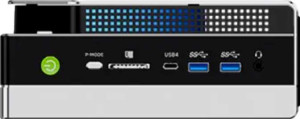
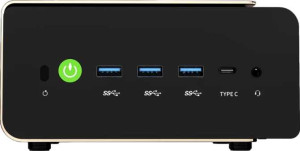
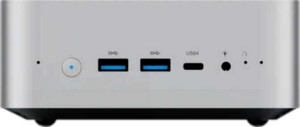
Wireless connectivity covers Wi-Fi 7 (802.11be) alongside backward-compatible Wi-Fi 6E, 6, 5, and 4 standards, paired with Bluetooth 5.4 for peripheral connections. On the wired side, the port layout includes two USB 2.0 ports, three USB 3.2 Gen 2 Type-A ports, and two USB 4 40Gbps ports, while there are no USB 3.2 Gen 1 or Gen 2x2 Type-C ports present. High-speed device connectivity is further supported by two Thunderbolt 4 ports, with no Thunderbolt 3 ports included. Display output is handled through one HDMI 2.1 port and one DisplayPort, and a single RJ45 port provides wired network access. A 3.5 mm headset jack is available for audio, though the unit lacks both a VGA connector and an S/PDIF output.
Benchmarks:
| PassMark result |
54021 |
| PassMark result (single) |
4142 |
| Geekbench 6 result (multi) |
17698 |
| Geekbench 6 result (single) |
2774 |
| PassMark result (overclocked) |
57021 |
In multi-threaded PassMark testing, the system scores 54021, rising to 57021 under overclocked conditions, while the single-threaded PassMark result stands at 4142. Geekbench 6 results follow a similar pattern, with a multi-core score of 17698 and a single-core score of 2774, together providing a broader picture of both sustained parallel performance and per-core responsiveness.
Miscellaneous:
| maximum memory amount |
128GB |
| has an external memory slot |
✕ |
| Type |
Laptop, Desktop |
| Uses big.LITTLE technology |
✕ |
| instruction sets |
MMX, F16C, FMA3, AES, AVX, AVX2, SSE 4.1, SSE 4.2 |
| Has NX bit |
✓ |
| GPU name |
Radeon 8060S |
| Supports ECC memory |
✓ |
| memory channels |
4 |
| RAM speed (max) |
8000 MHz |
| warranty period |
1 years |
| Uses flash storage |
✓ |
The system is classified for use in both laptop and desktop form factors and features the Radeon 8060S as its GPU. Memory support tops out at 128GB across four channels, with a maximum RAM speed of 8000 MHz, and the platform supports ECC memory for added data integrity — though no external memory slot is available. Storage relies on flash-based technology, and the CPU does not use big.LITTLE architecture. Supported instruction sets include MMX, F16C, FMA3, AES, AVX, AVX2, SSE 4.1, and SSE 4.2, and the processor includes an NX bit for hardware-level memory protection. The unit ships with a one-year warranty.