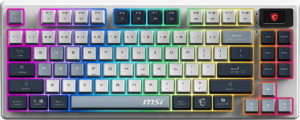
The MSI Forge GK600 TKL is a gaming mechanical keyboard built around a tenkeyless (80%) standard-profile layout, measuring 348 mm wide, 140 mm deep, and 45 mm thick at a weight of 943 g. It supports three connection modes — Bluetooth 5.1, 2.4GHz wireless, and wired USB — and is not specifically designed for Mac. The detachable cable adds convenience for wired use, while the 480-hour battery life makes it well-suited for extended wireless sessions. It operates at a 1000 Hz polling rate and carries a one-year warranty.
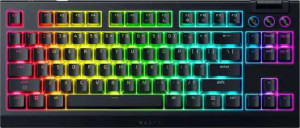
The GK600 TKL features a white plastic case with RGB backlighting across all keys, giving users control over per-key illumination. The board includes adjustable feet for tilting the typing angle to preference, though it does not come with a wrist rest. No additional color options are listed beyond the white finish.
The GK600 TKL is equipped with MSI Mechanical Linear switches, offering a smooth, non-tactile keystroke feel with a fixed 2 mm actuation point and 4 mm of total travel distance. The actuation force sits at 43 g, keeping keystrokes relatively light. Notably, the switches are hot-swappable, meaning they can be removed and replaced without soldering, which allows for straightforward switch changes down the line.
The GK600 TKL supports analog input and adjustable actuation, giving users some control over how the switches register keypresses, though it does not offer rapid trigger or dual actuation functionality. Full N-key rollover (NKRO) ensures that all simultaneous keypresses are accurately detected without conflict. The board also includes an onboard display, while USB passthrough is absent. On the firmware side, QMK, ZMK, and VIA are not supported, so customization is limited to MSI's own software ecosystem.
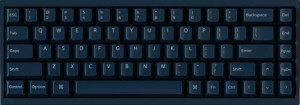
The GK600 TKL uses a standard ANSI (United States) layout with PBT dye-sublimated keycaps in a Cherry profile, which sits on the lower side and is widely regarded as comfortable for extended typing. The key layout is fully standard, making keycap replacement straightforward. Media functions are accessible via the Fn key rather than dedicated keys, and there is no rotary dial on the board.