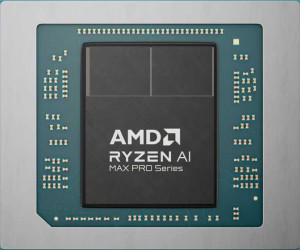
The AMD Ryzen AI Max Pro 390 is designed for use in both laptop and desktop systems, built on a 4nm semiconductor process that contributes to its compact power profile. It carries a Thermal Design Power (TDP) of 55W and is rated for a maximum CPU temperature of 100°C. The processor includes integrated graphics, supports 64-bit computing, and is compatible with PCIe version 4.
The processor runs 12 cores at a base speed of 3.2GHz each, supporting 24 threads for handling parallel workloads, with a turbo clock speed reaching 5GHz under load. The clock multiplier is set at 32, and the chip does not feature an unlocked multiplier or big.LITTLE heterogeneous core architecture. Its cache layout consists of 960KB of L1, 12MB of L2 at 1MB per core, and 64MB of L3 cache at 5.33MB per core, providing a substantial amount of fast-access memory to feed the cores efficiently.
In PassMark testing, the processor achieves a multi-core score of 43,189, reflecting its capacity for threaded workloads across all available cores. Its single-core PassMark result of 3,997 represents the measured performance of an individual core under the same benchmark conditions.
The integrated graphics solution is the Radeon 8050S, which operates at a turbo frequency of 2800MHz and can drive up to four displays simultaneously. It supports DirectX 12 for graphics rendering, alongside OpenGL version 4.6 and OpenCL version 3 for broader compatibility with graphics and compute workloads.
The processor supports DDR5 memory at speeds up to 8000MHz, spread across four memory channels for broad bandwidth availability. It accommodates a maximum of 128GB of RAM and includes support for ECC memory, allowing for error detection and correction in relevant system configurations.
The processor supports a broad set of instruction sets including MMX, F16C, FMA3, AES, AVX, AVX2, SSE 4.1, and SSE 4.2, covering a range of compute, encryption, and vector processing capabilities. Multithreading is enabled, allowing the chip to handle multiple threads per core simultaneously. The NX bit is present for hardware-level memory protection, while TrustZone is not supported on this processor.