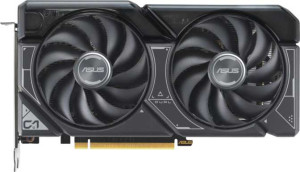
Asus Dual GeForce RTX 5050 OC Edition specifications and in-depth review

Asus Dual GeForce RTX 5050 OC Edition

Manufacturer: Asus

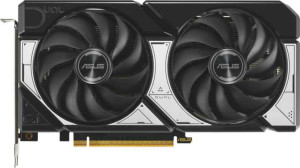
The Asus Dual GeForce RTX 5050 OC Edition is a mid-range graphics card from Asus based on Nvidia's Blackwell architecture, fabricated on a 5nm process with 16.9 billion transistors. It ships with 8GB of GDDR6 memory across a 128-bit bus, delivering an effective memory speed of 20000 MHz and a maximum bandwidth of 320 GB/s. The card runs at a base clock of 2317 MHz and reaches a boost of 2677 MHz under load, while its compact 203 x 120.2mm dual-fan cooler keeps the 130W thermal envelope in check.

On the feature side, the RTX 5050 OC Edition supports DirectX 12 Ultimate and OpenGL 4.6, along with hardware ray tracing and DLSS — both native to the Blackwell generation. Its 2560 shading units are paired with 80 texture mapping units and 32 ROPs, yielding a floating-point throughput of 13.71 TFLOPS and a texture fill rate of 214.2 GTexels/s. Connectivity covers up to four displays simultaneously via one HDMI 2.1b port and three DisplayPort outputs, with PCIe 5.0 handling host interface duties. Intel Resizable BAR is supported, and ECC memory capability is present for workloads that require it.

Pros
  • Supports hardware ray tracing and DLSS, both active features on this card
  • Drives up to four displays simultaneously via three DisplayPort outputs and one HDMI 2.1b port
  • ECC memory support adds a layer of data integrity for precision-sensitive workloads
  • Double Precision Floating Point (DPFP) capability broadens suitability beyond typical consumer rendering tasks
  • Compact physical dimensions of 203 x 120.2 mm make it easier to fit in smaller chassis
  • PCIe 5.0 interface ensures compatibility with current-generation motherboard platforms
Cons
  • 128-bit memory bus width limits memory bandwidth scaling compared to wider configurations
  • No USB-C output limits connectivity options for certain modern displays and adapters
  • Multi-GPU is not supported, restricting scaling to a single-card setup
  • No RGB lighting for users who prioritize aesthetic customization in their build
  • Air cooling only, with no hybrid water-cooling option available on this model
  • 8GB VRAM may prove restrictive for memory-intensive workloads or high-resolution texture sets
Who is this for?

This card is a reasonable fit for users building compact systems thanks to its 203 x 120.2mm footprint, and its 130W TDP keeps power and thermal demands manageable in smaller enclosures. The combination of hardware ray tracing, DLSS, and DirectX 12 Ultimate support makes it well-suited for gaming at moderate resolutions where those features meaningfully improve visual output. It also has merit for light compute and precision workloads, given its DPFP capability and ECC memory support — attributes that are uncommon at this card's power level and useful for users who occasionally run numerical or professional tasks alongside everyday graphics work. Those needing to run up to four displays simultaneously will also find the output configuration practical for productivity-oriented multi-monitor setups.

Who is this NOT for?

Users targeting high-resolution or highly demanding rendering workloads may find the 8GB VRAM across a 128-bit bus a limiting factor, as memory-intensive scenes and large texture assets can quickly saturate that capacity. The card's floating-point throughput of 13.71 TFLOPS and 32 ROPs also mean it is not well-matched for enthusiast-level gaming or GPU-accelerated production pipelines that demand significantly higher compute headroom. Additionally, the absence of USB-C display output and no support for multi-GPU configurations makes it a poor fit for users who rely on those specific connectivity or scalability requirements in their workflows.

Performance:

GPU clock speed 2317 MHz
GPU turbo 2677 MHz
pixel rate 85.66 GPixel/s
floating-point performance 13.71 TFLOPS
texture rate 214.2 GTexels/s
GPU memory speed 1750 MHz
shading units 2560
texture mapping units (TMUs) 80
render output units (ROPs) 32
Has Double Precision Floating Point (DPFP)

The RTX 5050 OC Edition operates at a base GPU clock of 2317 MHz, climbing to a boost of 2677 MHz under sustained load. Its 2560 shading units work alongside 80 texture mapping units and 32 render output units, producing a texture fill rate of 214.2 GTexels/s, a pixel rate of 85.66 GPixel/s, and an overall floating-point throughput of 13.71 TFLOPS. GPU memory runs at 1750 MHz, and the card includes support for Double Precision Floating Point (DPFP), which extends its usability to workloads that rely on higher numerical precision.

Memory:

effective memory speed 20000 MHz
maximum memory bandwidth 320 GB/s
VRAM 8GB
GDDR version GDDR6
memory bus width 128-bit
Supports ECC memory

The card is equipped with 8GB of GDDR6 VRAM running across a 128-bit memory bus, with a memory clock of 1750 MHz that translates to an effective speed of 20000 MHz. This configuration yields a maximum memory bandwidth of 320 GB/s, providing the throughput needed for texture-heavy and compute workloads alike. ECC memory support is also present, enabling error correction for applications where data integrity is a priority.

Features:

DirectX version DirectX 12 Ultimate
OpenGL version 4.6
OpenCL version 3
Supports multi-display technology
supports ray tracing
Supports 3D
supports DLSS
has XeSS (XMX)
AMD SAM / Intel Resizable BAR Intel Resizable BAR
has LHR
multi-GPU 0
has RGB lighting
supported displays 4

The RTX 5050 OC Edition supports DirectX 12 Ultimate, OpenGL 4.6, and OpenCL 3, covering a broad range of graphics and compute APIs. Hardware ray tracing and DLSS are both present, while XeSS (XMX) is not supported. The card can drive up to four displays simultaneously through its multi-display technology, and stereoscopic 3D is also supported. Intel Resizable BAR is available for improving data transfer between the CPU and GPU, whereas LHR is not implemented and multi-GPU configurations are not supported. The card does not feature RGB lighting.

Ports:

has an HDMI output
HDMI ports 1
HDMI version HDMI 2.1b
DisplayPort outputs 3
USB-C ports 0
DVI outputs 0
mini DisplayPort outputs 0

The card's output configuration consists of three DisplayPort outputs and one HDMI 2.1b port, totaling four display connections. There are no DVI, mini DisplayPort, or USB-C outputs on this model, keeping the bracket layout straightforward and focused on the two most widely used modern display interfaces.

General info:

GPU architecture Blackwell
Thermal Design Power (TDP) 130W
PCI Express (PCIe) version 5
semiconductor size 5 nm
number of transistors 16900 million
Has air-water cooling
width 203 mm
height 120.2 mm

The RTX 5050 OC Edition is built on the Blackwell architecture, manufactured using a 5nm process with 16,900 million transistors packed into a card measuring 203 mm wide and 120.2 mm tall. It connects via PCIe 5.0 and operates within a 130W TDP, relying on air cooling — there is no water-cooling support. The card does not include a hybrid air-water cooling solution.

Final Verdict

The Asus Dual GeForce RTX 5050 OC Edition occupies a focused position in the graphics card landscape, offering a compact and power-efficient package built on the Blackwell architecture with a credible feature set that includes hardware ray tracing, DLSS, and DirectX 12 Ultimate support. Its ECC memory and DPFP capability give it a subtle edge for users who blend gaming or creative work with occasional precision computing tasks — an uncommon combination at this thermal envelope. The 128-bit memory bus and 8GB VRAM ceiling do set natural boundaries on what the card can comfortably handle at the high end of workloads, but within its intended operating range it delivers a well-rounded and versatile experience. For users who need a small-footprint card with modern API support, multi-display output, and a manageable power draw, the RTX 5050 OC Edition represents a coherent and purposeful choice.

Popular Comparisons

Asus Dual GeForce RTX 5050 OC Edition
VS
Asus Dual GeForce RTX 4060
Asus Dual GeForce RTX 5050 OC Edition
VS
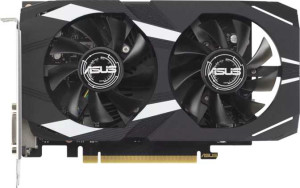
Asus Dual GeForce RTX 3050 OC Edition 6GB
Asus Dual GeForce RTX 5050 OC Edition
VS
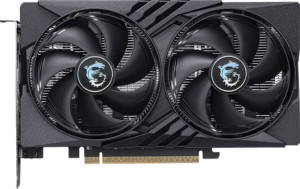
MSI GeForce RTX 5050 Gaming
Asus Dual GeForce RTX 5050 OC Edition
VS
Inno3D GeForce RTX 5060 Twin X2
Asus Dual GeForce RTX 5050 OC Edition
VS
XFX Speedster SWFT 210 Radeon RX 7600 XT
Asus Dual GeForce RTX 5050 OC Edition
VS
Asus Dual GeForce RTX 5060
Asus Dual GeForce RTX 5050 OC Edition
VS
Zotac Gaming GeForce RTX 5050 Solo
Asus Dual GeForce RTX 5050 OC Edition
VS
Colorful GeForce RTX 5050 Battle AX Duo