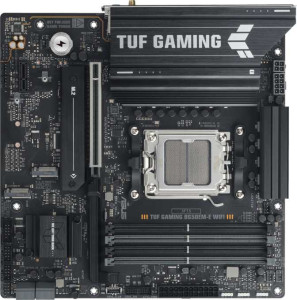
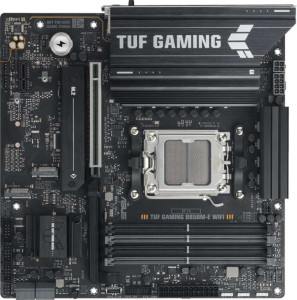
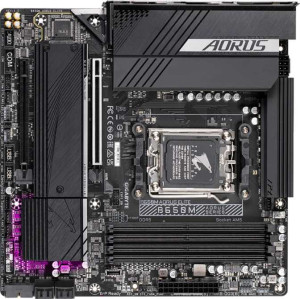
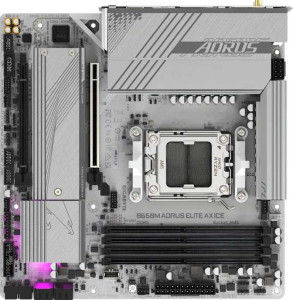
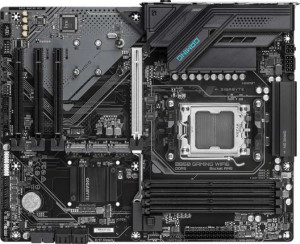
The Asus TUF Gaming B650EM-E Wi-Fi is built around the AM5 socket with B650 chipset compatibility and comes in a Micro-ATX form factor measuring 244 mm × 244 mm, fitting standard mid-tower and smaller enclosures. It supports overclocking and includes RGB lighting, though it lacks dual BIOS and an easy CMOS reset option. Wireless connectivity covers Wi-Fi 4, Wi-Fi 5, and Wi-Fi 6 (802.11ax) alongside Bluetooth 5.2, though aptX audio over Bluetooth is not supported. The board features a single CPU socket, has no integrated graphics or integrated CPU, and outputs video via HDMI 2.1. There is no support for integrated graphics, and the board carries a three-year warranty.
This board uses DDR5 memory across four slots arranged in a dual-channel configuration, with a maximum supported capacity of 256 GB. Overclocked RAM speeds can reach up to 8000 MHz, offering headroom for performance-focused builds. ECC memory is not supported.
The rear I/O provides a varied USB selection, including one USB 3.2 Gen 2 Type-A port, two USB 3.2 Gen 1 Type-A ports, one USB 3.2 Gen 2 Type-C port, and four USB 2.0 ports, while USB 3.2 Gen 1 Type-C, Gen 2x2, USB 4, Thunderbolt 3, and Thunderbolt 4 are all absent. Display output is handled by an HDMI port and two DisplayPort outputs, with no DVI or VGA connector present. Networking is covered by a single RJ45 port, and legacy input device support is provided through one PS/2 port. There are no eSATA ports on this board.
Internal connectivity includes three M.2 sockets and four SATA 3 connectors for storage, with no SATA 2, mSATA, or U.2 sockets available. USB expansion headers provide two USB 3.2 Gen 1 ports and four USB 2.0 ports through front-panel connections, along with two additional USB 3.0 ports via expansion. Four fan headers are present for cooling management, while a TPM connector is not included on this board.
Expansion options are modest but focused, with a single PCIe 5.0 x16 slot serving as the primary slot for a discrete graphics card or other full-length expansion card. A single PCIe x1 slot is also present for smaller add-in cards. There are no PCIe 4.0, 3.0, 2.0 x16 slots, no PCIe x8 slots, and no legacy PCI slots on this board.
The board supports 7.1-channel audio output through three analog audio connectors on the rear panel. A S/PDIF Out port is not included.
The board supports a broad range of RAID configurations, including RAID 0, RAID 1, RAID 5, and RAID 10 (1+0), covering common setups for both performance and redundancy needs. RAID 0+1 is not supported.