MSI H810M Gaming Wi-Fi6E specifications and in-depth review

MSI H810M Gaming Wi-Fi6E

Manufacturer: MSI

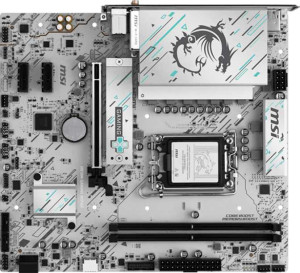
The MSI H810M Gaming Wi-Fi6E is a Micro-ATX motherboard built around the LGA 1851 socket, targeting users who want a compact platform with modern connectivity built in. It includes integrated Wi-Fi 6E (802.11ax) and Bluetooth 5.3, making it a solid choice for wireless-first desktop builds. RGB lighting is present on the board, and a dual BIOS design provides a layer of redundancy for system recovery situations. The board carries a three-year warranty and measures 220 mm by 243.8 mm.

On the memory side, the H810M Gaming Wi-Fi6E supports DDR5 across two slots with a native speed ceiling of 4800 MHz and overclocked profiles reaching up to 6400 MHz, accommodating up to 128 GB total across dual channels. Expansion is handled by a single PCIe 5.0 x16 slot alongside two PCIe x1 slots, and storage options include one M.2 socket and four SATA 3 connectors. The rear I/O provides a mix of USB ports — including a USB 3.2 Gen 2 Type-C and four USB 2.0 ports — along with HDMI 2.1, one DisplayPort output, and a single RJ45 Ethernet jack. Audio output runs through a 7.1-channel solution with three rear audio connectors.

Pros
  • Includes Wi-Fi 6E support alongside older Wi-Fi standards for broad wireless compatibility
  • Dual BIOS provides a built-in recovery option if the primary firmware becomes corrupted
  • DDR5 memory support with overclocked speeds up to 6400 MHz offers meaningful headroom for memory-intensive workloads
  • A single PCIe 5.0 x16 slot supports the latest generation of discrete graphics cards and add-in devices
  • Seven-point-one channel audio output is available directly from the rear panel without requiring a separate sound card
  • Three-year warranty period provides an extended coverage window for a motherboard
Cons
  • Only one M.2 socket limits NVMe storage expansion for users who need multiple fast drives
  • Two memory slots instead of four restricts future upgrade paths and limits maximum configuration flexibility
  • No TPM connector is present, which can be a requirement for certain security and enterprise software configurations
  • No USB 3.2 Gen 2 Type-A ports on the rear I/O, leaving the faster USB-A throughput unavailable
  • S/PDIF digital audio output is absent, ruling out direct digital connections to certain external audio equipment
  • ECC memory is not supported, making the board unsuitable for workloads that require error-correcting RAM
Who is this for?

This board is well suited to users building a compact desktop system around a current-generation platform, where a Micro-ATX footprint is a priority without sacrificing modern connectivity. The inclusion of Wi-Fi 6E and Bluetooth 5.3 makes it a natural fit for wireless-first setups where running ethernet cables is impractical. Users who plan to pair the system with a single high-end discrete card will benefit from the PCIe 5.0 x16 slot, and those who want a straightforward daily-use or gaming build with DDR5 memory and a manageable feature set will find the overall specification profile well matched to that purpose.

Who is this NOT for?

Users with demanding storage needs will find the single M.2 socket and absence of RAID 0+1 support restrictive, making this board a poor fit for content creators or professionals who rely on fast multi-drive configurations. The lack of ECC memory support rules it out for workstation or server-adjacent workloads where memory error correction is necessary. Similarly, the two-slot memory layout limits long-term upgrade flexibility, so users who anticipate scaling their RAM capacity significantly over time may find the configuration ceiling reached sooner than expected.

General info:

CPU socket LGA 1851
form factor Micro-ATX
supports Wi-Fi
Wi-Fi version Wi-Fi 4 (802.11n), Wi-Fi 5 (802.11ac), Wi-Fi 6 (802.11ax), Wi-Fi 6E (802.11ax)
Has Bluetooth
Bluetooth version 5.3
HDMI version HDMI 2.1
Easy to overclock
has RGB lighting
Easy to reset BIOS
Has dual BIOS
has aptX
CPU sockets 1
Has integrated graphics
warranty period 3 years
height 220 mm
width 243.8 mm
Has integrated CPU

The MSI H810M Gaming Wi-Fi6E is built around the LGA 1851 socket and adopts a Micro-ATX form factor, measuring 220 mm by 243.8 mm, which suits compact desktop builds. It accommodates a single CPU and does not include an integrated processor or onboard graphics. Wireless connectivity is handled by a built-in adapter supporting Wi-Fi 4, 5, 6, and Wi-Fi 6E (802.11ax), paired with Bluetooth 5.3, though aptX audio codec support is absent. Video output reaches up to HDMI 2.1, and the board includes RGB lighting for aesthetic customization. A dual BIOS design adds redundancy for firmware recovery, though neither easy overclocking nor a quick CMOS reset function is available. The board is backed by a three-year warranty.

Memory:

maximum memory amount 128GB
RAM speed (max) 4800 MHz
overclocked RAM speed 6400 MHz
memory slots 2
DDR memory version 5
memory channels 2
Supports ECC memory

This board uses DDR5 memory across two slots arranged in a dual-channel configuration, supporting up to 128 GB total capacity. The native maximum RAM speed sits at 4800 MHz, with overclocked profiles capable of reaching 6400 MHz for users who want additional memory bandwidth. ECC memory is not supported on this platform.

Ports:

USB 3.2 Gen 2 ports (USB-A) 0
USB 3.2 Gen 1 ports (USB-A) 2
USB 3.2 Gen 2 ports (USB-C) 1
USB 3.2 Gen 1 ports (USB-C) 0
USB 2.0 ports 4
USB 3.2 Gen 2x2 ports 0
USB 4 40Gbps ports 0
USB 4 20Gbps ports 0
Thunderbolt 4 ports 0
Thunderbolt 3 ports 0
has an HDMI output
DisplayPort outputs 1
RJ45 ports 1
Has USB Type-C
eSATA ports 0
DVI outputs 0
has a VGA connector
PS/2 ports 0

The rear I/O panel offers a practical spread of USB connectivity, including two USB 3.2 Gen 1 Type-A ports, one USB 3.2 Gen 2 Type-C port, and four USB 2.0 ports; there are no USB 3.2 Gen 2 Type-A, Gen 2x2, USB 4, Thunderbolt 3, or Thunderbolt 4 ports present. Display output is covered by one HDMI and one DisplayPort output, while VGA and DVI connectors are absent. A single RJ45 port handles wired network connectivity, and legacy interfaces such as eSATA and PS/2 are not included.

Connectors:

USB 3.2 Gen 1 ports (through expansion) 2
USB-C 3.2 Gen 2 ports (through expansion) 1
USB 2.0 ports (through expansion) 4
SATA 3 connectors 4
fan headers 3
USB 3.0 ports (through expansion) 2
M.2 sockets 1
Has TPM connector
U.2 sockets 0
Has mSATA connector
SATA 2 connectors 0

Internal expansion connectivity includes headers for two USB 3.2 Gen 1 ports, one USB-C 3.2 Gen 2 port, and four USB 2.0 ports, along with two additional USB 3.0 ports through expansion headers. Storage is served by four SATA 3 connectors and a single M.2 socket, while SATA 2, mSATA, and U.2 connectors are not present. The board provides three fan headers for cooling management, and a TPM connector is not included.

Expansion slots:

PCIe 4.0 x16 slots 0
PCIe 5.0 x16 slots 1
PCIe 3.0 x16 slots 0
PCIe x1 slots 2
PCI slots 0
PCIe 2.0 x16 slots 0
PCIe x4 slots 0
PCIe x8 slots 0

The board offers a modest but current expansion slot layout, centered on a single PCIe 5.0 x16 slot for the primary add-in card, complemented by two PCIe x1 slots for smaller peripherals. There are no PCIe 2.0, 3.0, or 4.0 x16 slots, and no PCIe x4, x8, or legacy PCI slots are present, reflecting the compact nature of the Micro-ATX design.

Audio:

audio channels 7.1
Has S/PDIF Out port
audio connectors 3

Audio output supports a 7.1-channel configuration, with three analog audio connectors available on the rear panel for connecting speakers or headsets. An S/PDIF digital audio output is not included on this board.

Storage:

Supports RAID 0+1

This board does not support RAID 0+1 storage configurations.
Final Verdict

The MSI H810M Gaming Wi-Fi6E delivers a focused Micro-ATX platform for users who want a compact, modern build centered on the LGA 1851 socket without unnecessary complexity. Its Wi-Fi 6E connectivity and PCIe 5.0 x16 slot represent genuine forward-looking value for a board of this size, and the dual BIOS adds a layer of reliability that is welcome at any level. The trade-offs — a single M.2 socket, two memory slots, and the absence of ECC support — reflect deliberate scope choices that keep the board focused on mainstream use rather than professional or heavily expandable configurations. For users whose priorities align with its feature set, the H810M Gaming Wi-Fi6E is a coherent and capable choice; those with more demanding storage or memory requirements should look toward a more expansive platform.

Popular Comparisons

MSI H810M Gaming Wi-Fi6E
VS
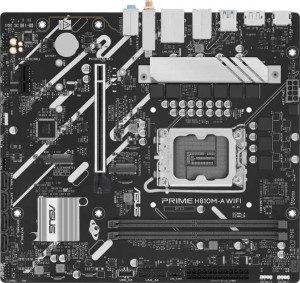
Asus Prime H810M-A WiFi
MSI H810M Gaming Wi-Fi6E
VS
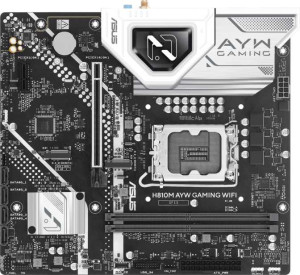
Asus H810M AYW Gaming WiFi
MSI H810M Gaming Wi-Fi6E
VS
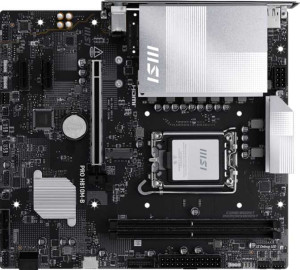
MSI Pro H810M-B
MSI Pro H810M-B