ASRock Radeon AI Pro R9700 Creator specifications and in-depth review

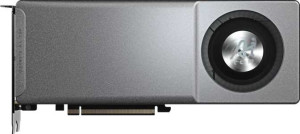
ASRock Radeon AI Pro R9700 Creator

Manufacturer: ASRock

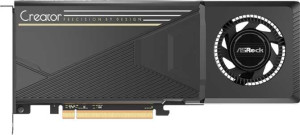
The ASRock Radeon AI Pro R9700 Creator is a graphics card designed around AMD's RDNA 4.0 architecture, manufactured on a 4 nm process node with 53,900 million transistors. It pairs a base clock of 1660 MHz with a boost frequency that reaches 2920 MHz, and the card ships with 32GB of GDDR6 memory across a 256-bit bus, delivering a peak bandwidth of 644.6 GB/s. With dimensions of 271 mm by 111 mm and a thermal design power of 300W, the card occupies a measurable physical footprint suited to full-size builds.

On the compute side, the R9700 Creator houses 4096 shading units, 256 texture mapping units, and 128 render output units, translating into a texture rate of 747.5 GTexels/s and a pixel rate of 373.8 GPixels/s. The card carries support for DirectX 12 Ultimate, OpenGL 4.6, and OpenCL 2.2, alongside ray tracing, AMD FSR4, AMD SAM, and ECC memory support. Connectivity is handled entirely through four DisplayPort outputs, capable of driving up to four displays simultaneously, while the card connects to the host system via a PCIe 5.0 interface.

Pros
  • 32GB of GDDR6 VRAM provides substantial memory capacity for memory-intensive workloads
  • ECC memory support adds data integrity protection useful in professional and compute environments
  • Double Precision Floating Point (DPFP) support enables accurate computation for technical and scientific tasks
  • Four DisplayPort outputs allow simultaneous connection of up to four displays
  • AMD SAM support enables the host CPU to access the full GPU memory pool directly
  • FSR4 upscaling support extends rendering flexibility across supported applications
Cons
  • No HDMI output limits compatibility with displays and devices that lack DisplayPort inputs
  • Absence of USB-C connectivity restricts connection options for certain modern monitors and peripherals
  • 300W TDP places a significant power demand on the system and power supply
  • No air-water cooling solution included, leaving thermal management entirely dependent on the card's own cooling design
  • No RGB lighting for users who factor visual integration into their build
Who is this for?

This card is well-matched to professionals working in compute-heavy environments, particularly those running workloads that benefit from Double Precision Floating Point support and ECC memory, such as scientific simulation, data processing, or machine learning tasks. The 32GB of GDDR6 VRAM makes it a practical choice for users handling large datasets, high-resolution textures, or complex 3D scenes, while the four DisplayPort outputs suit those who rely on multi-monitor setups for production workflows. Ray tracing support and FSR4 also make it viable for content creators who occasionally render visually demanding scenes.

Who is this NOT for?

Users looking for a straightforward home entertainment or gaming setup may find this card less suitable, as the absence of an HDMI output creates an immediate barrier with televisions and the majority of consumer monitors that lack DisplayPort. Those working in compact or power-constrained systems will also face challenges, given the 300W TDP which demands a robust power supply and adequate case airflow. Additionally, users seeking plug-and-play simplicity with USB-C connected displays will find no support for that connection type here.

Performance:

GPU clock speed 1660 MHz
GPU turbo 2920 MHz
pixel rate 373.8 GPixel/s
floating-point performance 47.84 TFLOPS
texture rate 747.5 GTexels/s
GPU memory speed 2518 MHz
shading units 4096
texture mapping units (TMUs) 256
render output units (ROPs) 128
Has Double Precision Floating Point (DPFP)

The card operates at a base clock of 1660 MHz, climbing to a boost frequency of 2920 MHz under load, while GPU memory runs at 2518 MHz. Its 4096 shading units are accompanied by 256 texture mapping units and 128 render output units, producing a texture rate of 747.5 GTexels/s and a pixel rate of 373.8 GPixels/s. Floating-point performance reaches 47.84 TFLOPS, and the card includes support for Double Precision Floating Point (DPFP), making it capable of handling workloads that require higher numerical accuracy.

Memory:

effective memory speed 20100 MHz
maximum memory bandwidth 644.6 GB/s
VRAM 32GB
GDDR version GDDR6
memory bus width 256-bit
Supports ECC memory

The card is equipped with 32GB of GDDR6 VRAM running across a 256-bit memory bus, with an effective memory speed of 20100 MHz and a maximum bandwidth of 644.6 GB/s. ECC memory support is included, adding a layer of data integrity protection suited to workloads where memory accuracy is a priority.

Features:

DirectX version DirectX 12 Ultimate
OpenGL version 4.6
OpenCL version 2.2
Supports multi-display technology
supports ray tracing
Supports 3D
has FSR4
has XeSS (XMX)
AMD SAM / Intel Resizable BAR AMD SAM
has LHR
has RGB lighting
supported displays 4

The card supports DirectX 12 Ultimate, OpenGL 4.6, and OpenCL 2.2, covering a broad range of graphics and compute APIs. Ray tracing, stereoscopic 3D, and multi-display output across up to four screens are all supported, and AMD FSR4 is available for upscaling. AMD SAM is included for host memory access optimization, while XeSS (XMX), LHR, and RGB lighting are not present on this card.

Ports:

has an HDMI output
DisplayPort outputs 4
USB-C ports 0
DVI outputs 0
mini DisplayPort outputs 0

The card's output connectivity consists entirely of four DisplayPort outputs, with no HDMI, DVI, USB-C, or mini DisplayPort connectors present.

General info:

GPU architecture RDNA 4.0
Thermal Design Power (TDP) 300W
PCI Express (PCIe) version 5
semiconductor size 4 nm
number of transistors 53900 million
Has air-water cooling
width 271 mm
height 111 mm

Built on the RDNA 4.0 architecture and fabricated on a 4 nm process node, the GPU integrates 53,900 million transistors and connects to the host system via PCIe 5.0. It carries a thermal design power of 300W and does not include an air-water cooling solution. The card measures 271 mm in width and 111 mm in height.
Final Verdict

The ASRock Radeon AI Pro R9700 Creator is a graphics card clearly oriented toward professional and compute-focused use, combining RDNA 4.0 architecture with 32GB of ECC-capable GDDR6 VRAM and Double Precision Floating Point support to address workloads that demand both memory capacity and numerical accuracy. Its four DisplayPort outputs, FSR4 support, and ray tracing capability add practical versatility for content creation environments, though the 300W power requirement and the absence of HDMI or USB-C connectivity mean it is best suited to purpose-built workstations rather than general consumer setups. For users whose workflows align with its technical profile, the R9700 Creator presents a well-specified option within the professional graphics card segment.

Popular Comparisons

ASRock Radeon AI Pro R9700 Creator
VS
Gigabyte Radeon AI Pro R9700 AI Top
ASRock Radeon AI Pro R9700 Creator
VS
Nvidia GeForce RTX 5090
ASRock Radeon AI Pro R9700 Creator
VS
Nvidia RTX Pro 2000 Blackwell
ASRock Radeon AI Pro R9700 Creator
VS
Nvidia RTX Pro 4000 Blackwell