Asus Prime B860M-K specifications and in-depth review

Asus Prime B860M-K

Manufacturer: Asus

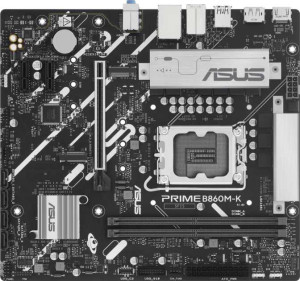
The Asus Prime B860M-K is a Micro-ATX motherboard designed around Intel's LGA 1851 platform and the B860 chipset. It measures 244 mm × 222 mm, fitting comfortably into compact builds without sacrificing core functionality. The board supports DDR5 memory across two slots, with a maximum capacity of 128 GB and overclocked speeds reaching up to 8800 MHz, giving builders room to push performance within the platform's limits. RGB lighting and a dual BIOS implementation round out its feature set for everyday assembly and maintenance.

On the connectivity side, the board provides four SATA 3 connectors alongside two M.2 sockets for fast storage, and it supports RAID configurations including RAID 0, 1, 5, and 10. Rear I/O includes one USB 3.2 Gen 2 Type-A port, two USB 3.2 Gen 1 Type-A ports, three USB 2.0 ports, one USB Type-C, and a single RJ45 LAN port. Video output is handled through HDMI 2.1 and one DisplayPort. The board carries one PCIe 4.0 x16 slot and two PCIe x1 slots for expansion, three fan headers for thermal management, and a TPM connector. Audio runs through a 7.1-channel solution with three rear audio connectors. Wi-Fi and Bluetooth are not included.

Pros
  • Dual BIOS support adds a layer of firmware reliability, reducing the risk of a failed update bricking the board
  • Supports RAID 0, 1, 5, and 10, giving users meaningful flexibility in how they configure their storage drives
  • DDR5 memory with overclocked speeds up to 8800 MHz provides substantial headroom for fast memory configurations
  • Two M.2 sockets allow for multiple fast storage devices without occupying SATA ports
  • A 3-year warranty offers reassuring long-term coverage for a platform investment
  • Easy BIOS reset via clear CMOS simplifies troubleshooting without requiring additional tools
Cons
  • Only two memory slots limit future upgrade paths, as the board is already at maximum configuration with two DIMMs installed
  • No Wi-Fi or Bluetooth onboard means wireless connectivity requires a separate adapter
  • No USB Type-C ports with Gen 2 speeds on the rear I/O, limiting fast data transfer options for USB-C devices
  • Only three fan headers may be insufficient for builds with more demanding thermal setups
  • No S/PDIF output restricts digital audio options to HDMI-based passthrough
  • Absence of a PCIe 5.0 x16 slot means the board cannot take full advantage of next-generation graphics or storage cards that require higher bandwidth
Who is this for?

This board is a practical fit for users building a capable desktop system in a compact enclosure, where the Micro-ATX form factor keeps things manageable without sacrificing essential functionality. Those who plan to run a single dedicated GPU will find the PCIe 4.0 x16 slot sufficient for their needs, while the dual M.2 sockets and four SATA 3 connectors make it a reasonable choice for anyone wanting a mix of fast NVMe storage and traditional drives. The support for RAID 0, 1, 5, and 10 also makes it appealing to home users or small office setups where basic data redundancy or striped performance is a priority. Users who appreciate firmware stability will value the dual BIOS and easy CMOS reset, and the DDR5 support with overclocked speeds up to 8800 MHz suits those looking to extract strong memory performance from the LGA 1851 platform.

Who is this NOT for?

This board is a poor match for users who need wireless connectivity out of the box, as there is no built-in Wi-Fi or Bluetooth, which can be an inconvenience in desktop setups where running a wired connection is impractical. It is equally unsuitable for those planning to build a high-end workstation, since ECC memory is not supported and there is no PCIe 5.0 slot for next-generation components requiring maximum bandwidth. Content creators or audio professionals who rely on a dedicated digital audio output will find the absence of an S/PDIF port limiting, and users who anticipate expanding their system with multiple high-speed USB-C peripherals may be frustrated by the lack of rear USB Type-C ports at Gen 2 speeds. The two-slot memory configuration also makes this a less compelling option for anyone who values granular memory upgrade flexibility over time.

General info:

CPU socket LGA 1851
chipset B860
form factor Micro-ATX
supports Wi-Fi
Has Bluetooth
HDMI version HDMI 2.1
Easy to overclock
has RGB lighting
Easy to reset BIOS
Has dual BIOS
CPU sockets 1
Has integrated graphics
warranty period 3 years
height 222 mm
width 244 mm
Has integrated CPU

The Asus Prime B860M-K uses an LGA 1851 socket paired with the B860 chipset, housed in a Micro-ATX form factor measuring 244 mm × 222 mm. It accommodates a single CPU and does not include an integrated processor or integrated graphics. Video output is available through an HDMI 2.1 connection, while Wi-Fi and Bluetooth are absent, meaning a wired network connection or separate adapter would be required for wireless connectivity. The board supports easy overclocking and features a clear CMOS function for straightforward BIOS resets, alongside a dual BIOS setup for added firmware reliability. RGB lighting is present, and the board is backed by a 3-year warranty.

Memory:

maximum memory amount 128GB
overclocked RAM speed 8800 MHz
memory slots 2
DDR memory version 5
memory channels 2
Supports ECC memory

The board supports DDR5 memory across two slots arranged in a dual-channel configuration, with a maximum total capacity of 128 GB. Overclocked RAM speeds can reach up to 8800 MHz, providing headroom for performance-oriented memory kits. ECC memory is not supported, making this configuration suited to consumer rather than workstation or server use cases.

Ports:

USB 3.2 Gen 2 ports (USB-A) 1
USB 3.2 Gen 1 ports (USB-A) 2
USB 3.2 Gen 2 ports (USB-C) 0
USB 3.2 Gen 1 ports (USB-C) 0
USB 2.0 ports 3
USB 3.2 Gen 2x2 ports 0
USB 4 40Gbps ports 0
USB 4 20Gbps ports 0
Thunderbolt 4 ports 0
Thunderbolt 3 ports 0
has an HDMI output
DisplayPort outputs 1
RJ45 ports 1
Has USB Type-C
eSATA ports 0
DVI outputs 0
has a VGA connector
PS/2 ports 1

The rear I/O panel offers a reasonable spread of USB connectivity, including one USB 3.2 Gen 2 Type-A port, two USB 3.2 Gen 1 Type-A ports, and three USB 2.0 ports. A single USB Type-C port is present, though it operates at Gen 1 speeds, and there are no USB 3.2 Gen 2x2, USB 4, Thunderbolt 3, or Thunderbolt 4 ports. Display output is handled through an HDMI output and one DisplayPort, with no DVI or VGA connectors available. Networking is covered by a single RJ45 port, and a PS/2 port is included for legacy peripherals. eSATA is not provided.

Connectors:

USB 3.2 Gen 1 ports (through expansion) 2
USB 2.0 ports (through expansion) 4
SATA 3 connectors 4
fan headers 3
USB 3.0 ports (through expansion) 2
M.2 sockets 2
Has TPM connector
U.2 sockets 0
Has mSATA connector
SATA 2 connectors 0

Internal connectivity is well-covered for a Micro-ATX board, with four SATA 3 connectors for traditional storage drives and two M.2 sockets for faster NVMe or SATA-based solid-state drives. No SATA 2, mSATA, or U.2 sockets are present. USB expansion headers include two USB 3.2 Gen 1 connectors, two USB 3.0 connectors, and four USB 2.0 headers, allowing additional ports to be added via the case front panel. Three fan headers are available for cooling management, and a TPM connector is included for hardware-based security modules.

Expansion slots:

PCIe 4.0 x16 slots 1
PCIe 5.0 x16 slots 0
PCIe 3.0 x16 slots 0
PCIe x1 slots 2
PCI slots 0
PCIe 2.0 x16 slots 0
PCIe x4 slots 0
PCIe x8 slots 0

The board provides one PCIe 4.0 x16 slot as the primary expansion lane, suitable for a dedicated graphics card or other full-length PCIe devices. Alongside it are two PCIe x1 slots for smaller add-in cards. There are no PCIe 5.0, PCIe 3.0, PCIe 2.0, PCIe x4, PCIe x8, or legacy PCI slots, which is consistent with the board's compact Micro-ATX layout and its focus on straightforward, single-GPU configurations.

Audio:

audio channels 7.1
Has S/PDIF Out port
audio connectors 3

The onboard audio solution supports 7.1-channel surround sound and is accessible through three analog audio connectors on the rear panel. An S/PDIF optical output is not included, so users requiring digital audio passthrough would need to rely on an alternative connection method such as HDMI.

Storage:

Supports RAID 1
Supports RAID 10 (1+0)
Supports RAID 5
Supports RAID 0
Supports RAID 0+1

The board supports a solid range of RAID configurations, including RAID 0, 1, 5, and 10, covering common setups for both performance striping and redundancy. RAID 0+1 is not supported, though the available modes address the needs of most consumer and prosumer storage arrangements.
Final Verdict

The Asus Prime B860M-K is a straightforward Micro-ATX motherboard that delivers a well-rounded feature set for mainstream desktop builds on the LGA 1851 platform. Its support for DDR5 memory with overclocked speeds up to 8800 MHz, combined with dual M.2 sockets, versatile RAID support, and dual BIOS protection, gives it a solid foundation for users who want reliability and reasonable storage flexibility in a compact footprint. That said, the absence of built-in wireless connectivity, limited rear USB-C options, and a two-slot memory layout mean it is best suited to straightforward single-GPU desktop builds rather than demanding workstation or enthusiast configurations. For users whose needs align with those boundaries, the Asus Prime B860M-K represents a dependable and capable platform choice.

Popular Comparisons

Asus Prime B860M-K
Asus Prime B860M-K
VS
ASRock B650M Pro X3D Wi-Fi
Asus Prime B860M-K
Asus Prime B860M-K
VS
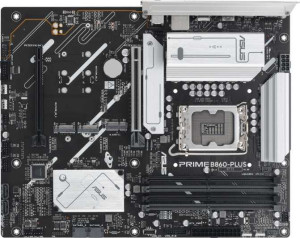
Asus Prime B860-Plus
Asus Prime B860M-K
Asus Prime B860M-K
VS
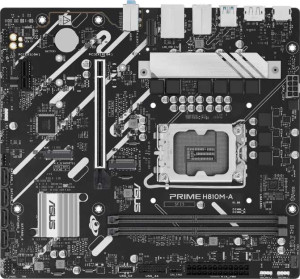
Asus Prime H810M-A
Asus Prime H810M-A
Asus Prime B860M-K
Asus Prime B860M-K
VS
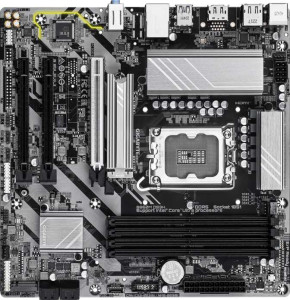
Gigabyte B860M DS3H
Gigabyte B860M DS3H
Asus Prime B860M-K
Asus Prime B860M-K
VS
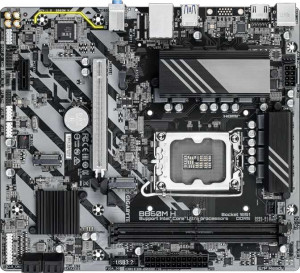
Gigabyte B860M H
Gigabyte B860M H