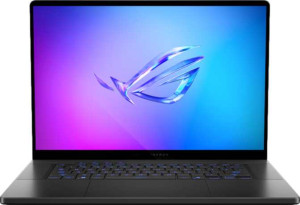
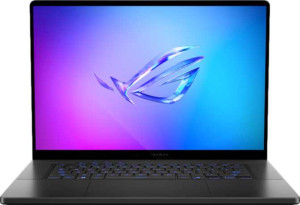
The Asus ROG Zephyrus G16 (2025) GU605 is a gaming laptop with a slim 14mm profile and a footprint of 354mm wide by 246mm deep, giving it a total volume of around 1,219cm³. Despite its compact build, it weighs 1,950g, which is moderate for its class. The machine includes a backlit keyboard but does not use a fanless cooling design, nor does it offer weather sealing or a ruggedized build.
The display is a 16″ OLED/AMOLED panel running at a resolution of 2560x1600 pixels, which works out to a pixel density of 188 ppi. It supports a 240Hz refresh rate, making it well-suited for fast-paced content, and the GPU can drive up to four displays simultaneously. The screen does not include touch input or an anti-reflection coating.
The processor runs 16 threads across a multi-cluster configuration clocked at 6 cores at 2.9GHz and 8 cores at 2.7GHz, with a turbo frequency reaching 5.4GHz, and is built on a 4nm process with multithreading and 64-bit support. System memory is 64GB of DDR5 RAM at 7,467MHz, which is also the maximum supported amount, with no user-accessible memory slots. Storage is handled by a 2,048GB NVMe SSD connected over PCIe 4.0. On the graphics side, the GPU runs at a base clock of 990MHz and boosts to 1,515MHz, backed by 24GB of GDDR7 VRAM, with a floating-point throughput of 31.8 TFLOPS, a texture rate of 496.9 GTexels/s, a pixel rate of 193.9 GPixel/s, and support for DirectX 12 Ultimate; XeSS is not supported.
In CPU benchmarking, the system scores 17,173 in Geekbench 6 multi-core and 2,897 in the single-core test. On the PassMark side, the overall result comes in at 33,969, while the single-thread PassMark score reaches 4,472.
The port selection includes one USB 3.2 Gen 2 Type-C port, two USB 3.2 Gen 2 Type-A ports, one USB 4 40Gbps port, and one Thunderbolt 4 port, while there are no USB 2.0, Gen 1, DisplayPort, mini DisplayPort, or RJ45 ports. Video output is handled by a single HDMI 2.1 port, and an external memory slot is also present. Wireless connectivity covers Wi-Fi 7 (802.11be) along with Wi-Fi 6E, 6, 5, and 4, paired with Bluetooth 5.4. AirPlay is supported, but there is no VGA connector.
The laptop is equipped with a 90Wh battery and includes sleep-and-charge USB ports, allowing connected devices to be charged even when the system is powered off. It does not use a MagSafe power adapter.
Audio is handled by stereo speakers with Dolby Atmos support, a 3.5mm headset jack, and three built-in microphones, though there is no S/PDIF output. On the graphics side, the system supports both ray tracing and DLSS. For security and input, a front camera with 3D facial recognition is included, while a fingerprint scanner, stylus, and voice commands are absent. The laptop also does not feature a gyroscope, accelerometer, compass, GPS, or an optical disc drive.
The discrete GPU is the Arc 140T, based on the Blackwell architecture, with 10,496 shading units, 328 texture mapping units, 128 ROPs, and 128 execution units, built from 17,800 million transistors. It operates with a 256-bit memory bus at an effective speed of 25,400MHz and a raw GPU memory speed of 2,000MHz, yielding a maximum memory bandwidth of 811.5 GB/s. The GPU supports multi-display output, stereoscopic 3D, double precision floating point, OpenCL 3, OpenGL 4.6, and ECC memory, and does not include LHR. On the CPU side, the laptop processor uses a BGA 2049 socket, a clock multiplier of 29, a 95W TDP, 24MB of L3 cache, and a maximum operating temperature of 110°C; it employs big.LITTLE technology and integrated graphics, supports the NX bit, and carries instruction sets including MMX, F16C, FMA3, AES, AVX, AVX2, SSE 4.1, and SSE 4.2, though the multiplier is locked. Memory runs across two channels with a maximum supported RAM speed of 8,400MHz, and Intel Resizable BAR is enabled. The overclocked PassMark result stands at 34,411.