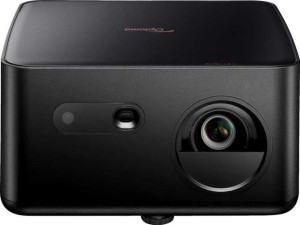
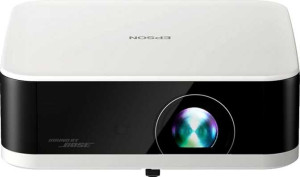
The Optoma Photon Life PK32 uses a traditional lamp-based light source rather than laser, with a lamp life rated at 30,000 hours in eco mode and an operating power consumption of 163W. It does not come with a dedicated smartphone app. In terms of physical dimensions, the unit measures 240 mm wide, 220 mm deep, and 130 mm tall, with a total volume of 6,864 cm³ and a weight of 2,200 g.
The Optoma Photon Life PK32 delivers a 4K output resolution with a refresh rate of 240Hz and a response time of 4.6 ms, making it suited for content that benefits from smooth motion rendering. It supports HDR10 and HLG for improved dynamic range handling, though HDR10+ and Dolby Vision are not supported. The projector operates at an 8-bit color depth and features motorized focus for convenient image adjustment, while zoom must be handled manually as motorized zoom is not available — nor is manual focus as a separate option. It can project images up to 150″ with a minimum throw distance of 1.9 m.
The Optoma Photon Life PK32 offers a wired-only connectivity setup, featuring two HDMI ports and two USB ports as its primary input options. It does not include an RJ45 port, VGA, DVI, or S/PDIF output. On the wireless side, the projector lacks Wi-Fi, Bluetooth, and all wireless streaming protocols, meaning AirPlay, Chromecast, Miracast, and DLNA are not supported.
The Optoma Photon Life PK32 includes a built-in stereo speaker system rated at 2 × 5W, along with a 3.5 mm headphone jack for external audio output. A remote control is provided, while voice commands are not supported. The projector does not feature built-in smart TV functionality, an external memory slot, or a sleep timer, and Dolby Atmos is absent. Lens shift is unavailable in both vertical and horizontal directions, and there is no support for voice-based control.