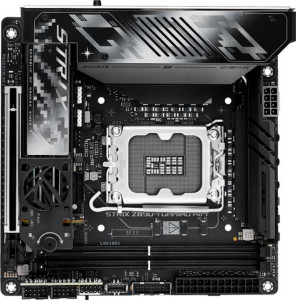
Asus ROG Strix B860-I Gaming WiFi specifications and in-depth review

Asus ROG Strix B860-I Gaming WiFi

Manufacturer: Asus

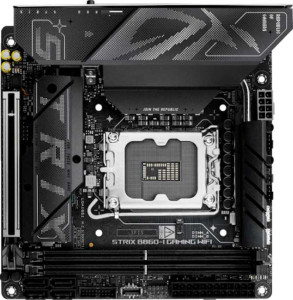
The Asus ROG Strix B860-I Gaming WiFi is a compact Mini-ITX motherboard built around Intel's B860 chipset and LGA 1851 socket, targeting users who want a small-form-factor build without giving up modern connectivity or storage flexibility. It ships with RGB lighting, a dual BIOS setup for straightforward recovery, and a clear CMOS button that makes resetting the firmware less of a hassle. A three-year warranty rounds out the package for those planning a long-term system. The board also carries Wi-Fi 7 (802.11be) alongside Bluetooth 5.4, so wireless connectivity covers the latest standards available at this form factor.

On the memory side, the board offers two DDR5 slots capable of holding up to 128 GB total, with overclocked speeds reaching 9066 MHz across dual channels. Expansion is handled by a single PCIe 5.0 x16 slot, and storage options include two M.2 sockets and four SATA 3 connectors with full RAID 0, 1, 5, and 10 support. The rear I/O is notably well-stocked for its size, featuring a USB 4 40 Gbps port, a Thunderbolt 4 port, one USB 3.2 Gen 2x2 port, and a mix of additional USB-A connections alongside HDMI 2.1 and DisplayPort outputs. Audio is handled by a 7.1-channel implementation with a 120 dB signal-to-noise ratio and an S/PDIF output, while a single RJ45 port covers wired networking.

Pros
  • Supports Wi-Fi 7 alongside the full range of previous Wi-Fi generations, making it ready for the latest wireless standards
  • Thunderbolt 4 and USB 4 40Gbps ports on a Mini-ITX board provide high-bandwidth connectivity options rarely seen at this size
  • DDR5 memory can be overclocked up to 9066 MHz across a dual-channel configuration, offering meaningful headroom for memory tuning
  • Dual BIOS and a dedicated clear CMOS button simplify firmware recovery and reduce the risk of a failed update causing permanent issues
  • RAID 0, 1, 5, and 10 support across four SATA 3 connectors and two M.2 sockets gives solid storage configuration flexibility for such a compact form factor
  • A 120 dB signal-to-noise ratio on the DAC and 7.1-channel audio output represent a capable onboard audio solution
Cons
  • Only two fan headers are available, which may limit thermal management options in more demanding Mini-ITX builds
  • With just two memory slots, there is no room to expand by adding more DIMMs — upgrades require replacing existing modules entirely
  • ECC memory is not supported, ruling out use cases that require error-correcting RAM
  • No USB 3.2 Gen 2 or Gen 1 Type-C ports are present on the rear I/O, with Type-C connectivity limited to the USB 4 and Thunderbolt 4 ports
  • The single PCIe 5.0 x16 slot leaves no room for additional expansion cards alongside a dedicated GPU
Who is this for?

This board is well-suited to users building a compact high-end desktop where space is limited but connectivity demands are not — the Mini-ITX footprint combined with Thunderbolt 4, USB 4 40 Gbps, and Wi-Fi 7 support makes it a strong fit for a capable small-form-factor workstation or enthusiast gaming system. Those who prioritize fast wireless connectivity and modern peripheral support will find the full Wi-Fi generation stack and varied USB rear I/O particularly useful. The overclocking-friendly DDR5 memory support reaching 9066 MHz and a PCIe 5.0 x16 slot also make it relevant for users who want to push system performance within a tight chassis without sacrificing the latest interface standards.

Who is this NOT for?

Users who need more than one expansion slot — such as those running a dedicated GPU alongside a capture card or other PCIe add-in board — will find the single-slot Mini-ITX layout too restrictive. The board is also a poor fit for workstation environments that depend on ECC memory for data integrity, as this feature is not supported. Additionally, with only two fan headers available, builders planning thermally demanding configurations with multiple cooling components may find the thermal management options insufficient for their needs.

General info:

CPU socket LGA 1851
chipset B860
form factor Mini-ITX
supports Wi-Fi
Wi-Fi version Wi-Fi 4 (802.11n), Wi-Fi 5 (802.11ac), Wi-Fi 6 (802.11ax), Wi-Fi 6E (802.11ax), Wi-Fi 7 (802.11be)
Has Bluetooth
Bluetooth version 5.4
HDMI version HDMI 2.1
Easy to overclock
has RGB lighting
Easy to reset BIOS
Has dual BIOS
has aptX
CPU sockets 1
Has integrated graphics
warranty period 3 years
height 170 mm
width 170 mm
Has integrated CPU

The Asus ROG Strix B860-I Gaming WiFi is built around the LGA 1851 socket paired with the B860 chipset, housed in a compact Mini-ITX form factor measuring 170 mm × 170 mm with a single CPU socket and no integrated CPU or graphics. Wireless connectivity spans the full range from Wi-Fi 4 through Wi-Fi 7 (802.11be), complemented by Bluetooth 5.4, though aptX is not supported. The board includes HDMI 2.1 output, RGB lighting, and practical firmware management features such as dual BIOS and a clear CMOS button, while overclocking is noted as accessible. It does not support aptX audio over Bluetooth, and the warranty period covers three years.

Memory:

maximum memory amount 128GB
overclocked RAM speed 9066 MHz
memory slots 2
DDR memory version 5
memory channels 2
Supports ECC memory

This board supports DDR5 memory across two slots arranged in a dual-channel configuration, with a maximum capacity of 128 GB. Overclocked RAM speeds can reach up to 9066 MHz, giving enthusiasts meaningful headroom for memory tuning. ECC memory is not supported.

Ports:

USB 3.2 Gen 2 ports (USB-A) 1
USB 3.2 Gen 1 ports (USB-A) 3
USB 3.2 Gen 2 ports (USB-C) 0
USB 3.2 Gen 1 ports (USB-C) 0
USB 2.0 ports 2
USB 3.2 Gen 2x2 ports 1
USB 4 40Gbps ports 1
USB 4 20Gbps ports 0
Thunderbolt 4 ports 1
Thunderbolt 3 ports 0
has an HDMI output
DisplayPort outputs 1
RJ45 ports 1
Has USB Type-C
eSATA ports 0
DVI outputs 0
has a VGA connector
PS/2 ports 0

The rear I/O offers a varied USB lineup that includes one USB 3.2 Gen 2 Type-A port, three USB 3.2 Gen 1 Type-A ports, two USB 2.0 ports, and one USB 3.2 Gen 2x2 port, alongside a USB 4 40 Gbps port and a Thunderbolt 4 port for high-bandwidth device connectivity — there are no USB 3.2 Gen 2 or Gen 1 Type-C ports, no USB 4 20 Gbps port, and no Thunderbolt 3 port. Display output is handled by one HDMI port and one DisplayPort, with no DVI or VGA connector present. Networking is covered by a single RJ45 port, and the board does not include any eSATA or PS/2 ports.

Connectors:

USB 3.2 Gen 1 ports (through expansion) 2
USB-C 3.2 Gen 2 ports (through expansion) 1
USB 2.0 ports (through expansion) 2
SATA 3 connectors 4
fan headers 2
USB 3.0 ports (through expansion) 2
M.2 sockets 2
Has TPM connector
U.2 sockets 0
Has mSATA connector
SATA 2 connectors 0

Internal connectivity includes two M.2 sockets and four SATA 3 connectors for storage, while SATA 2 and U.2 sockets are absent, and there is no mSATA connector. USB expansion headers cover two USB 3.2 Gen 1 ports, two USB 3.0 ports, one USB-C 3.2 Gen 2 port, and two USB 2.0 ports for additional front-panel or add-in connectivity. The board also provides two fan headers and a TPM connector, rounding out the internal header options available on this Mini-ITX layout.

Expansion slots:

PCIe 4.0 x16 slots 0
PCIe 5.0 x16 slots 1
PCIe 3.0 x16 slots 0
PCIe x1 slots 0
PCI slots 0
PCIe 2.0 x16 slots 0
PCIe x4 slots 0
PCIe x8 slots 0

The board provides a single PCIe 5.0 x16 slot as its sole expansion option, which is typical for the Mini-ITX form factor. No PCIe 4.0, 3.0, or 2.0 x16 slots are present, and there are no PCIe x8, x4, or x1 slots, nor any legacy PCI slots.

Audio:

Signal-to-Noise ratio (DAC) 120 dB
audio channels 7.1
Has S/PDIF Out port
audio connectors 2

The onboard audio implementation supports 7.1-channel output and delivers a DAC signal-to-noise ratio of 120 dB, with two analog audio connectors available on the rear panel. Digital audio output is also covered through an S/PDIF Out port for connecting to external receivers or DACs.

Storage:

Supports RAID 1
Supports RAID 10 (1+0)
Supports RAID 5
Supports RAID 0
Supports RAID 0+1

The board supports RAID 0, 1, 5, and 10 (1+0) configurations, covering the most commonly used modes for both performance and redundancy setups. RAID 0+1 is not supported.
Final Verdict

The Asus ROG Strix B860-I Gaming WiFi is a well-specified Mini-ITX motherboard that manages to pack a surprisingly capable feature set into a 170 mm × 170 mm footprint. Its standout strength lies in its connectivity credentials — Thunderbolt 4, USB 4 40 Gbps, and Wi-Fi 7 together position it well above what is typically expected from a compact form-factor board, making it a genuine option for enthusiasts who refuse to compromise on modern interface support. DDR5 memory with overclocking headroom up to 9066 MHz and a PCIe 5.0 x16 slot further reinforce its performance-oriented character. The trade-offs inherent to the Mini-ITX format — a single expansion slot, just two fan headers, and no ECC memory support — mean it is best approached by users who have already weighed those constraints against their build goals. For anyone building a small but capable system around the LGA 1851 platform, this board represents a thorough and well-rounded option within its size class.

Popular Comparisons

Asus ROG Strix B860-I Gaming WiFi
VS
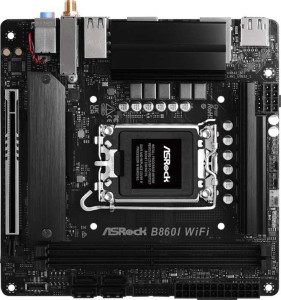
ASRock B860I Lightning WiFi
Asus ROG Strix B860-I Gaming WiFi
VS
ASRock B860I WiFi
ASRock B860I WiFi
Asus ROG Strix B860-I Gaming WiFi
VS
Asus ROG Strix B850-I Gaming WiFi
Asus ROG Strix B860-I Gaming WiFi
VS
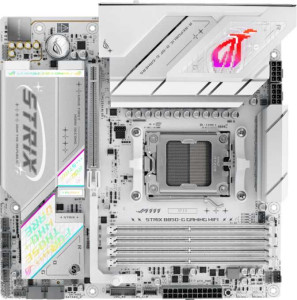
Asus ROG Strix B850-G Gaming Wi-Fi
Asus ROG Strix B860-I Gaming WiFi
VS
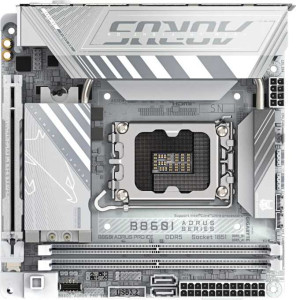
Gigabyte B860I Aorus Pro Ice
Asus ROG Strix B860-I Gaming WiFi
VS
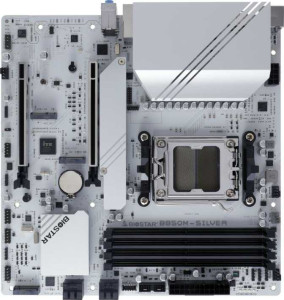
Biostar B850M-Silver
Asus ROG Strix B860-I Gaming WiFi
VS
Gigabyte B850I Aorus Pro
Asus ROG Strix B860-I Gaming WiFi
VS
Asus ROG Strix Z890-I Gaming WiFi
Asus ROG Strix B860-I Gaming WiFi
VS
Asus ROG Strix Z890-E Gaming WiFi
Asus ROG Strix B860-I Gaming WiFi
VS
Gigabyte B850 Aorus Elite WiFi7
Asus ROG Strix B860-I Gaming WiFi
VS
MSI Z890 Gaming Plus WiFi