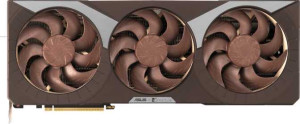
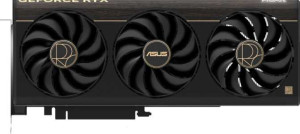
Asus ProArt GeForce RTX 5070 Ti specifications and in-depth review

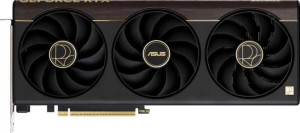
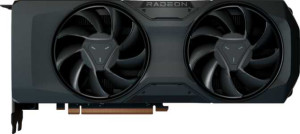
Asus ProArt GeForce RTX 5070 Ti

Manufacturer: Asus

The Asus ProArt GeForce RTX 5070 Ti is a graphics card designed around Nvidia's Blackwell architecture, manufactured on a 5nm process and equipped with 8960 shading units. It operates at a base clock of 2295 MHz with a turbo frequency reaching 2452 MHz, delivering 43.94 TFLOPS of floating-point performance. The card includes RGB lighting and supports up to four simultaneous displays, making it a versatile option for multi-monitor setups.

On the memory side, the card carries 16GB of GDDR7 VRAM across a 256-bit bus, with an effective memory speed of 28000 MHz and a maximum bandwidth of 896 GB/s. It supports DirectX 12 Ultimate, OpenGL 4.6, and OpenCL 3, alongside ray tracing and DLSS. Connectivity is handled through one HDMI 2.1b port, two DisplayPort outputs, and one USB-C port, with the card drawing power within a 300W thermal envelope and interfacing via PCIe 5.

Pros
  • Supports up to four simultaneous displays, offering flexibility for multi-monitor configurations
  • ECC memory support helps maintain data integrity in error-sensitive workloads
  • DLSS and ray tracing are both supported, enabling advanced rendering techniques
  • The 256-bit memory bus paired with 896 GB/s bandwidth provides substantial data throughput for demanding tasks
  • Intel Resizable BAR support allows the CPU to access the full GPU framebuffer, which can improve frame delivery
  • Includes a USB-C output alongside HDMI 2.1b and DisplayPort, covering a wide range of display connection needs
Cons
  • A 300W TDP places significant demands on system power delivery and case airflow
  • Air-water cooling is not supported, limiting cooling flexibility to air-only solutions
  • With only one HDMI port, users needing multiple HDMI connections will require adapters
  • No DVI or mini DisplayPort outputs, which may be limiting for users with older or specialized displays
  • XeSS (XMX) is not supported, reducing compatibility with certain upscaling workflows
Who is this for?

This card is well-suited to users who regularly work with ray tracing and DLSS-enabled workloads, where the combination of 8960 shading units, 43.94 TFLOPS of floating-point performance, and hardware ray tracing support can be fully utilized. The 16GB of GDDR7 VRAM with 896 GB/s of bandwidth also makes it a strong fit for GPU-accelerated compute tasks where ECC memory support and Double Precision Floating Point capability add meaningful reliability and numerical accuracy. Users running multi-display setups of up to four screens will find the output variety — HDMI 2.1b, two DisplayPort connections, and a USB-C port — accommodating for complex workstation or productivity arrangements.

Who is this NOT for?

Users with systems that lack adequate power delivery may struggle, as the 300W TDP places considerable demands on the PSU and requires solid case airflow to maintain stable operation. Since air-water cooling is not supported, builders planning a liquid-cooled GPU configuration will need to look elsewhere. Additionally, users who rely on multiple HDMI connections simultaneously — such as those connecting several HDMI-only displays — will find the single HDMI port a limiting factor without the use of adapters.

Performance:

GPU clock speed 2295 MHz
GPU turbo 2452 MHz
pixel rate 235.4 GPixel/s
floating-point performance 43.94 TFLOPS
texture rate 686.6 GTexels/s
GPU memory speed 1750 MHz
shading units 8960
texture mapping units (TMUs) 280
render output units (ROPs) 96
Has Double Precision Floating Point (DPFP)

The Performance section of this card centers on a base GPU clock of 2295 MHz that boosts up to a turbo frequency of 2452 MHz, supported by 8960 shading units and 280 texture mapping units. It delivers a texture rate of 686.6 GTexels/s and a pixel rate of 235.4 GPixel/s, with 96 render output units contributing to rasterization throughput. Floating-point performance reaches 43.94 TFLOPS, while the GPU memory runs at 1750 MHz. The card also supports Double Precision Floating Point (DPFP), adding utility for workloads that require higher numerical accuracy.

Memory:

effective memory speed 28000 MHz
maximum memory bandwidth 896 GB/s
VRAM 16GB
GDDR version GDDR7
memory bus width 256-bit
Supports ECC memory

The card is equipped with 16GB of GDDR7 VRAM running across a 256-bit memory bus, with an effective memory speed of 28000 MHz. This configuration yields a maximum memory bandwidth of 896 GB/s, providing substantial throughput for demanding workloads. ECC memory support is also included, which helps maintain data integrity by detecting and correcting memory errors during operation.

Features:

DirectX version DirectX 12 Ultimate
OpenGL version 4.6
OpenCL version 3
Supports multi-display technology
supports ray tracing
Supports 3D
supports DLSS
has XeSS (XMX)
AMD SAM / Intel Resizable BAR Intel Resizable BAR
has LHR
has RGB lighting
supported displays 4

This card supports DirectX 12 Ultimate, OpenGL 4.6, and OpenCL 3, covering a broad range of rendering and compute workloads. Ray tracing and DLSS are both supported, while XeSS (XMX) is not present. Multi-display technology is enabled with support for up to four simultaneous displays, and stereoscopic 3D is also supported. Intel Resizable BAR is included to help the CPU access the full GPU framebuffer, and the card does not feature LHR. RGB lighting is built in, rounding out the feature set.

Ports:

has an HDMI output
HDMI ports 1
HDMI version HDMI 2.1b
DisplayPort outputs 2
USB-C ports 1
DVI outputs 0
mini DisplayPort outputs 0

The card's output configuration consists of one HDMI 2.1b port, two DisplayPort outputs, and one USB-C port. There are no DVI or mini DisplayPort connections present. This arrangement provides a total of four video outputs, covering a range of common display connection types while omitting legacy interfaces.

General info:

GPU architecture Blackwell
Thermal Design Power (TDP) 300W
PCI Express (PCIe) version 5
semiconductor size 5 nm
number of transistors 45600 million
Has air-water cooling
width 304 mm
height 126 mm

Built on the Blackwell architecture and manufactured using a 5nm process, this card integrates 45,600 million transistors and connects via PCIe 5. It carries a Thermal Design Power of 300W and does not include air-water cooling. The card measures 304mm in width and 126mm in height, and interfaces with the system through a PCIe 5 slot.
Final Verdict

The Asus ProArt GeForce RTX 5070 Ti brings together a well-rounded specification profile built around the Blackwell architecture, where its 43.94 TFLOPS of floating-point performance combined with 16GB of GDDR7 VRAM and ECC memory support position it as a capable option for both graphics-intensive rendering and compute-oriented tasks. Ray tracing, DLSS, and a flexible four-display output setup add practical depth to its feature set, while the 300W TDP and air-only cooling constraint are factors that demand thoughtful system planning. For users whose workloads align with what this card offers — particularly those working with advanced rendering pipelines or multi-display workstation setups — the ProArt RTX 5070 Ti presents a technically coherent package worth serious consideration.

Popular Comparisons

Asus ProArt GeForce RTX 5070 Ti
VS
AMD Radeon RX 7800 XT
Asus ProArt GeForce RTX 5070 Ti
VS
ASRock Radeon RX 9070 XT Steel Legend
Asus ProArt GeForce RTX 5070 Ti
VS
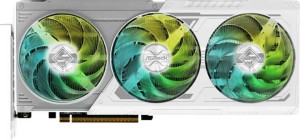
ASRock Radeon RX 9070 XT Monster Hunter Wilds Edition
Asus ProArt GeForce RTX 5070 Ti
VS
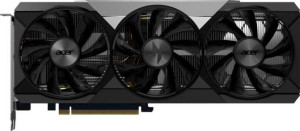
Acer Nitro Radeon RX 9070 XT
Asus ProArt GeForce RTX 5070 Ti
VS
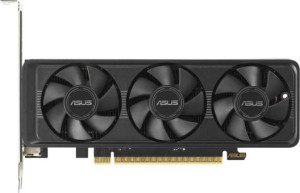
Asus GeForce RTX 5060 LP BRK
Asus ProArt GeForce RTX 5070 Ti
VS
Asus GeForce RTX 5080 Noctua OC Edition
Asus ProArt GeForce RTX 5070 Ti
VS
Asus ProArt GeForce RTX 5080
Asus ProArt GeForce RTX 5070 Ti
VS
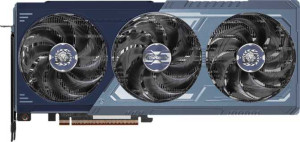
Sapphire Pure Radeon RX 9070 XT
Asus ProArt GeForce RTX 5070 Ti
VS
Palit GeForce RTX 4070 Ti Super Infinity 3
Asus ProArt GeForce RTX 5070 Ti
VS
Nvidia GeForce RTX 5060 Ti 16GB
Asus ProArt GeForce RTX 5070 Ti
VS
MSI GeForce RTX 5070 Ti MLG Edition OC
Asus ProArt GeForce RTX 5070 Ti
VS
Yeston Gaea GeForce RTX 5070