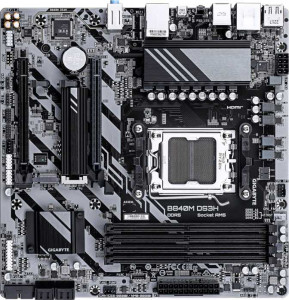
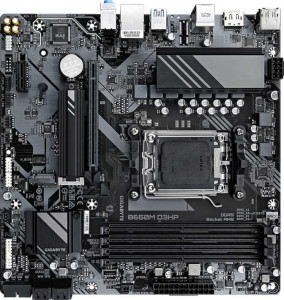
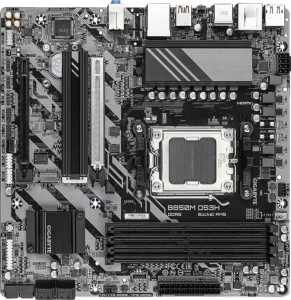
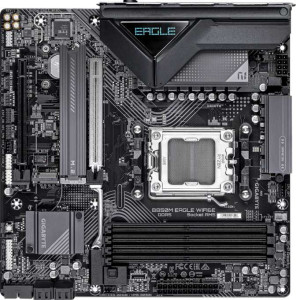
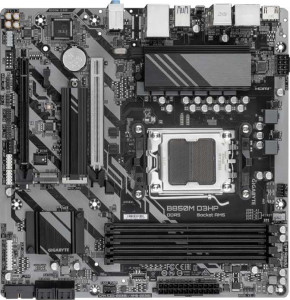
The Gigabyte B840M DS3H is built around the AM5 socket with B840 chipset compatibility and adopts a Micro-ATX form factor at 244 x 244 mm, making it suited for compact builds. It features a single CPU socket and supports easy overclocking, along with dual BIOS for safer firmware management. The board outputs video via HDMI 2.1 but does not include integrated graphics or an integrated CPU, so a discrete GPU or a processor with its own graphics is required. Wi-Fi and Bluetooth are not present, and there is no RGB lighting or easy CMOS reset functionality. A three-year warranty is included.
The board supports DDR5 memory across four slots in a dual-channel configuration, with a maximum capacity of 256GB. Standard RAM speeds top out at 5200 MHz, while overclocked profiles can reach up to 8200 MHz, offering meaningful headroom for performance tuning. ECC memory is not supported.
The rear I/O panel provides a reasonable spread of USB connectivity, including one USB 3.2 Gen 2 Type-A port, two USB 3.2 Gen 1 Type-A ports, and four USB 2.0 ports. While a USB Type-C port is present, it operates at Gen 1 speeds, and there are no USB 3.2 Gen 2x2, USB 4, Thunderbolt 3, or Thunderbolt 4 ports. Video output is handled by one HDMI port and two DisplayPort outputs, with no DVI or VGA connectors on offer. Networking is covered by a single RJ45 port, and legacy users are accommodated with one PS/2 port. eSATA is not included.
Internal connectivity is well-covered for a board of this size, with two M.2 sockets and four SATA 3 connectors available for storage, while SATA 2 and U.2 sockets are absent, as is an mSATA connector. USB expansion headers include two USB 3.2 Gen 1 connectors and four USB 2.0 headers, along with two additional USB 3.0 expansion ports. Thermal management is supported by four fan headers, and a TPM connector is present for security module use.
Expansion options are modest but functional, with one PCIe 4.0 x16 slot serving as the primary lane for a discrete graphics card, and one PCIe x4 slot available for additional cards. There are no PCIe 5.0, PCIe 3.0, PCIe 2.0, PCIe x1, PCIe x8, or legacy PCI slots on the board, reflecting the focused layout typical of the Micro-ATX form factor.
The board delivers 7.1-channel audio through three analog connectors on the rear I/O, covering the needs of most standard speaker and headset setups. An S/PDIF Out port is not included, so digital optical audio output is not available.
The board supports a solid range of RAID configurations, including RAID 0, 1, 5, and 10, catering to different needs across performance, redundancy, and combined setups. RAID 0+1 is not supported.