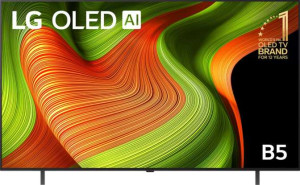
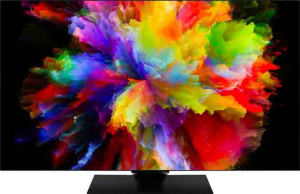
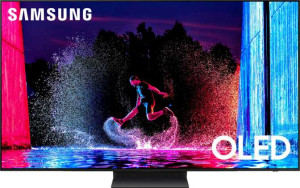
The display on this TV uses OLED panel technology at a screen size of 83.5″, delivering a 4K UHD resolution of 3840 x 2160 pixels at a pixel density of 53 ppi and a 10-bit color depth capable of rendering 1070 million colors. It runs at a 120Hz refresh rate with a 0.1ms response time, and supports adaptive synchronization through Nvidia G-Sync, AMD FreeSync, and AMD FreeSync Premium. HDR coverage includes HDR10, Dolby Vision, and HLG, though HDR10+ is not supported. Both the horizontal and vertical viewing angles reach 178°, and the panel is equipped with an anti-reflection coating and an ambient light sensor for adapting to different room conditions.
The TV includes four HDMI 2.1 ports and three USB ports, along with a single RJ45 ethernet port for wired network connections. Wireless connectivity covers Wi-Fi 4, Wi-Fi 5, Wi-Fi 6, and Wi-Fi 6E, paired with Bluetooth 5.3, and the set also supports Miracast for wireless screen sharing. Tuner support spans DVB-T, DVB-T2, DVB-C, DVB-S, and DVB-S2, covering a wide range of broadcast formats. There is no 3.5mm headset jack, no external memory slot, and no VGA or DVI connector on this model.
The audio system includes stereo speakers with a built-in subwoofer and supports Dolby Atmos, Dolby Audio, and Dolby Digital, though Dolby Digital Plus and Dolby Virtual are not supported. On the DTS side, both DTS:X and DTS-HD High Resolution Audio are present. Digital Out is supported, and the TV offers both HDMI ARC and HDMI eARC for external audio equipment. SRS TheaterSound HD is not included on this model.
The LG OLED83C5PUA measures 1841.5 mm wide, 1054.1 mm tall, and 53.3 mm thick, with a total volume of approximately 103,461 cm³ and a weight of 33,022 g. It supports VESA mounting for wall installation. Operating temperatures range from a minimum of 0 °C to a maximum of 40 °C.
The TV comes with a built-in smart TV platform that includes Chromecast, AirPlay, and a web browser, and it supports voice commands through both Google Assistant and Amazon Alexa, though Siri and Apple HomeKit are not supported. Smartphones can be used as a remote, and USB recording is available for capturing broadcast content directly. Practical utilities include a sleep timer, child lock, and an ambient-aware setup, while the remote control itself is not rechargeable. On the power side, operating consumption is rated at 223W with a standby draw of just 0.5W and an annual consumption figure of 410 kWh. The set comes with a one-year warranty.