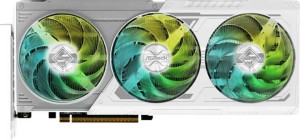
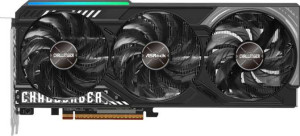
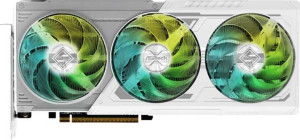
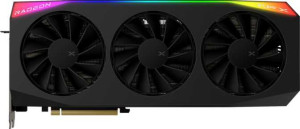
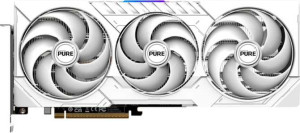
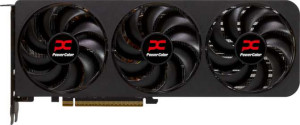
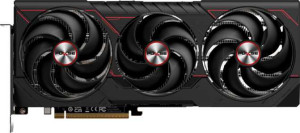
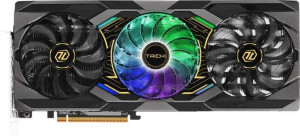
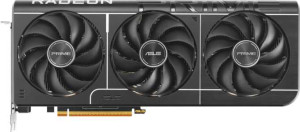
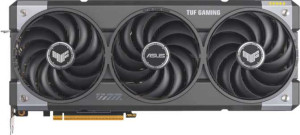
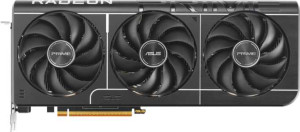
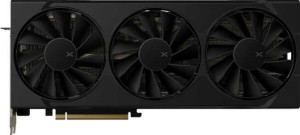
The Performance section of the ASRock Radeon RX 9070 XT Steel Legend centers on a base GPU clock of 1660 MHz that scales up to a turbo frequency of 2970 MHz under sustained load. The card is equipped with 4096 shading units, 256 texture mapping units, and 128 render output units, collectively enabling a texture rate of 760.3 GTexels/s and a pixel rate of 380.2 GPixel/s. At its core, floating-point performance reaches 48.66 TFLOPS, supported by a GPU memory speed of 2518 MHz. The card also includes Double Precision Floating Point (DPFP) support, which broadens its suitability for compute-oriented workloads beyond standard rendering tasks.
The card is equipped with 16GB of GDDR6 VRAM running across a 256-bit memory bus, with an effective memory speed of 20,000 MHz that yields a maximum memory bandwidth of 644.6 GB/s. ECC memory support is also present, adding a layer of data integrity for workloads where memory accuracy is a consideration.
The RX 9070 XT Steel Legend supports DirectX 12 Ultimate, OpenGL 4.6, and OpenCL 2.2, covering a broad range of graphics and compute APIs. Ray tracing and stereoscopic 3D are both supported, and AMD FSR4 is available as an upscaling solution, while DLSS and XeSS are not supported. The card includes AMD SAM for memory access optimization, drives up to four displays simultaneously with multi-display support, and features RGB lighting. Multi-GPU configurations are not supported, nor is LHR limiting applied.
The card's output configuration consists of one HDMI 2.1b port and three DisplayPort outputs, offering a total of four display connections. There are no USB-C, DVI, or mini DisplayPort outputs present on this model.
Built on the RDNA 4.0 architecture and fabricated using a 4 nm process node, the card integrates 53,900 million transistors and connects to the system via a PCIe 5.0 interface. It carries a thermal design power rating of 304W and relies on air cooling, with no water cooling option included. The card measures 298 mm in width and 131 mm in height.